




Disgruntled Ibans warn BN of backlash
The ruling coalition could see itself losing a portion of its faithful supporters if it continues to ignore the plight of Ibans from six longhouses in Pantu, Sarawak.
The ruling coalition could see itself losing a portion of its faithful supporters if it continues to ignore the plight of Ibans from six longhouses in Pantu, Sarawak.
The residents are upset with the encroachment of outsiders into their native customary rights land (NCR) for timber and to start-up an oil palm plantation.
Turning to their state assemblyperson, Mong Dagang of Parti Rakyat Sarawak (PRS), also proved futile.
 They were allegedly told that nothing could be done as the matter involved 'higher-up' individuals.
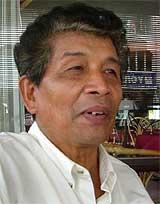
"What's the point (in going to the higher authorities) when all they want is to tell you to listen to them?" asked their representative Jacob Emang (left) at a recent press conference.
"We're not against the government. We want the government to work together with us," he said.
Unfortunately, Emang, a retired school principal and senior education officer, said this has not been the case.
According to him, the authorities have not only been less than transparent in its intention but also never consulted the Iban when it decided to invite outsiders to start the oil palm project on their land.
"We'd have been quite happy to work together if we had been told of the extent of our participation and shareholdings in a joint venture," he explained.
Emang warned that a serious political backlash could transpire if the government continues to treat them in this manner.
"We've always been supporting the Barisan Nasional. But if they do not look after our welfare and interests don't blame us if we can no longer support them," he said.
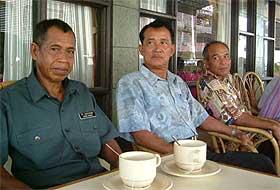 The six villages involved are Kampung Tekuyong, Kampung Aping,Dadak, Kampung Aping Oulau Batu, Aping Uban (Aping Engkana), Sungai Tenggang and Kampung Abok (next to Kampung Aping).
The culprits
They claim the culprits are the state government agency Land Consolidation and Development Authority (LCDA) and a joint venture company the agency formed with Johor investors group Tertangga Akrap-Pelita Pantu Sdn Bhd which has been issued a provisional lease of about 7000 hectares for oil palm plantation in an area described as Sungai Mansau/Sg Tenggoh Block.
A LCDA subsidiary Nadi Pelita Sdn Bhd has been given the licence to remove timber as part of clearing for the planting of oil palm. It has in turn engaged local company Montana Enterprise to do the actual felling work.
The area which the Iban are trying to protect covers about 5000 hectares which form part of a larger area of about 7000 hectares under the provisional lease issued to the agency.
"About 1000 acres have already been cleared and planted with oil palm," said Emang, adding that they have already gone to court to seek an injunction to stop work and claim compensation for the damages.
He said the situation has become so ridiculous that when one of their tuai rumah (longhouse chief) wanted to go to the temuda (communal reserve) to take timber for personal use, he and his anakbiaks (other longhouse followers) were stopped by forestry officials who told them they had no permit to do so.
Own scheme
The Iban themselves have started their own oil palm smallholders scheme on their NCR land and have to date already surveyed, cleared and planted 300 hectares involving 37 families in Aping, Pantu, as part of a 5000ha area earmarked for their community-based effort without any subsidy or help from outside.
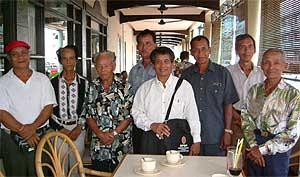 "We want to invite the authorities to come and see what we're doing and to help us in whatever way, including subsidies," said Emang.
Emang, from Kampung Abok and a New Zealand graduate in education and English, is chairperson of a eight-member village working committee on security and development (oil palm scheme) called AJKK Kebun Sawit.
"Our initiative is in direct response to the government's policy to develop NCR land either by teaming up with investors or on our own efforts," he said.
He added that their concept is 'everybody is involved, everybody decides and everybody contributes financial, labour and other forms.'


