


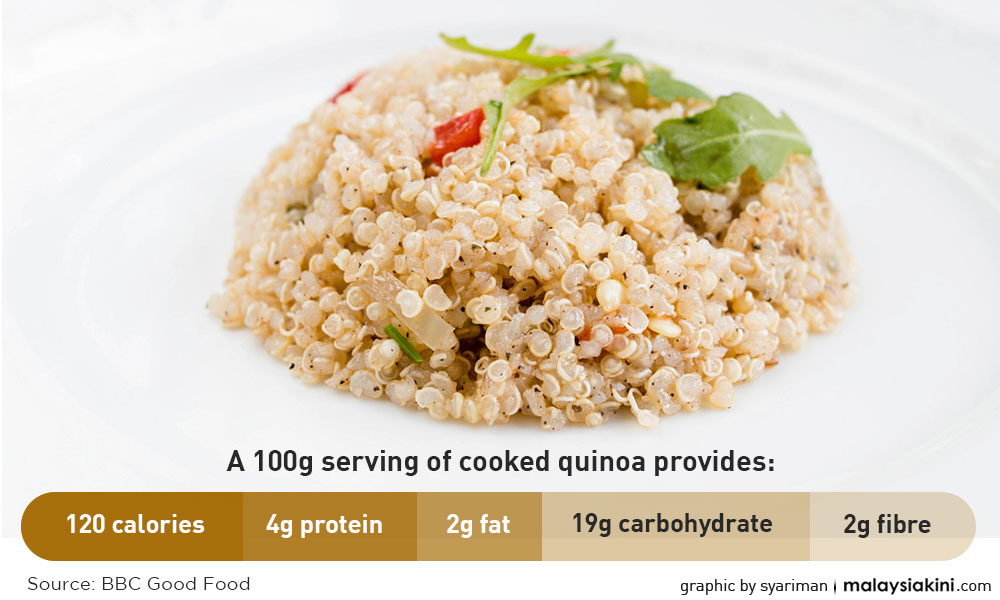

Quinoa - digesting Najib's 'ancient' diet
New buzzwords appear in the political landscape often but an unexpected addition has piqued the interest of Malaysians over the past 24 hours, thanks to Prime Minister Najib Abdul Razak.
Quinoa, pronounced “keen-wah” and described as a “pseudo-cereal” is now trending on Google Trends as well...
New buzzwords appear in the political landscape often but an unexpected addition has piqued the interest of Malaysians over the past 24 hours, thanks to Prime Minister Najib Abdul Razak.
Quinoa, pronounced “keen-wah” and described as a “pseudo-cereal” is now trending on Google Trends as well.
So what exactly is quinoa?
Commonly perceived as a whole grain like white rice and wheat, quinoa is more closely related to spinach and amaranth, and it is the seeds which are harvested and consumed.
Quinoa originated in the Andean region of South America about 3,000 to 4,000 years ago, spanning parts of Peru and Bolivia, where most of the world’s supply is still grown.
Bolivia is the main exporter of quinoa in the world followed by Peru and Ecuador.
Quinoa is planted on what is called the “altiplano”, a cold and barren 14,000-ft plateau, and is one of the few things which can grow in such conditions.
As it is cultivated in the same way now as it has been for millennia, it is considered an ancient grain.
Najib had said that he switched to quinoa due to its health benefits as it is supposedly healthier than rice.
There does not seem to be any conclusive research that shows quinoa to be healthier than rice, especially brown rice, as it has similar nutritional values as other grains.
As such, it can easily replace rice and other grains in cooking recipes.
However, it is worth noting that quinoa has the highest protein content of all whole grains which makes it suitable for vegetarians and vegans.
It is also a good source of magnesium, manganese and other minerals and vitamins, as well as naturally gluten-free and high in dietary fibre.
Prices have soared
Quinoa is often called “the golden grain of the Andes” by the indigenous people and researchers due to its high nutritional value.
Due to its touted health benefits, quinoa has seen a steady rise in popularity as a substitute for rice, especially in the world of health food.
The United Nations (UN) general assembly even declared 2013 as the “International Year of Quinoa”, with the UN’s Food and Agriculture Organisation (FAO) serving it as its secretariat.
According to the FAO's International Year of Quinoa, this initiative was announced in recognition of the indigenous peoples of the Andes who have “maintained, controlled, protected and preserved quinoa as food for present and future generations thanks to their traditional knowledge and practices of living in harmony with nature.”
FAO director-general Jose Graziono da Silva had also called quinoa an “ally in the fight against hunger and food insecurity”.
However, quinoa's popularity as a health food had caused its prices to soar, tripling between 2006 and 2013.
This was pointed out by DAP's Segambut MP Lim Lip Eng, who criticised Najib for being out of touch with the plight of normal Malaysians.
Malaysiakini’s check with Tesco's online shop revealed that a 250-gram packet of Love Earth Organic Quinoa costs RM14.79 which means 10kg would cost RM591.60.
A 10kg packet of Jasmine Super Special (five percent broken rice) cost RM25.85.
Pakatan Harapan chairperson Dr Mahathir Mohamad also quipped today that he only eats local rice.
Read more: I only eat local rice – Dr M's gastronomic swipe at Najib
Negative effects
On a global scale, quinoa's price hike prompted some reports on its negative effects on the locals and indigenous people in Peru and Bolivia, for whom quinoa is a staple food.
Around 2011 and 2013, a number of news reports claimed that Western demand for quinoa had pushed its prices beyond the reach of the poor people in Peru and Bolivia.
Reports also quoted then Bolivian rural development minister Nemecia Achacollo as stating that only 10 percent of quinoa cultivated in Bolivia stayed in the country while the other 90 percent gets exported.
This has supposedly caused some local children to show signs of malnutrition as their parents have replaced rice and noodles for quinoa, according to a report by the Associated Press in 2011.
A New York Times report in 2011 also said that fewer Bolivians can afford quinoa after the price hikes, which hastened their embrace of cheaper, processed foods such as white flour and rice.
On the other hand, an analysis published on the Andean Information Network said that quinoa farmers now have economic stability as quinoa fetches guaranteed high prices.
In turn, this economic power has granted them political power through producers’ associations and cooperatives.
Not only that, the analysis points out that quinoa tends to be more filling than rice and is generally eaten in smaller amounts.
Quinoa is also not the only highly nutritious seed and grain cultivated in the region, as Bolivia also produces kaniwa and amaranth.
There are a host of other complex issues surrounding the production and import of quinoa but it remains wildly popular as a health food internationally.


Report this comment
Are you sure you want to delete this comment?
This action cannot be undone.