


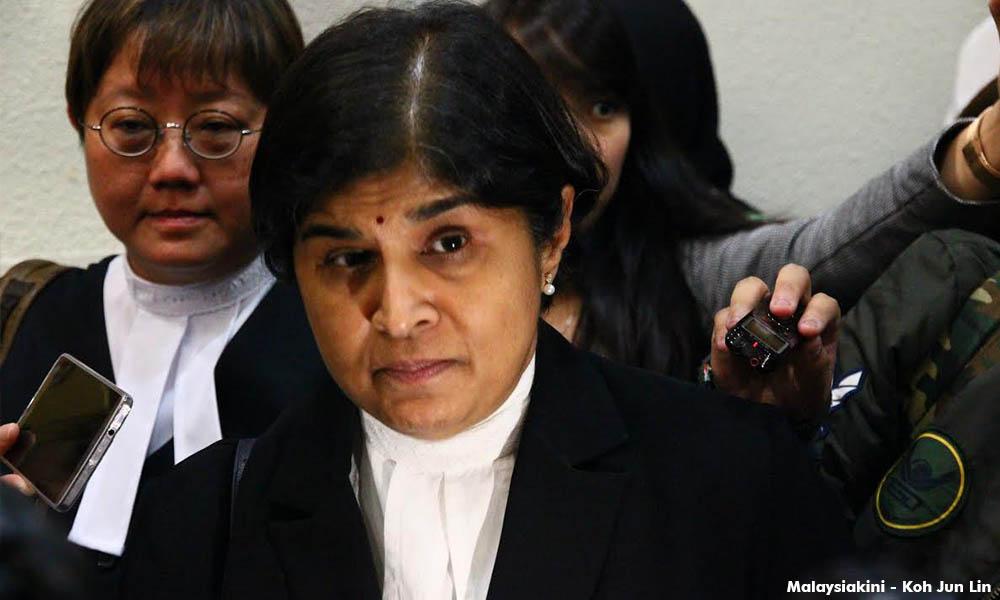

Gov't possibly interfering with judicial independence, Ambiga warns
Lawyer Ambiga Sreenevasan today told a seven-member Federal Court bench that the issue of Prime Minister Najib Abdul Razak agreeing to advise the appointment and tenure extension of two top judges is justiciable.
Citing the landmark decisions in the Semenyih Jaya and Indira Gandhi cases, Ambiga stipulated that when the decision of the executive is inconsistent with the Federal Constitution, the court is duty bound to intervene.
Pointing to the press statement issued by the Prime Minister's Office on July 7, 2017, she said that allowing the extension of Chief Justice Md Raus Sharif and Court of Appeal president Zulkefli Ahmad Makinudin's tenures by way of appointing them as additional judges would undermine the judiciary.
"We say after the judgment in (the cases of) Semenyih Jaya and Indira Gandhi that the prime minister’s advice to the Yang di-Pertuan Agong is not immune to scrutiny...
Lawyer Ambiga Sreenevasan today told a seven-member Federal Court bench that the issue of Prime Minister Najib Abdul Razak agreeing to advise the appointment and tenure extension of two top judges is justiciable.
Citing the landmark decisions in the Semenyih Jaya and Indira Gandhi cases, Ambiga stipulated that when the decision of the executive is inconsistent with the Federal Constitution, the court is duty bound to intervene.
Pointing to the press statement issued by the Prime Minister's Office on July 7, 2017, she said that allowing the extension of Chief Justice Md Raus Sharif and Court of Appeal president Zulkefli Ahmad Makinudin's tenures by way of appointing them as additional judges would undermine the judiciary.
"We say after the judgment in (the cases of) Semenyih Jaya and Indira Gandhi that the prime minister’s advice to the Yang di-Pertuan Agong is not immune to scrutiny.
"The executive cannot be allowed to interfere with the independence of the judiciary. The acts in the (extension and appointments) are inconsistent with the constitution and the law. The court is duty-bound to intervene," she said.
In a press statement, Ambiga also said that the government intends to extend the retirement age of judges to 70, which she termed a somewhat “backdoor approach” to justify the appointments.
Ambiga, who led the team of lawyers from the Malaysian Bar, also reiterated that the scheme of the Federal Constitution determined that the top four posts of the judiciary cannot be occupied by additional judges, as is the case with Raus and Zulkefli.
The posts, she added, must be occupied by "tenured judges" - namely those who have yet to attain the mandatory retirement age of 66 years and six months, as specified in the Federal Constitution.
Ambiga also questioned how a former chief justice could agree to the extensions of Raus and Zulkefli a day before his own retirement.
According to the lawyer, a plain interpretation of Articles 122(1A) and 122B(2) show that the appointments are to be made and take effect during the tenure of the appointing CJ - making the extensions unconstitutional.
"It is also untenable as it violates the principle of judicial independence, which has been established by recent apex court decisions as forming part of the basic structure of the Federal Constitution."
‘Far-reaching consequences’
Ambiga reminded the bench, led by Federal Court judge Justice Hasan Lah, to take cognisance of the serious ramifications if such practices were allowed.
"We must uphold the appointment and the retirement age as stipulated in the Federal Constitution, otherwise it would become meaningless.
"The promotion of judges will be affected, it would open floodgates to one chief justice binding another chief justice. So where does it end?" she asked.
"It affects the independence of the judiciary as it affects the security of tenure. The consequences are far-reaching (if such practices are allowed to continue)," she said.
Ambiga noted that the bench faced a burdensome task in this case.
However, she stressed that the onus was on the judiciary to ensure compliance with the constitution, as it could affect the future of judges being appointed to the judiciary.
"Let justice be done though the heavens fall," she said.
Questions of law
Four questions of law were posed to the seven-member bench today, namely:
- Whether under Article 121(1A) of the Federal Constitution, an additional judge can be appointed on the advice of the CJ, which is advised to take effect after the latter's retirement;
- Whether under Article 121(1A), read together with Article 122B (1), Article 122B (2) and Article 125(1) of the Federal Constitution an additional judge can be appointed as the CJ or President of the COA;
- Whether the appointment of judges by the Yang di-Pertuan Agong under Articles 122(1A) and 122B (1) of the Federal Constitution is justiciable; and
- Whether the appointment of additional judges, and thereafter of the CJ and the COA president announced whilst they were serving judges, but to take effect after retirement, violates Article 121(1), Article 122 (1A) and Article 125(1) of the Federal Constitution.
Representing the government, senior federal counsel Amarjeet Singh said that the Malaysian Bar contends that the CJ and COA president cannot be additional judges.
However, he said the Bar's contention is based on a literal and "pedantic" interpretation of Article 122(1).
"The proper construction of Article 122(1) is that the provision is intended to define the composition of the Federal Court and the number of positions available. It is not to distinguish between the two type of judges, the CJ and an additional judge.
"In the circumstances, the appointment of the CJ and President of COA is constitutional," he argued.
Amarjeet also noted that the prime minister is not involved in the appointments of additional judges under Article 122(1A).
"That discretion is solely with the CJ, and the Yang di-Pertuan Agong gives effect of the advice.
"It is submitted that the prime minister's function under Article 122B(1) is not justiciable. If it was, then no judge of the Federal Court, the appellate court, and the High Court, including the CJ, COA president and the Chief Judges (of Malaya and Sabah and Sarawak) can ever be appointed."
Amarjeet said the constitution gives the prime minister exclusive discretion on the appointment of judges.
"The Yang di-Pertuan Agong must act on such advice according to Article 40(1A). The appointment made by the Agong flows from the decision made by the PM," he said.
Lawyer Muhammad Shafee Abdullah, for the Muslim Lawyers Association, said the position of tenured judges to additional judges should be considered equal.
He also stated that historically, the purpose of the appointment of additional judges was to fill up posts in the Supreme Court, where there was fear of an insufficient number of qualified judges.
Hence, he said there were retired judges who were reappointed.
Shafee pointed to a case in Singapore, where a retired judge of the Supreme Court was appointed and retained in the post of CJ.
"This is despite the retired judge attaining the mandatory retirement age of 70 years. We still have a problem in Malaysia, as it is not easy to find judges at apex court," he said.
After almost seven hours of submission, the bench led by Justice Hasan reserved delivering its decision.


Are you sure you want to delete this comment?
This action cannot be undone.