


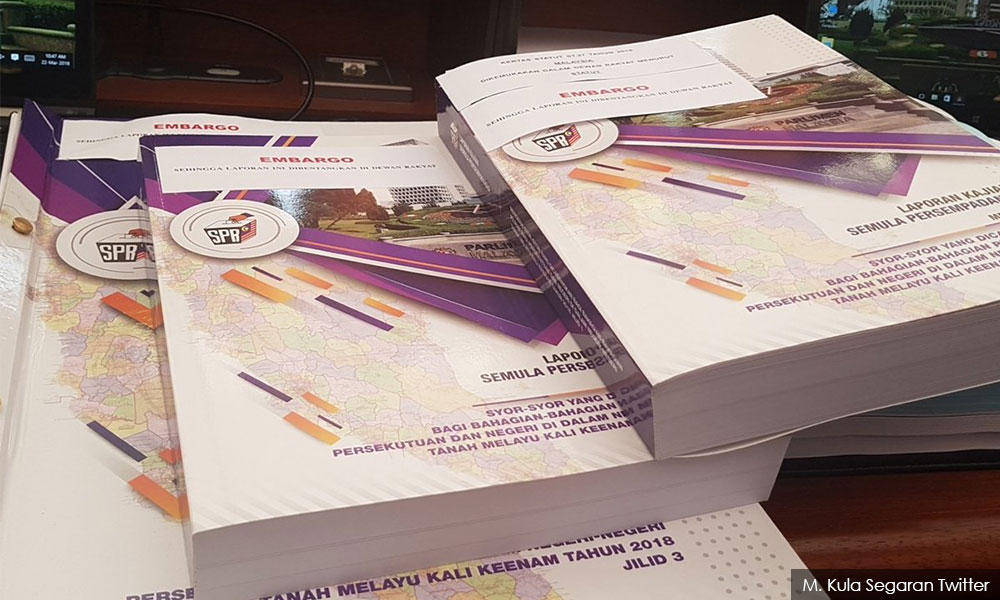

Done deal: What's in the EC's final redelineation report?
KINIGUIDE | The Election Commission's final redelineation report for Peninsular Malaysia and the Federal Territories was presented to Parliament today. But what does the report mean for the regular voter?
Apart from having to check whether your voting location has changed for the next general election, the exercise also alters the value of your vote.
Regardless of whether a constituency has 10,000 voters or 100,000 voters, each constituency can only elect one representative.
The redelineation exercise is conducted at least every eight years so that the constituencies can be readjusted to ensure balance. However, this process can sometimes be abused to favour one party.
How 'powerful' is your vote? Visit Undi Power to find out
In this KiniGuide, we take you through the electoral boundary changes made by the EC in its latest redelineation report.
We will also consider how these changes will influence the results of the forthcoming general election, and how you can check to see if you are affected by the new changes...
KINIGUIDE | The Election Commission's final redelineation report for Peninsular Malaysia and the Federal Territories was presented to Parliament today. But what does the report mean for the regular voter?
Apart from having to check whether your voting location has changed for the next general election, the exercise also alters the value of your vote.
Regardless of whether a constituency has 10,000 voters or 100,000 voters, each constituency can only elect one representative.
The redelineation exercise is conducted at least every eight years so that the constituencies can be readjusted to ensure balance. However, this process can sometimes be abused to favour one party.
How 'powerful' is your vote? Visit Undi Power to find out
In this KiniGuide, we take you through the electoral boundary changes made by the EC in its latest redelineation report.
We will also consider how these changes will influence the results of the forthcoming general election, and how you can check to see if you are affected by the new changes.
How are Malaysian constituencies structured?
Before going into the changes that the EC made to the electoral boundaries, it is necessary to understand the structure of the constituencies.
There are a total of 222 parliamentary seats, each of which contains between two and six state seats.
Within the state seats are polling districts, which can be as little as four in small areas, and more than 20 in large and densely populated areas.
The EC can make alterations at each of these levels.
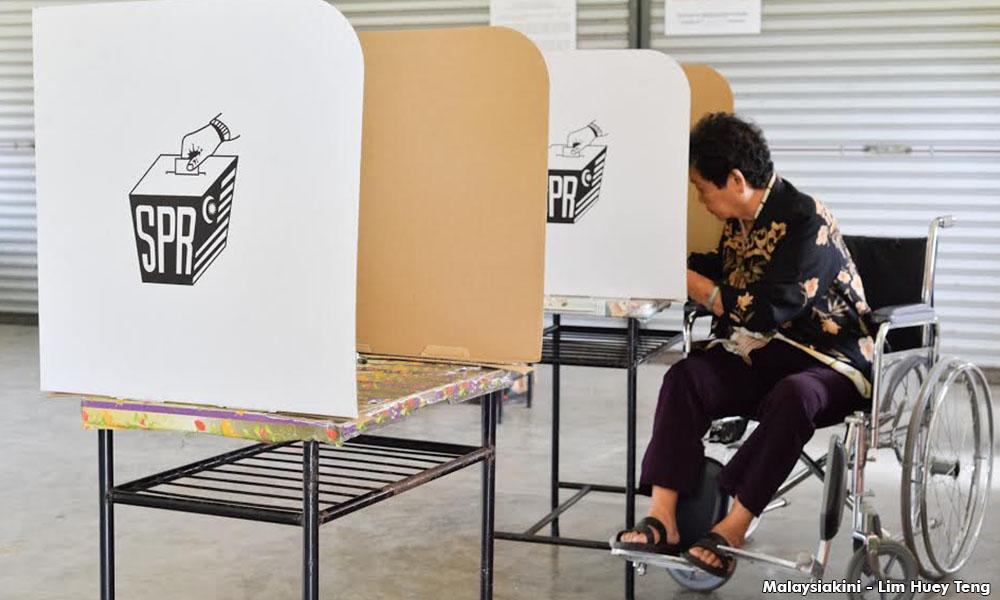
What kind of changes can the EC make?
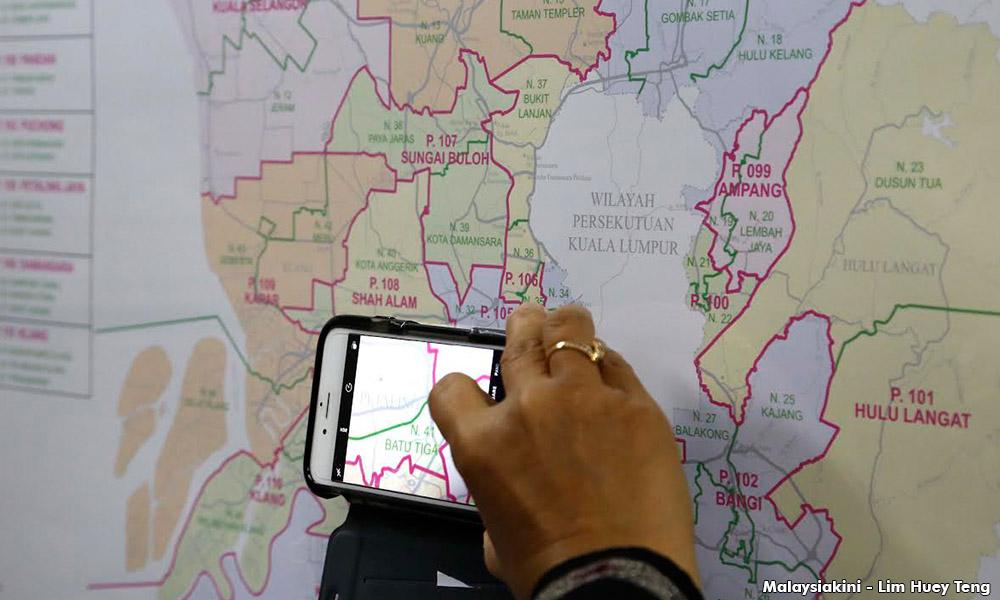
At the federal level, the EC can move or swap a state seat from one federal constituency to another, thereby altering a parliamentary seat's composition, voter population and even political leaning.
The same thing can be done at the state level, by moving polling stations from one state constituency to another. This form of change is harder to track, due to the sheer number of polling stations.
For example, Selangor alone has a total of 946 polling stations.
Another form of alteration that the EC can carry out, though less common, is to break up a polling station into two and place them in separate state constituencies.
Alternatively, the EC can merge polling stations from separate constituencies into one.
Apart from the transfer, the EC can also change a constituency or polling station's name.
What kind of changes has the EC made in its latest redelineation report?
The redelineation this time is unique as it does not involve any increase of seats in Parliament, which would require a constitutional amendment and the approval of two-thirds of MPs, a parliamentary majority which the BN does not have.
However, the EC has managed to redraw the borders while maintaining the 222 parliamentary seats, which only requires a simple majority to be passed in the Dewan Rakyat, allowing BN to do so without the support of the opposition.
Likewise, any increase in state seats must receive two-thirds approval of the respective state assemblies.
This has been done in Sabah and Sarawak but not in Peninsular Malaysia, where BN does not have control of three states and lacks a two-thirds majority in several others.
We will now take a look at what changes the EC has made at three levels: federal, state, and polling district.
Changes at the federal level
A review of the redelineation report showed at least 14 parliamentary seats were altered by transferring state seats from one federal constituency to another.
In Perak, the state seat of Sitiawan (renamed Astaka) under the parliamentary seat of Lumut was transferred to the parliamentary seat of Beruas.
In the last general election, Lumut had three state seats, namely Sitiawan, Pasir Panjang and Pangkor, which PKR won by 8,168 votes.
However, the bulk of PKR's votes came from Sitiawan, which DAP won by a whopping 11,820 votes. It lost in both Pasir Panjang and Pangkor.
Without Sitiawan, the opposition will unlikely be able to hold on to Lumut.
Has your constituency been affected by the new electoral boundaries?
In Kelantan, the state seat of Chetok in Pasir Mas was swapped with the state seat of Meranti in Rantau Panjang.
PAS won Pasir Mas by 8,047 votes and Rantau Panjang by 6,276 votes respectively in the last general election.
By taking out Meranti (which PAS won by 3,933 votes) from Rantau Panjang, and replacing it with Chetok (which PAS won by 1,985 votes), Rantau Panjang becomes a more marginal seat, while the already safe Pasir Mas seat becomes more secure for PAS.
The remaining changes took place in Selangor, involving a total of 10 parliamentary seats with similar outcomes as in previous examples.
They are Hulu Langat, Serdang (renamed Bangi), Puchong, Kelana Jaya (Subang), Petaling Jaya Selatan (Petaling Jaya), Petaling Jaya Utara (Damansara), Subang (Sungai Buloh), Kapar, Klang and Kota Raja.
The image below summarises the changes.
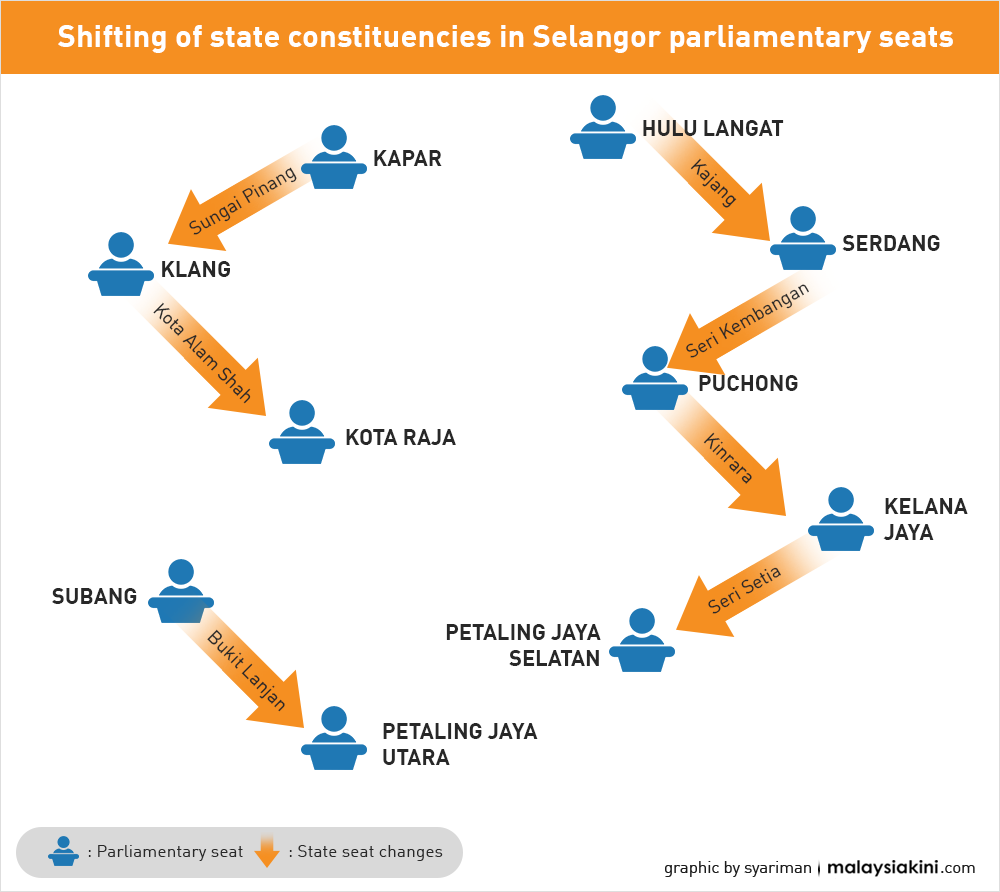
Some of the state seats involved have also been renamed, namely Bangi (renamed Sungai Ramal), Damansara Utama (Bandar Utama), Sungai Pinang (Bandar Baru Klang), Kota Alam Shah (Sentosa) and Sri Andalas (Sungai Kandis).
Penang was the only state that was not altered in any way in the redelineation exercise, be it at the federal or state level.
Changes at the state level
A state seat can be altered by shifting polling districts from one constituency to another.
In total, there are about 6,125 polling stations in Peninsular Malaysia and the federal territories. Hundreds of changes have been made to these polling stations in the EC’s report, making it impractical to list them all here.
To illustrate the nature of some of these changes, an example is the state seat of Bukit Selambau in Kedah, which PKR won by a mere 530 votes in the previous general election.
The EC decided to shift the polling station of Taman Ria Jaya, which PKR won by 905 votes, from Bukit Selambau to the neighbouring state seat of Sidam.
This effectively erases PKR's majority in Bukit Selambau and gives BN a 375-vote advantage.
In Johor, the DAP narrowly lost the state seat of Paloh by 103 votes.
The EC, in its redelineation report, moved Felda Kahang Barat into Paloh, a polling district which the BN won by a whopping 1,279 votes in the last general election.
The polling district was originally from the neighbouring state seat of Kahang, which BN won comfortably by 7,801 votes.
View this chart in Infogram.
Changes at polling district level
The splitting or merging of polling stations is a less common method but a review of the redelineation report by Malaysiakini found a couple of instances.
In Terengganu, the polling district of Pak Sabah, located within the state seat of Rantau Abang (PAS won by 141 votes), had 1,887 voters.
According to Google Maps, the polling district comprises two population clusters, namely the village of Che Lijah and the village of Pak Sabah.
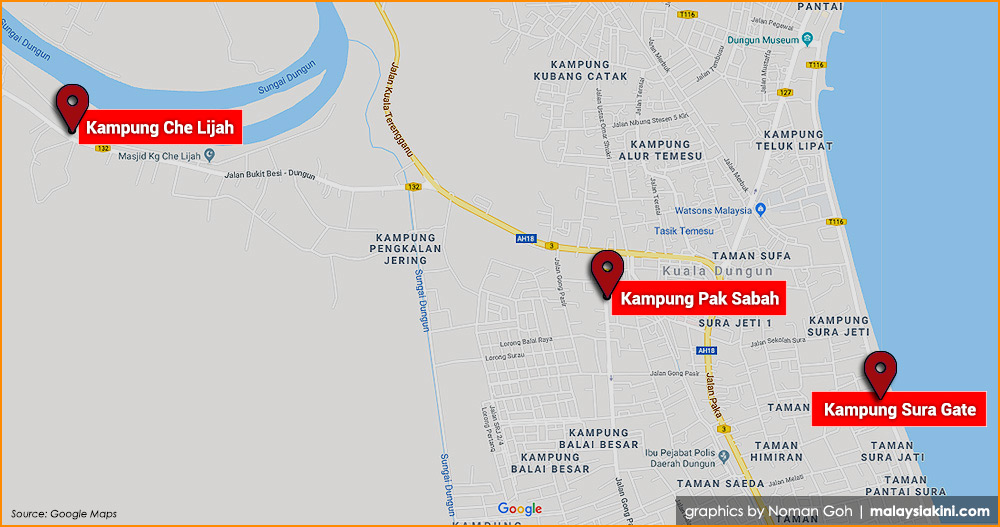
The EC decided to transfer 1,163 of the 1,887 voters in the Pak Sabah polling district to Sura Gate, a polling station located in the neighbouring state seat of Sura.
With the Pak Sabah polling station now only comprising voters from the village of Che Lijah, it was naturally renamed as Che Lijah polling station.
Changes at this level are harder to analyse, as both Che Lijah and Pak Sabah voters cast their votes in the same ballot boxes during the last general election, making it impossible to know how each village voted respectively.
However, as a whole, 59.87 percent of the voters in both villages voted in favour of PAS. Assuming the 1,163 voters transferred out had voted in the same proportion, it would translate to a loss of almost 700 PAS votes.
Having won Rantau Abang by only 141 votes in the previous general election, the transfer will likely cost PAS the seat.
How will these changes affect the outcome of GE14?
All the calculations above were based on GE13 results and the new electoral borders.
However, with several new factors emerging in GE14, the new electoral borders could amplify the strengths or weaknesses of both BN and the opposition.
For example, if support level remains at status quo, multi-cornered fights coupled with the new electoral borders could see Pakatan Harapan and PAS suffer a heavy defeat.
On the other hand, if there is a "Malay tsunami" in favour of Harapan, as professed by Bersatu, the redelineation’s concentration of Malay voters could backfire on BN.
How can I find out whether I've been affected by the EC's new changes?
Malaysiakini has developed a redelineation checker where voters can check if their constituency has been shifted. The data is based on the final redelineation report tabled in Parliament today.


Report this comment
Are you sure you want to delete this comment?
This action cannot be undone.