




Suhakam: Set up parliamentary committee on fake news
The Human Rights Commission (Suhakam) has urged the government to set up a parliamentary committee on fake news.
In a statement today, Suhakam chairperson Razali Ismail said the commission cannot support the Anti-Fake News Bill 2018 in its present form, and the committee is needed to consider more plausible measures to address the problem of fake news...
The Human Rights Commission (Suhakam) has urged the government to set up a parliamentary committee on fake news.
In a statement today, Suhakam chairperson Razali Ismail said the commission cannot support the Anti-Fake News Bill 2018 in its present form, and a parliamentary committee is needed to consider more plausible measures to address the problem of fake news.
“Though the concern over the utilisation of fake news is global, which Suhakam agrees must be managed, Suhakam having perused the Anti-Fake News Bill 2018, cannot support the bill,” he said.
Razali listed ten reasons for Suhakam’s rejection of the bill.
Among others, he said the proposed law could have enormous implications and could inspire an authoritarian form of government.
“The government’s track record in utilising laws for reasons other than its intended purpose is arguably questionable,” he added.
He expressed concern that the proposed law could also be used to exert control on the media and worsen Malaysia’s standing on the Reporters Without Border’s World Press Freedom Index. Malaysia ranked 144th out of 180 countries in the 2017 index.
Razali also pointed out that several key parts of the proposed legislation is vague or poorly addressed.
These include the fact that the bill fails to specify who is responsible for verifying whether a piece of information is fake or otherwise and does not offer a distinction between news that was generated with malicious intent or not.
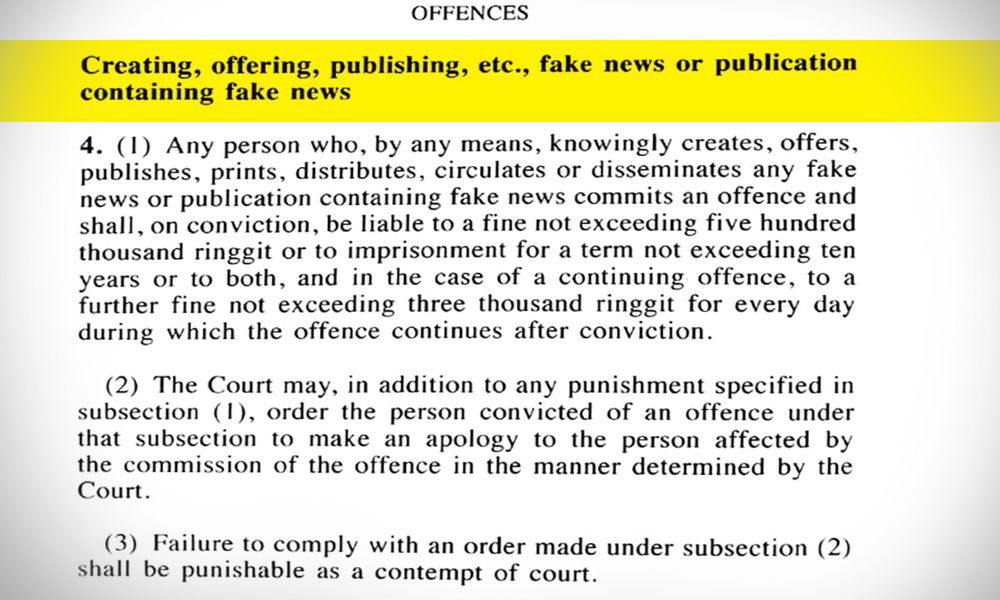
The word “knowingly” under Section 4(1) of the bill, which criminalises the deliberate production and dissemination of fake news, is ambiguous.
The term “prejudicial or likely to be prejudicial to public order or national security” under Section 8(3) also poorly defined, he said.
The clause disallows the court from setting aside an order to remove fake news deemed as such by the government.
“Suhakam cannot agree on this clause as it ousts the jurisdiction of the courts, further taking away judicial powers and denying the right to seek relief from the courts, which is an affront to the rule of law in a democratic form of government,” he said.
Penalties imposed unreasonable
In addition to these, Razali said the bill is not in line with the principles of freedom of expression under the Federal Constitution as well as the Universal Declaration of Human Rights.
The penalties imposed are also considered unreasonable and disproportionate.
He also expressed concern over the lack of public consultation for the bill and the rushed manner it is being tabled in Parliament, which he said is a cause for concern and not in the national interest.
“Despite being legally mandated to advise and assist the government in formulating legislation, Suhakam was only invited to the final consultation, without having sight of the bill.
“The trend to ignore this provision in the Human Rights Commission of Malaysia Act 1999 is of serious concern,” he said.
Apart from coming up with alternative solutions for tackling fake news, Razali suggested that the parliamentary committee should also find ways to avoid confusion over the various laws already available to tackle misinformation.
He said these include the Penal Code, the Sedition Act 1948, the Defamation Act 1957, the Printing Presses and Publications Act 1984, and the Communications and Multimedia Act 1998, among others.
The Anti-Fake News Bill was tabled in the Dewan Rakyat for its first reading on Monday and is expected to be carried through its second and third reading during the current parliamentary sitting, which lasts until April 5.
Among others, it prescribes a fine up to RM500,000, or up to ten years' jail, or both, for those found to be deliberately fabricating or disseminating fake news.
It also allows anyone harmed by fake news to apply for an ex-parte order at the Sessions Court to remove it, failing which will result in a fine up to RM100,000.


Are you sure you want to delete this comment?
This action cannot be undone.