



New categories and BR1M increase will raise the country's fiscal deficit
COMMENT | Caretaker prime minister Najib Abdul Razak announced in the launching of the BN manifesto that once BN wins again, the BR1M will be added with new categories, and the amounts for the existing categories will be increased.
Think tank Political Studies for Change (KPRU) is of the opinion that this will bring pressure towards the national economic growth, and may increase the federal government's 2018 fiscal deficit from the projected 2.8 percent to 3.1 percent.
Najib announced that households with an income of RM4,000 to RM5,000 may get RM700, while households with an income of RM3,000 or below, will have their cash aids increased from the current RM1,200 to RM2,000, and households with an income of RM3,001 to RM4,000 will have theirs increased from the current RM900 to RM1,500. Individuals with an income of less than RM2,000 will have their aids increased from RM450 to RM600...
COMMENT | Caretaker prime minister Najib Abdul Razak announced in the launching of the BN manifesto that once BN wins again, the BR1M will be added with new categories, and the amounts for the existing categories will be increased.
Think tank Political Studies for Change (KPRU) is of the opinion that this will bring pressure towards the national economic growth, and may increase the federal government's 2018 fiscal deficit from the projected 2.8 percent to 3.1 percent.
Najib announced that households with an income of RM4,000 to RM5,000 may get RM700, while households with an income of RM3,000 or below, will have their cash aids increased from the current RM1,200 to RM2,000, and households with an income of RM3,001 to RM4,000 will have theirs increased from the current RM900 to RM1,500. Individuals with an income of less than RM2,000 will have their aids increased from RM450 to RM600.
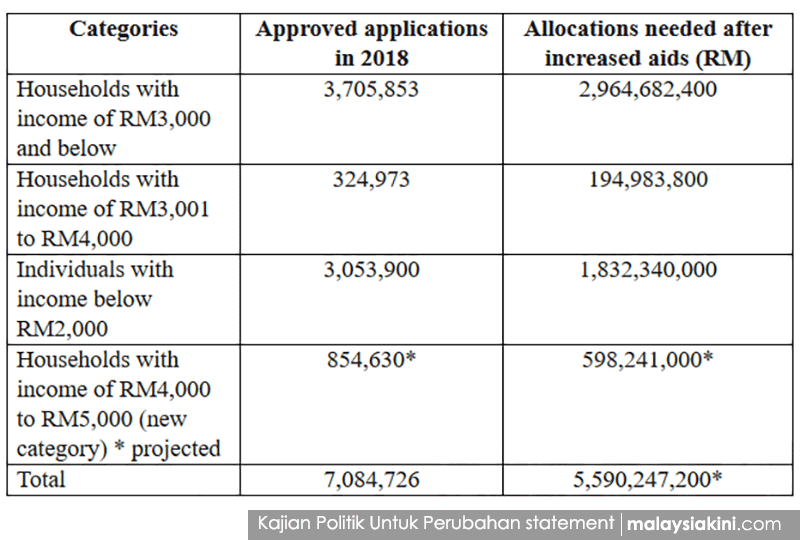
Before this, the Ministry of Finance (MOF) said that in 2018, the government had approved 7,084,726 BR1M applications, and disbursed RM6.12 billion. Among these, there were 3,705,853 households with an income not exceeding RM3,000, 324,973 households with an income from RM3,001 to RM4,000, and 3,053,900 individuals with an income of less than RM2,000.
According to official figures, in 2014, the households with an income of RM4,000 to RM5,000 made up 12.8 percent (854,630) of the total households. Therefore, based on our calculations, the new increment of BR1M will need an additional allocation of approximately RM5.6 billion!
By adding it to the RM6.1 billion being approved earlier, simply disbursing BR1M alone in 2018 will amount up to RM11.7 billion! And this RM11.7 billion would have made up 26.6 percent of the GST income of RM44 billion for last year!
Besides this, according to the Economic Report 2017/2018, the federal government fiscal deficit in 2017 was 3.0 percent. However, in 2018, as then-minister of finance, Najib tabled and passed the Supplementary Supply (2017) Act 2018 in the Parliament, we estimate that this supplementary budget of RM8.8 billion had already raised the fiscal deficit to 3.6 percent.
Despite this, the government still forecasted the fiscal deficit of 2018 to be reduced to 2.8 percent. However, simply increasing the BR1M is already sufficient to affect the government’s fiscal deficit goal, and may raise it to 3.1 percent.
Therefore, in our opinion, the caretaker government, in announcing the increase the BR1M, did not only think about the way to improve the people’s lives in the long term but also violated the convention of a caretaker government, openly bribing voters with money. This not only does not improve the people’s lives but might even affect the governance of national finance after the general election, burdening the people and the country.


Report this comment
Are you sure you want to delete this comment?
This action cannot be undone.