




Govt abolishes excise duty rebates for Proton
Malaysia today announced an ambitious automotive policy to enhance the competitiveness of national carmakers Proton and Perodua, and to become a regional car manufacturing and assembly hub.
Malaysia today announced an ambitious automotive policy to enhance the competitiveness of national carmakers Proton and Perodua, and to become a regional car manufacturing and assembly hub.
In a 10-page statement on the framework for a highly-anticipated national automotive policy, the government listed a string of measures to spur further growth in Malaysia's ailing automotive sector.
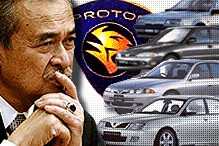 A government official said the new measures would see Proton immediately stripped of excise duty rebates, but that the automaker would be not be adversely affected.
"With the introduction of these measures, the government will remove excise duty rebates for Proton immediately," the official said.
"Based on simulations run by the Treasury, the removal of the excise duty rebates for Proton and subsequent introduction of new incentives, there will not be any material effect on Proton or on car prices," the official said.
The amount of excise duty rebates have never been revealed by the government. All foreign cars are required to pay a substantial excise duty.
Five major objectives were listed in the framework, which were adopted by the cabinet this morning.
Besides promoting a competitive national auto sector and becoming a regional hub for manufacturing, assembling and distributing vehicles, the government said it wanted to enhance local expertise in the industry.
Malaysia also aims to nurture export-oriented manufacturers and components and parts vendors, as well as promote the skills and participation of the country's bumiputeras in all areas of the industry.
Nine measures
The statement listed nine measures for immediate implementation to support these new objectives for the automotive sector.
They include the creation of an industrial adjustment fund to assist Malaysian manufacturers to face challenges from increased competition and liberalisation.
The fund's incentives can take the form of free loans, financing for component development, as well as technology enhancement, the government said.
Foreign auto players are also qualified to apply for these incentives, depending on their level of investment, it said.
Other incentives include provisions for grants for training, and research and development.
When asked if the new auto policy would have a negative impact on Proton, which is losing market share to imports, the government official said: "We want to support Proton in a way it can compete with any manufacturers that come to Malaysia.
"At present, Proton is entitled to the lion's share of the incentives based on the amount of investments they have put in. This is one step towards making Proton a competitive entity," the official said.
"Going forward, Proton will have to compete. If Toyota comes to Malaysia and they do the same thing, they will enjoy the same incentives like Proton."
The national carmarker used to sell six out of every 10 new cars in Malaysia but growing foreign competition is eating into its market share, which fell to 44 percent in 2004 from 48 percent in 2003.


Are you sure you want to delete this comment?
This action cannot be undone.