



Reveal all rail project papers before May 9
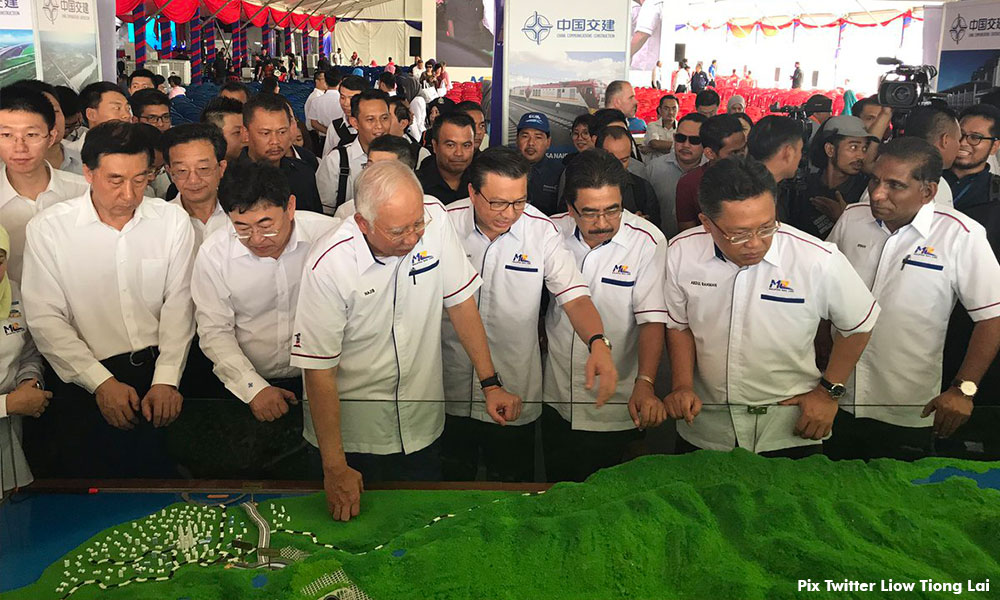
COMMENT | Since Najib Abdul Razak became the sixth prime minister of Malaysia on April 3, 2009, he has kept himself busy with so many mega-projects. By the same token, he also kept many papers close to his chest.
However, the main questions are these: Do Malaysians benefit from such-and-such a project? Or is it a case of public spending that would result in the outflow of funds from the country’s economic cycle? Why only foreigners seem to benefit? What’s left for locals?
Many of us would like to believe that all of these massive transport infrastructure projects such as the High-Speed Rail between KL and Singapore, the East Coast Rail Link (ECRL) and Gemas-JB KTMB double tracking project are meant to improve our country’s connectivity, increase the capacity of transport and logistics services and shorten our journey times between all these places.
At the same time, these transport infrastructure projects will also actually drive our economy forward, lead our country to perform better logistically and make Malaysia more efficient and possibly more competitive, too.
Economically speaking, Najib is taking the approach to drive the economy, known as public sector spending, as opposed to relying on a private sector-driven economy. At billions of dollars apiece, these projects better be good and functioning, otherwise the government would be blamed for their failure.
How true is it that ECRL, for instance, has a good potential to be a white elephant upon its completion?...
COMMENT | Since Najib Abdul Razak became the sixth prime minister of Malaysia on April 3, 2009, he has kept himself busy with so many mega-projects. By the same token, he also kept many papers close to his chest.
However, the main questions are these: Do Malaysians benefit from such-and-such a project? Or is it a case of public spending that would result in the outflow of funds from the country’s economic cycle? Why only foreigners seem to benefit? What’s left for locals?
Many of us would like to believe that all of these massive transport infrastructure projects such as the High-Speed Rail between KL and Singapore, the East Coast Rail Link (ECRL) and Gemas-JB KTMB double tracking project are meant to improve our country’s connectivity, increase the capacity of transport and logistics services and shorten our journey times between all these places.
At the same time, these transport infrastructure projects will also actually drive our economy forward, lead our country to perform better logistically and make Malaysia more efficient and possibly more competitive, too.
Economically speaking, Najib is taking the approach to drive the economy, known as public sector spending, as opposed to relying on a private sector-driven economy. At billions of dollars apiece, these projects better be good and functioning, otherwise the government would be blamed for their failure.
How true is it that ECRL, for instance, has a good potential to be a white elephant upon its completion?
RM55 billion is a colossal amount of public spending in order to build a piece of infrastructure that will serve about 4.5 million people (1.718 million in Kelantan, 1.25 in Terengganu and1.65 million in Pahang). It is an equally massive borrowing to drive the sleepy economies of these three East Coast states.
Why is the rail line only single track?
Will there be rapid population increases in these three states? Or is the demand for travel growing so rapidly that other modes of transport can no longer cope with the increases? Has the new East Coast highway (photo) reached its capacity already?
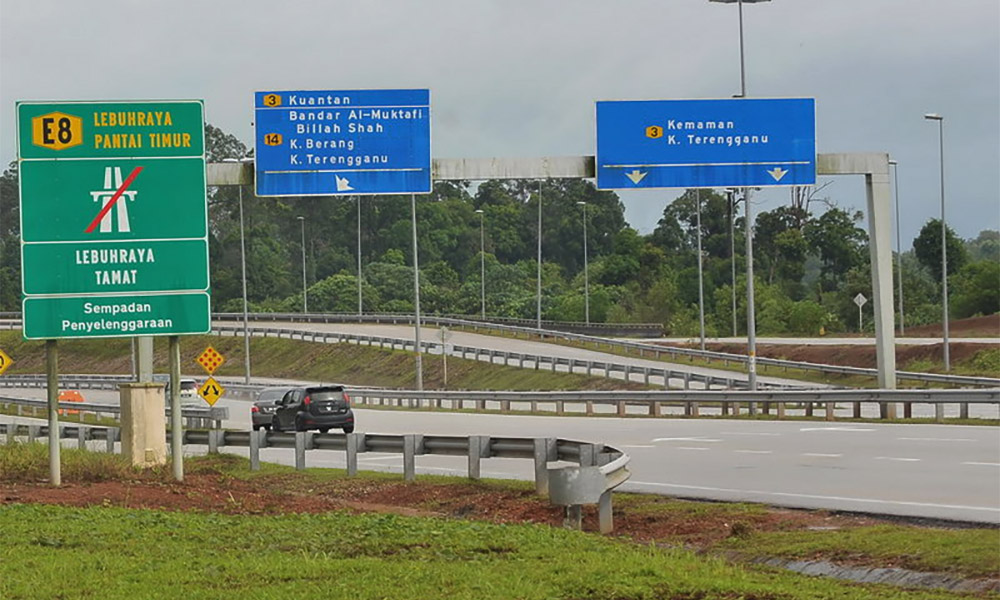
But even if the forecasts are that high, why is it that the rail line is only single track? How could a single track railway be of any real use for long distance travel of over 600km?
At the moment, as an alternative mode of travel between KL-Kota Bharu and KL-Kuala Terengganu are direct flights from Subang (or KLIA), taking only between 50 to 65 minutes at a fractional cost of the proposed rail tickets for both destinations.
Given the current demand and travel characteristics, RM55 billion is way over the top for such a venture that possibly cannot be justified economically and financially.
However, under normal circumstances and in order to show that the projects are worth the spending and would drive the country’s economy further, they have to be accompanied by a series of documents that can withstand any form of criticism.
The funding of these projects, after all, are made through the purse of the public, under the trust of the government. Therefore, the rakyat has every right to know how their money is spent and how they stand to benefit from this massive expenditure.
For instance, there are valid reasons and proven arguments why a feasibility study is undertaken; why a tender qualification exercise is done, why selected companies are invited to participate, why projects are tendered out, why the evaluation and selection process must be transparent and so on.
A clever way?
In short, the government must practice what it preaches. This becomes much more fundamental and crucial if a government is already perceived as a corrupt and a kleptocratic government. A lot more documents need to be revealed, rather than just a feasibility study in order to convince such an excessive expenditure.
Massive government spending can be justified if economic feasibility studies could show or produce results that would be beneficial to Malaysians. Benefits, both economics and financials, are normally and clearly spelt out (quantified in dollars and cents) through feasibility studies.
The economic benefits that are measured and shown clearly may include payment to Malaysian landowners whose land have been acquired for the projects and various local consultants who are engaged in the planning and project execution.
To name a few, the list of consultants may include local land surveyors, town planners, civil and structural engineers, soil engineers, design engineers and architects, mechanical and electrical engineers, traffic planners, systems engineers, lawyers and many others.
These are important local professionals who should stand to benefit directly from such a project as they employ and train many local graduates to develop their careers through such specialist fields.
Next in line would be local contractors or specialist construction companies, construction equipment and materials suppliers and a host of other smaller contractors.
If these two groups of key players or companies (consultants and contractors) cannot participate in government-driven projects, then it is not worth planning for such a project in the first place.
Public expenditure becomes worthless if only foreigners benefit but not locals. This is not a clever way of managing a state’s driven economy.
The number of local people employed and their total salaries and wages earned from such a project is another important indicator that should be shown clearly in any project feasibility study. If such a figure is dismal then a government planner has a lot to answer for.
Another key indicator is that a government is borrowing to fund such a project and to pay local contracting companies so that Malaysians could be employed for the project. In this way, new money is brought in and circulated within the national economy to enlarge the base and keep it circulating.
Most people employed in the project could earn a decent income, while graduates could find employment and pay for their basic expenditure such as food, clothing and shelter.
But is this happening? It seems like we continue to receive more foreign workers to work on projects which we ourselves fund and pay for. Is this a clever way to formulate and implement such a project?
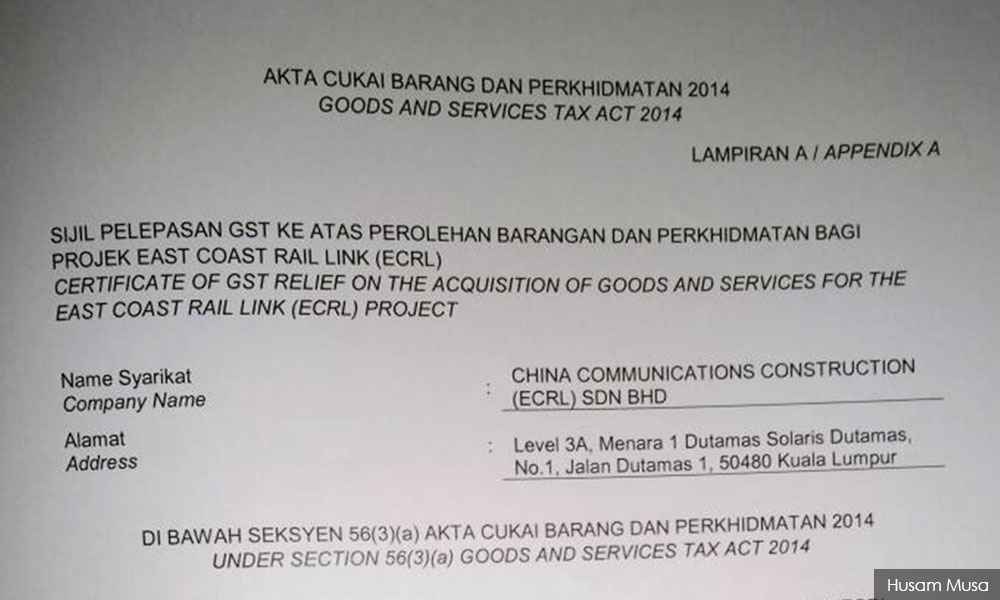
Another issue which has not been made transparent by the government and which cropped up yesterday is the exemption for paying the goods and services tax (GST) given to a foreign company. Perhaps, the government can provide an explanation on why foreign companies are exempted but not local companies.
The tax rule is very clear that any income derived from within Malaysia, above a certain threshold, is liable for GST. The rule should be applied uniformly across the board, regardless of whether one is local or foreign.
Who got the contract?
We spent a lot of money on double-tracking the KTMB rail system and electrification of these lines with the stated objectives of running more trains at higher speeds. At the moment the government has completed the track up north to Padang Besar and down to Gemas.
The recent Gemas-JB double tracking project has just been awarded. Do we know who the recipient of this massive contract is?
Why can’t the government be more transparent and share with us the names of these companies; who owns them and how much will they be making from the public purse?
There are a lot of questions that demand immediate answers from the government. Again, over RM8 billion is a lot of money; how will the people benefit from such a massive expenditure is another question.
Certainly, there are queries about why the KL-JB corridor should have two railway lines – the KTMB track which is going to be double-tracked and the proposed high-speed rail link (myHSR) to Singapore.
Do we really need two different sets of railway lines between KL and Singapore running parallel with each other? Why? Why all these secrets when public funds are being utilised? Share with us, the people, these details!
Why not use the existing KTMB alignment, straighten it where required or needed, so that higher speeds could be attained in order to introduce a high-speed train? Maybe it requires a new gauge size. Some may argue that there is no need for a new line as it is expensive and not really required.
Or have they considered extending the ERL line from KLIA to down south? That would be another feasible and cheaper option, if the intention is to serve Seremban, Malacca and beyond.
But maybe the government forecasts for a population boom along this corridor. Maybe there will be more projects planned at the various stations. We are not sure. At this moment we can only speculate.
That is why we are asking that the government should share with us the contents of the several feasibility studies reports, letter of awards, agreements, etc. Do such documents exist? For the rakyat’s sake, we need to know before we go to vote on May 9.
ROSLI KHAN has been a practising transport and logistics professional, academician, consultant and company director for over 30 years.
The views expressed here are those of the author/contributor and do not necessarily represent the views of Malaysiakini.


Are you sure you want to delete this comment?
This action cannot be undone.