




Press freedom: Malaysias ranking improves
Malaysia's press freedom ranking improved this year, moving up nine notches to 113, according to an international survey by the Paris-based, Reporters Sans Frontiers (RSF).
Malaysia's press freedom ranking improved this year, moving up nine notches to 113, according to an international survey by the Paris-based, Reporters Sans Frontiers (RSF).
Last year , the country was placed at 122 while its 2003 ranking was at 103. The survey is carried out on 167 nations.
In the world press freedom index report released yesterday, RSF said Malaysia no longer had any journalists or cyber-dissidents in jail.
Timor Leste, which gained its independence from Indonesia three years ago, came in at a surprising 58, making its media the freest in Southeast Asia.
According to the report, Asia is the 'toughest continent for journalists' where half of its countries were in the bottom of the index.
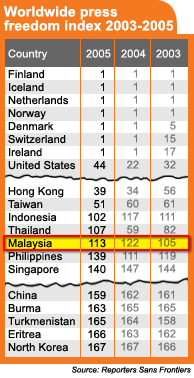 Those are Burma (163), China (159), Vietnam (158), Turkmenistan (165), Iran (164) and North Korea (167).
"These are where journalists have the toughest time and where government repression or armed groups prevent the media from operating freely," read the report.
RSF said although there were some media privatisation in China, the media were still forbidden to mention dozens of sensitive subjects in the past year.
"No improvement was seen in Burma and the replacement of some of the ruling generals did not benefit the media."
The report also stated that Singapore, ranked 140, was still in the lower rungs because Prime Minister Lee Hsien Loong kept the grip on the media and used drastic laws to crack down on the few independent journalists there.
In the Philippines (139), RSF revealed that killing of journalists increased as well as tighter censorship, mainly by local councils.
It said that President Gloria Arroyo Macapagal showed intolerance towards the media, especially foreign ones, for exposing corruption.
Black holes
Taking the bottom slot once again was North Korea, followed closely by Eritrea and Turkmenistan, which the RSF described as other 'black holes' for news, where privately-owned media are not allowed and freedom of expression does not exist.
South Korea and Taiwan, both ranked 34, were the highest in Asia followed by Hong Kong at 37.
The United States fell 22 places to its current ranking of 44. RSF attributed this to the imprisonment of New York Times reporter Judith Miller and legal moves undermining the privacy of journalistic sources.
At the top of the index once again were northern European countries Denmark, Finland, Ireland, Iceland, Norway and the Netherlands.
The index also contradicts the frequent argument by leaders of poor and repressive countries that economic development was a vital precondition for democracy and respect for human rights.
Several poor nations (with a per capita GDP of less than US$1,000 in 2003) were among the top 60, such as Benin (25), Mali (37), Bolivia (45), Mozambique (49), Mongolia (53), Niger (57) and Timor Leste (58).


Are you sure you want to delete this comment?
This action cannot be undone.