




Harmony at its best during festivals
Boasts about racial harmony in Malaysia reach a feverish pitch whenever a festivity is around the corner. So one can imagine what the temperature would be when Deepavali and Hari Raya fall on the same week this year.
Boasts about racial harmony in Malaysia reach a feverish pitch whenever a festivity is around the corner. So one can imagine what the temperature would be when Deepavali and Hari Raya fall on the same week this year.
Malaysiakini takes to the streets to find out if this harmony is really true or merely a political myth.
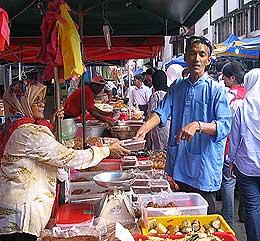 A stroll down the bazaars along Jalan Masjid India and Chow Kit proved that warm ties do, in fact, exist. At least, that is, on the culinary level.
Even foreigners, malaysiakini was told, have been amongst those snatching up the dizzying variety of traditional sweets and delicacies on sale at the bazaars in these two popular areas, traditional clothes and decorations associated with Hari Raya and Deepavali.
According to trader Hafizal Hussin, many non-Malays have eagerly bought the traditional cakes and biscuits he sells, from kuih bahulu and wajik to dodol and kuih bangkit .
Hafizal says he is more than confident of reaping significantly more than the RM30,000 he invested, as the customers flocking to his stall in Chow Kit will only be increasing as the days near the festive days.
 "We were very surprised when even Japanese tourists bought our
dodol
(sweet dessert made from durian). According to them, the sweet taste of
dodol
is unique. It cannot be found elsewhere," he said when met.
"We were very surprised when even Japanese tourists bought our
dodol
(sweet dessert made from durian). According to them, the sweet taste of
dodol
is unique. It cannot be found elsewhere," he said when met.
Sense of pride
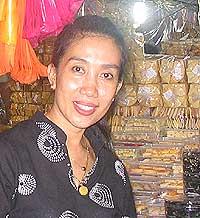
His exhuberance was echoed by fellow trader Dewi Ibrahim (left), whose cakes and biscuits have also seen an overwhelming response from non-Malay customers.
Malays, on the other hand, have been as equally eager to snatch up 30-year-old trader M Ramesh's muruku or other traditional Indian snacks.
"I feel a strange sense of pride when Malays come to my stall to buy sweets and other foods that traditionally only Indians would purchase," said Ramesh.
Hari Raya paraphernalia were in Ramesh's stall laid side by side with items for Deepavali. So much so that Indians would often overlook his business as it blended with the blaze of colors coming from the stalls of Malay traders.
"We put up these banana trees for this purpose - so that Indians would know this is an Indian stall," he said.
Forty-eight-year old S Doraisamy, however, smiles at Ramesh's youthful excitement and says he has always experienced such cross-cultural culinary harmony throughout his 20 years participating in such bazaars.
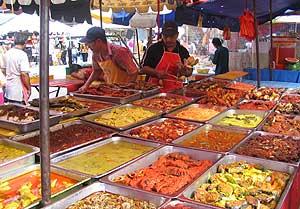 "I've set up stalls almost every year for twenty years during the festive seasons," he said.
Traditional way
"It's not a new thing. Malays have always been buying some of my Indian products, and vice-versa, especially muruku and some other traditional snacks. They say they would rather buy from me because they know my suppliers make these things the traditional way.
"There are, of course, Malays making and selling muruku . But it's not quite the same because it's mostly Indian suppliers who know who to make such things according to the traditional ways," said Doraisamy, who has earned between RM1,000 to RM2,000 a day this past month.
Even P Thillaiamali, who offers customers meehendi designs to be drawn on their hands and arms, benefits from the patronage of non-Indians to her stall.
During one visit to her stall, all three customers then having their hands decorated with the meehendi designs were Malay girls.
"You, sir, would you like meehendi designs on your hands?" she asked as a dashing, young foreigner passed by.


