
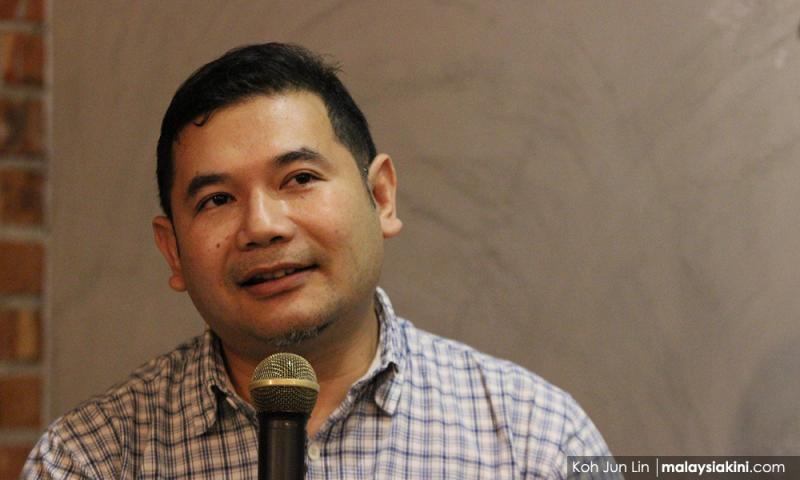
A duty to criticise and the middle-class bubble, according to Rafizi
Following the formation of the Pakatan Harapan administration, the much-adulated Rafizi Ramli found himself in the line of fire over his claims that Prime Minister Dr Mahathir Mohamad had “bulldozed” his way with cabinet appointments.
In an interview with BFM today, Rafizi defended his actions, and said his role now is to ensure that the executive branch of government must abide by the very same principles adopted by the Harapan presidential council when it comes to decision-making...
Following the formation of the Pakatan Harapan administration, the much-adulated Rafizi Ramli found himself in the line of fire over his claims that Prime Minister Dr Mahathir Mohamad had “bulldozed” his way with cabinet appointments.
In an interview with BFM today, Rafizi defended his actions, and said his role now is to ensure that the executive branch of government must abide by the very same principles adopted by the Harapan presidential council when it comes to decision-making.
He said that all four Harapan component parties are equal partners in government, as they are in the presidential council – meaning that the same rules of decision-making by consensus and inclusivity must apply.
“We have to make sure that we get the basis and principles right from the very beginning. Pakatan was built since 1998 (then Barisan Alternatif) on consensus, agreement and inclusivity.
“Amanah was a lot weaker by any measure, compared to PKR or DAP when we started Harapan, but we accorded Amanah the same stature and influence where decision making is concerned.
“Because of that, whoever leads the Harapan government must allow for as much inclusivity and consultation in decision making. That is an important reminder from the very beginning,” he said.
Middle-class euphoria
Two days after the May 9 elections, tensions simmered over the initial cabinet appointments, as de facto PKR leader Anwar Ibrahim – still in jail at the time – could not participate in meetings.

Eventually, Mahathir, who was in a rush to form a cabinet before May 14, announced his first four cabinet ministers, reportedly without achieving a consensus with PKR.
This prompted an outburst from Rafizi, which elicited condemnations from netizens demanding that he allow Mahathir free passage.
This was followed by Subang MP Wong Chen’s efforts to defend Rafizi, earning the former about 10,000 comments on his Facebook page, most of which critical.
In the interview with BFM, Rafizi suggested that the urban middle class appear to be in a euphoric mood and were “100 percent” loyal to Harapan, to the point where any attempts to criticise the coalition’s leadership cannot be accepted.
“The problem with middle-class Malaysians generally is that they tend to give 100 percent devotion and loyalty to what they want to believe in.
“Just because the Malaysian middle-class throws their support for the Harapan government, does not mean we cannot question and have a difference of opinion,” he said.
Rafizi said that it is easy to criticise the opinions of an opponent, but more difficult to provide check-and-balance, which he believes should both be valued and celebrated.
Middle-class bubble
The PKR vice-president also dismissed suggestions that the Harapan administration was “fragile,” suggesting instead that it is the Malaysian urban middle-class who have trouble stomaching constructive criticism.
“It is not the Harapan government that is fragile. It is the Malaysian middle-class who have to get out of their comfort zone to understand and believe in society. They (the lower income groups) know what they are doing.

“The Harapan government is a lot stronger. We went through 20 years (of struggle). (It was) worse than some one or two criticisms,” he said.
The middle-class, said Rafizi, have long been the toughest people to convince because of their condescending attitudes towards those outside their comfort zones.
“Just because you are living in Bandar Utama or Taman Tun Dr Ismail, you think that people outside your circle of comfort are not as smart as you.
“Over the past two or three years, I often have to convince the Malaysian middle-class that voters outside their urban circles actually know exactly what to do with this country," he stressed.
“In the past, it was also the Malaysian middle-class who always said that ‘we cannot change the government’, ‘Malaysians are too stupid’, ‘Malays do not care about corruption’, ‘Malays can be bought with RM100’...
“It was the Malaysian middle-class who felt that (Harapan) didn’t have enough plans to take over because BN is going to do this and that undemocratically. ‘What about a coup d'etat’, ‘What about the National Security Council’…”
Race and religion here to stay
Meanwhile, Rafizi said regardless of the change in government, race and religion will remain an unavoidable facet of Malaysian politics – as it is in other countries in Europe and the US.
As such, he said the Harapan administration will have to tread cautiously to avoid a pushback from Malays who may be racked by uncertainty if the fast pace of reforms becomes unnerving.
“If there is one big threat to the reform that we are trying to pursue is that we are being too insensitive to Malay insecurity and Malay anxiety.

“That we may alienate the Malays outside the middle-class comfort zone of the urban centres. That may push them towards Umno and PAS,” he warned.
A precedent, Rafizi said, can be seen Pakatan Rakyat forming the Perak government in 2008 and being unable repeat that success in the subsequent election.
“In the euphoria of a new government, I understand there are so many things that you want to push for, but you also have to take into account whether or not there is enough time to politically educate those Malays outside the urban middle class.
“We have to make sure they are comforted that everything is done at the right pace, without pushing them towards the Umno and PAS axis.”
Rafizi said even if gerrymandering were no longer an equation in the Malaysian electoral system, population trends dictate that Malays will continue to grow as the biggest voting bloc.
“If you are not careful enough and you make the biggest voting group in Malaysia feel they are sidelined and under threat, then you can expect the worse.
“After the last election, there is no longer such a thing as a certain way a group votes. They can swing, based on whatever they think is good for them."


Are you sure you want to delete this comment?
This action cannot be undone.