


Labour groups pan Kulasegaran's local cooks regulation
Labour rights advocacy groups have taken aim at Human Resources Minister M Kulasegaran after his announcement that only local chefs should work in restaurants from next year.
Labour rights advocacy groups have taken aim at Human Resources Minister M Kulasegaran after his announcement that only local chefs should work in restaurants from 2019.
Adrian Pereira, the executive director of monitory rights advocacy group North South Initiative (NSI), pointed out that the regulation would discriminate against migrant workers...
Labour rights advocacy groups have taken aim at Human Resources Minister M Kulasegaran after his announcement that only local chefs should work in restaurants from next year.
Adrian Pereira, the executive director of monitory rights advocacy group North South Initiative (NSI), pointed out that the regulation would discriminate against migrant workers.
“Usually work is decided based on skill and not nationality.
“When it comes to non-discrimination principles, work should not have spaces for any form of discrimination by nationality, gender, race, religion, and et cetera,” he said.
Speaking to Malaysiakini, Adrian stressed that the lack of proper research and supporting measures before the implementation of such a policy may eventually exacerbate the current problem of undocumented workers.
“They have not done any detailed study of the formal and informal labour markets. This will be bad for industry and force migrants further into irregular situations.”
Adrian also described Kula’s announcement as an “abrupt” and “populist” decision without any proper consultation and research on the labour force market, and without concern on the migrant workers’ rights.
“I hope the new government does not make populist decisions abruptly, which are not rights-based. The government should talk to CSOs, trade unions and the Malaysian Employers Federation (MEF) before deciding with all evidence on the table.
“(The policy) is surely not reasonable. The minister needs to look at overall labour market supply and demand statistics before making ad hoc and abrupt policy decisions,” he said.
The minister, Adrian added, has to come out with a systematic policy to manage the labour migration situation in the country rather than use discriminatory positions in specific sectors.
A more holistic plan
Selangor Friends of Women Association adviser Irene Xavier (photo), meanwhile, noted that the ministry has the power to open or restrict the recruitment of migrant workers in any sector, but needs to come out with a holistic plan.

“Well, we can’t really say that it is a kind of discrimination. Migrant workers are recruited specifically for some sectors.
If the ministry doesn’t want any migrant workers to be recruited in any sector, this is something that can be discussed.”
“However, the more urgent thing is to come out with a proper and holistic plan to deal with the whole issue, including the undocumented workers and the high cost of migration and so on, instead of just saying that ‘we don’t want foreign chefs anymore’,” she told Malaysiakini.
Irene also pointed out that there is a large population of foreign chefs already working in the country, and they will probably be forced to become undocumented if there is a lack of supplementary measures.
She also suggested the ministry should reduce Malaysia’s dependency on migrant labour gradually, to mitigate the impact on business owners and the workers themselves.
“I think it should be a more gradual kind of policy. The minister should make the decision after studies and consultations with those involved with migrant workers.”
At present, six sectors are allowed to recruit migrant workers, namely manufacturing, estate plantations, agriculture, construction, mining, and the service industry.
As “restaurant cook” falls under the service industry, it is legal to have foreign chefs if both employers and workers meet eligibility requirements.
Playing nationalism card
Mohamad Amerul Zufar, a member of Socialist Alternative, criticised the policy as being “nearly a superficial effort” which will not directly benefit the working classes in any way.
Amerul claimed that the Pakatan Harapan government’s incapability of fulfilling its promise to increase the minimum wage has led to them playing “the nationalist card,” and victimising migrant workers to relieve themselves of political pressure.
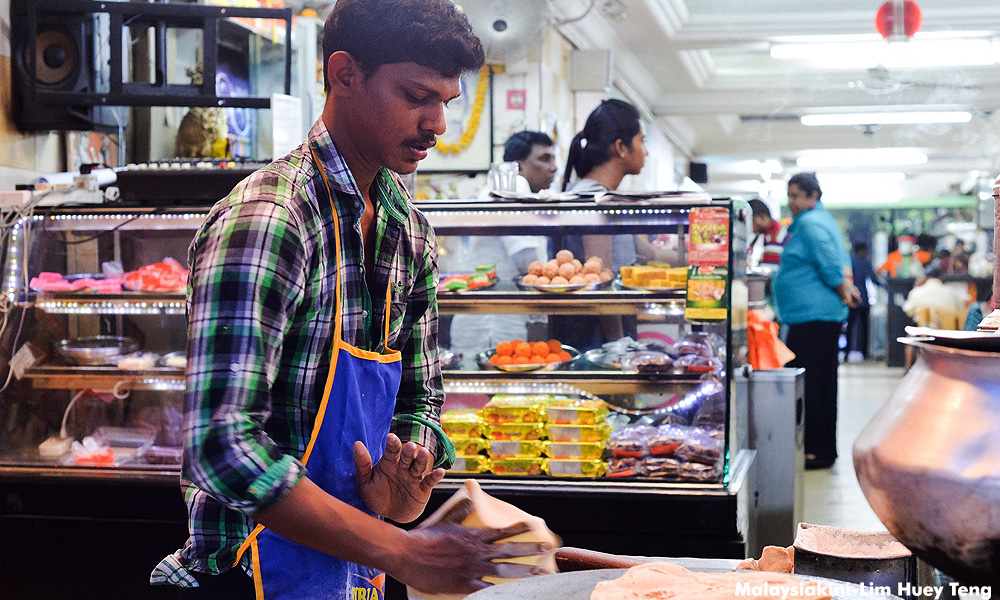
“However, this move will only have minimal effect. There would be more local cooks if they are given a decent wage. The issue here is low wages.
“Many sectors of our industry are flooded by migrant workforce due to the low wages, and employers exploit them for profit,” he told Malaysiakini.
Amerul stressed that the government should focus on raising the minimum wage and ensure employers adhere to it, instead of trying to create divisions between oppressed groups, such as local and migrant workers.
“The ministry should discipline the employer class instead of victimising workers,” he said.
The 34th promise of Harapan’s manifesto stated that it would equalise and raise the minimum wage to RM1,500 per month nationwide within their first term, with a review promised every two years.
It also promised to share 50 percent of the due to the rise in minimum wage, meaning the government will split the cost difference of the rise from RM1,000 with the employer.
Their manifesto also noted that the number of migrant workers would be reduced from six million to four million in its first term, as they believe that the surplus of migrant labour is keeping real wage levels low.


Report this comment
Are you sure you want to delete this comment?
This action cannot be undone.