



Cutting the nose to spite the face
COMMENT | Malaysia has had six prime ministers, Robert Kuok is known to have said in his best-selling biography: "I know all of them". With Dr Mahathir Mohamad as the seventh prime minister, he should have added, "I know the latest one too" since the seventh is effectively the return of the fourth.
But as the works of Professor Edmund Terence Gomez and his research associates at the University of Malaya has shown through their research on Ministry of Finance Incorporation, there are seven government investment linked companies (GLICs) and 445 government-linked companies (GLCs).
Even if one removes 1MDB from one of the seven GLICs, the government of Pakatan Harapan is still left with six GLICs, and the same number of GLCs.
Together, they formed 75 per cent of the weightage of the Kuala Lumpur Composite Index, as Professor Gomez argued in his opening chapter.
Not all Malaysian chief executive officers (CEOs) of GLICs or GLCs are as fortunate as Kuok, himself a patriotic Malaysian. The latter had the unique privilege - and self-designed luck to know all the prime ministers either by way of his prior association with them at Raffles College in Singapore or through his multitude of far-flung businesses.
Thus the CEOs of the GLICs or GLCs could not have known all the excesses of Najib Abdul Razak. Even Nazir Razak, the chairperson of CIMB Bank, the youngest brother of Najib, could not have known them all. Especially the transfer of about RM28 million into his account in the run-up to the 13th general election.
To be sure, Bank Negara Malaysia (BNM), undertook a probe on the matter. The investigation was headed by Nor Shamsiah Mohd Yunus, who is the current BNM governor.
CIMB Bank also engaged Ernst &Young to conduct an audit while Nazir himself took leave of absence to ensure an independent review. It was also further reported that Khazanah Nasional Bhd sought independent legal advice on the issue, where the
current attorney-general (AG) Tommy Thomas, was the lead legal practitioner...
COMMENT | Malaysia has had six prime ministers, Robert Kuok is known to have said in his best-selling biography: "I know all of them". With Dr Mahathir Mohamad as the seventh prime minister, he should have added, "I know the latest one too" since the seventh is effectively the return of the fourth.
But as the works of Professor Edmund Terence Gomez and his research associates at the University of Malaya has shown through their research on Ministry of Finance Incorporation, there are seven government investment linked companies (GLICs) and 445 government-linked companies (GLCs).
Even if one removes 1MDB from one of the seven GLICs, the government of Pakatan Harapan is still left with six GLICs, and the same number of GLCs.
Together, they formed 75 per cent of the weightage of the Kuala Lumpur Composite Index, as Professor Gomez argued in his opening chapter.
Not all Malaysian chief executive officers (CEOs) of GLICs or GLCs are as fortunate as Kuok, himself a patriotic Malaysian. The latter had the unique privilege - and self-designed luck to know all the prime ministers either by way of his prior association with them at Raffles College in Singapore or through his multitude of far-flung businesses.
Thus the CEOs of the GLICs or GLCs could not have known all the excesses of Najib Abdul Razak. Even Nazir Razak, the chairperson of CIMB Bank, the youngest brother of Najib, could not have known them all. Especially the transfer of about RM28 million into his account in the run-up to the 13th general election.
To be sure, Bank Negara Malaysia (BNM), undertook a probe on the matter. The investigation was headed by Nor Shamsiah Mohd Yunus, who is the current BNM governor.
CIMB Bank also engaged Ernst &Young to conduct an audit while Nazir himself took leave of absence to ensure an independent review. It was also further reported that Khazanah Nasional Bhd sought independent legal advice on the issue, where the
current attorney-general (AG) Tommy Thomas, was the lead legal practitioner.
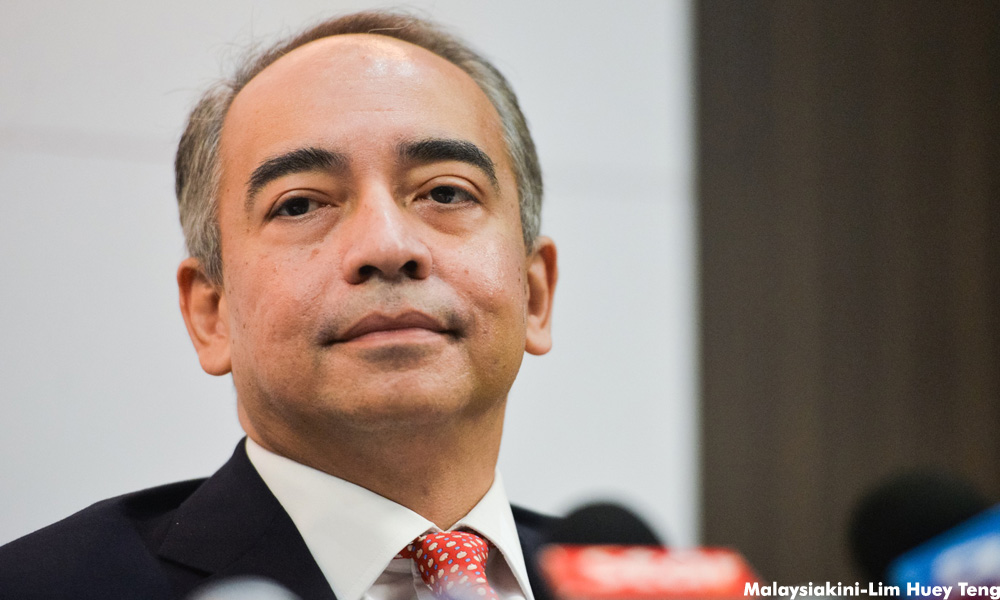
These investigations cleared Nazir (photo) from any wrongdoings by the present AG and current BNM governor. Nazir returned to his role as chairperson about a month later after the findings from the review concluded that he “did not misuse his position as group chief executive at the time nor was there any inappropriate use of the
bank’s resources.”
In fact, as early as 2013, Nazir has repeatedly warned the whole of the administration in Umno and BN - albeit from behind the scene -that if the government did not behave accordingly, they would be wiped out. Thus if one is to give credit where credit is due, Nazir saw it coming.
In all the 1MDB dealings, CIMB was not involved. While no one knows the extent of siblings' influence on the Razak family, the lone voice of Nazir clearly failed to stop Najib from over-indulging in policies that came close to taxing people down to the bone.
May 9, 2018, has given Malaysians a new start. Now that the focus of the criminal case is on Najib, which will expand from the current case on SRC to 1MDB, there is no need to cut the nose to spite the face.
The entire corporate landscape of Malaysia has been carefully cultivated like a Japanese garden. While some branches and overshot bamboos need to be tweaked, it is dangerous to run rough all over them.
As Napoleon Hill, author of the Seven Steps to Accurate Thinking, once said: "Inductive, and deductive thinking are all based on facts, not made hypothesis." Guilt by association alone, as Johan Jaafar pointed out in The Star on July 7, 2018, may not be sufficiently credible to be the benchmark of evidence - especially one that can lead to early termination of one's high flying corporate career in their late 40s or early 50s, both of which are age cohorts that have positioned them to be at their prime.
Indeed, Lim Kit Siang has warned that there were many people caught at the wrong place and the wrong time, in the run-up to the 14th general election. If the new government takes a no holds barred policy to wiping most, if not all of the corporate CEOs, with a broad brush, the financial bloodletting that one has seen in the recent
week, where US$33 billion has left the shores of Malaysia, probably cannot be stopped.
If the trends become irreversible, given the ongoing Sino-American trade war, the corporate foundations of Malaysia would be rocked to the core. Being magnanimous in victory has proven to be a wise strategy of how Germany and Japan have been won
over to be a part of the West.
Not sacking the entire city of Mecca when Prophet Muhammad was victorious in his return also proved to be one of the major catalysts in
the growth of the Islamic empire.
If Malaysia, a nation of 32 million people, start taking out the crème de la crème, of its own country, such a measure would be akin to shooting one in the foot. At a time when the essence of globalization is speed and dexterity, it helps to reprimand the CEOS who
have erred but not to cut them out from the business ecology completely.
Malaysia thrives on clean and conscientious corporate and nation-building strategy; not decisions influenced by calumny.
Worst still, if the decision is coloured by the vested interests of anyone, or of any group.
Whether it is, any one individual or any one political party in the new coalition that created history or anyone in the very powerful Council of Eminent Persons (CEPs) or Council of Elders is sometimes seen as the parallel government by some.
Remember, Harapan is an administration for many, not for few.
RAIS HUSSIN is a supreme council member and policy and strategy bureau head of Bersatu.
The views expressed here are those of the author/contributor and do not necessarily represent the views of Malaysiakini.


Are you sure you want to delete this comment?
This action cannot be undone.