
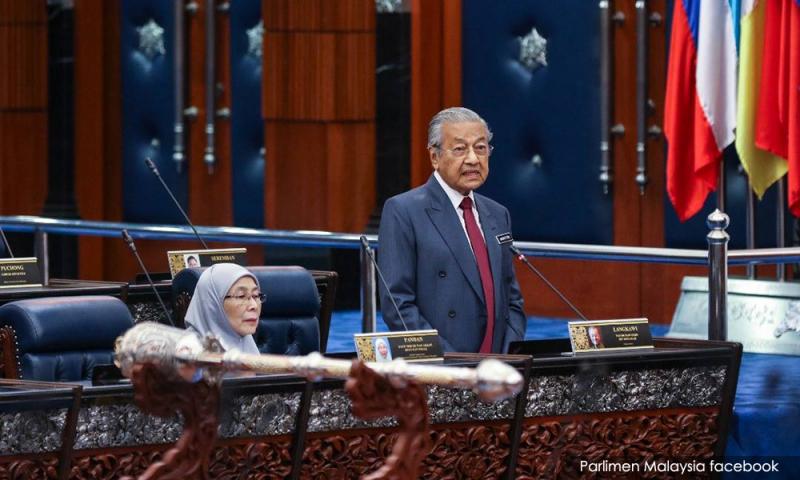
Dr M: Gov't won't restore royal veto despite NSC fiasco
PARLIAMENT | Prime Minister Dr Mahathir Mohamad said a constitutional amendment made during his first stint as prime minister, which allows bills to become law even without royal assent, was misinterpreted by the previous BN government to pass the National Security Council Act 2016 (NSC Act).
However, Mahathir said, there is no intention to reverse that constitutional amendment but the government is looking into the possibility of repealing the NSC Act...
PARLIAMENT | Prime Minister Dr Mahathir Mohamad said a constitutional amendment made during his first stint as prime minister, which allows bills to become law even without royal assent, was misinterpreted by the previous BN government to pass the National Security Council Act 2016 (NSC Act).
However, Mahathir said, there is no intention to reverse that constitutional amendment but the government is looking into the possibility of repealing the NSC Act, which allows the prime minister to declare "security zones".
Security forces can detain those in security zones without trial and no inquiry is required in the event that they are killed.
"The Yang di-Pertuan Agong's consent is still needed for any bill that involves the powers of the Yang di-Pertuan Agong.
"In this context, the previous administration had misinterpreted Article 66(4) and 66(4A) (of the Federal Constitution) to pass the NSC Act.
"The NSC Act clearly touches on the Agong's power to declare an emergency, whereby the power would become meaningless.
"The power to declare an emergency is a privilege accorded to the Agong as it has serious implications," Mahathir said.
Article 66(4) states that the Agong shall, within 30 days after a bill is presented to him, assent to the bill by causing the public seal to be affixed thereto.
Article 66(4A) states If a bill is not assented to by the Agong within the time specified in Clause (4), it shall become law at the expiration of the time specified in that clause in the like manner as if he had assented thereto.
Prior to the above provision, the Agong could veto any bill approved by the Dewan Rakyat.
Mahathir was responding to a question from Ismail Mohamed Said (BN-Kuala Krau) during Question Time in the House today on whether the above constitutional provisions would be undone to avoid a repeat of the NSC Act 2016.

In a follow-up question, Wan Junaidi Tuanku Jaafar (PBB-Santubong, photo), asked if Article 66(4) and 66(4A), to which the last amendment was made in 1994, remains relevant today.
To this, Mahathir stressed that a democratic country cannot accord absolute power to the Yang di-Pertuan Agong to block bills by the Dewan Rakyat, which is democratically elected.
"If the Agong is given absolute power to reject any law brought by the people, we would become an absolute monarchy and no longer a democracy," he said.
Takiyuddin Hassan (PAS-Kota Bharu) then argued that while the Federal Constitution required the Agong to act on the advice of the prime minister in most instances, the same does not apply to certain states, including Mahathir's own home-state of Kedah.
Takiyuddin said the monarchs of such states had refused to consent to amendments to the State Constitution that would require them to act on the advice of the state menteri besar.
As such, he asked if the Pakatan Harapan government will try to convince these states to amend its state constitutions to be consistent with the federal constitution.
However, Mahathir said the federal government cannot force these states to comply.
"I am aware that even my own sultan had not consented (to state constitutional amendments requiring monarchs to act on advice).
"We do not have coercive power (kuasa paksa). In other countries, they have coercive power but in Malaysia, we can't force anyone.
"It is only a formal arrangement, an understanding of our respective duties," he said.


Are you sure you want to delete this comment?
This action cannot be undone.