


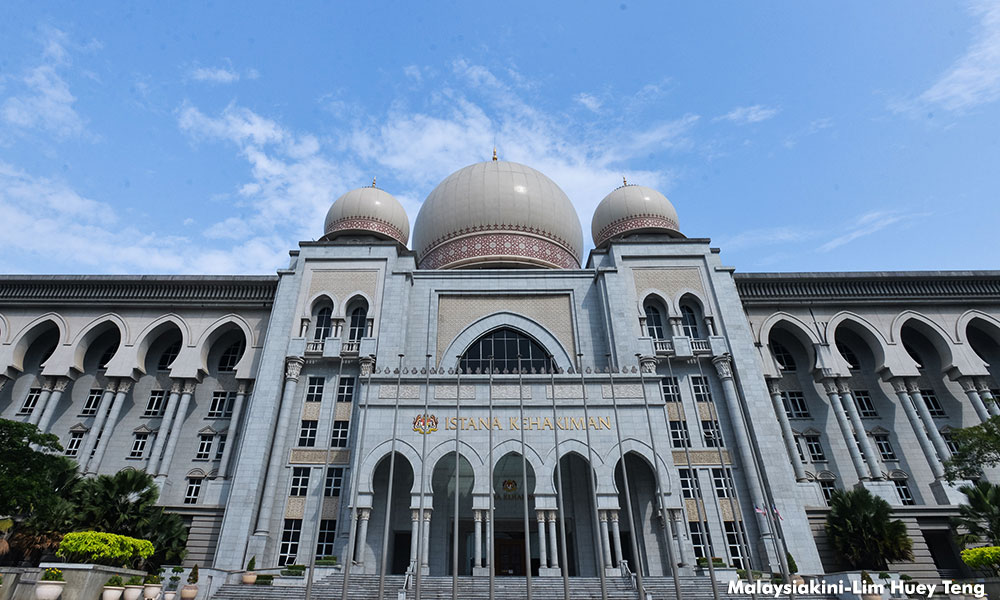

Nine-member bench to rule if shariah council decision binds civil court
For the first time, a nine-member Federal Court bench will sit tomorrow to decide on the constitutionality of a Shariah Advisory Council ruling which is said to bind the civil High Court, in a commercial dispute between Kuwait Finance House (M) Bhd versus JRI Resources Sdn Bhd and its three guarantors.
On Thursday, another nine-member bench will hear a case on stateless children...
For the first time, a nine-member Federal Court bench will sit tomorrow to decide on the constitutionality of a Shariah Advisory Council ruling which is said to bind the civil High Court, in a commercial dispute between Kuwait Finance House (M) Bhd versus JRI Resources Sdn Bhd and its three guarantors.
On Thursday, another nine-member bench will hear a case on stateless children.
Prior to this, the newly appointed Chief Justice Richard Malanjum had said that a nine-member bench would be empanelled to hear on constitution-related matters.
In the past, a seven-member bench was the maximum number empanelled to hear such cases in the apex court.
When contacted by Malaysiakini today, JRI's lawyer Dinesh Nandrajog confirmed that the reference case on the issue will proceed tomorrow.
He said the registrar had told him late last month that a panel of nine judges will hear the case.
The reference to the apex court is over the constitutionality of Section 56, 57 and 58 of the Central Bank of Malaysia Act 2009 (CBMA), following Kuwait Finance House’s (KFH) claim against JRI and three others for purported failure to make payment to KFH under Islamic banking facilities called Ijarah facilities and asset purchase agreement.
JRI is a shipping company that derives its revenue from charter parties, using the various vessels it operates. KFH is the beneficial owner of the vessels, under the Ijarah facilities and asset purchase agreement.
According to the facts of the case, a dispute arose as to who should be responsible for the major maintenance works of the vessels, whereby certain agreements under Ijarah provided that KFH was responsible for major maintenance work, while in other parts, it stipulated that JRI should bear all the maintenance costs.
As a result, JRI, according to its lawyers, was unable to service the loan repayment.
KFH managed to obtain a summary judgment against JRI at the High Court.
JRI then appealed, and the Court of Appeal directed the High Court to refer to the conflicting clauses in the Ijarah agreements dealing with the responsibility of maintenance and whether they were syariah compliant.
The Shariah Advisory Council ruled that the Ijarah agreements are valid and syariah compliant.
However, according to Dinesh, a question arose as to the effect of the Shariah Advisory Council's ruling as Section 57 of CBMA binds the High Court to adopt it.
This, he said, went against the constitutional position as such powers should be vested with the judiciary.
JRI then filed an application for referral under Article 128 of the Federal Constitution and Section 84 of the Courts of Judicature Act, whereby several questions were posed to the Federal Court on the grounds that Section 57 and 58 of the CBMA stipulated the effect of syariah rulings, and that the Shariah Advisory Council's ruling would prevail in civil court proceedings.
The lawyers for JRI said the advisory council was usurping the judicial powers of the court and denying their client's right to due process.
While the High Court dismissed the reference, JRI on appeal at the Court of Appeal was successful in reversing the High Court's decision.
As a result, the case now stands at the apex court for hearing before a nine-member bench.


Are you sure you want to delete this comment?
This action cannot be undone.