
Survey: Male journos, vernacular media journos paid less
A recent survey has shown that journalists at vernacular news media outlets earn less than at their counterparts attached to English-language media houses.
Conducted by the Institute of Journalists (IoJ), the Malaysian Media Salary Survey 2018 also showed that female journalists were generally paid higher than male journalists...
A recent survey has shown that journalists at vernacular news media outlets earn less than at their counterparts attached to English-language media organisations.
Conducted by the Institute of Journalists (IoJ), the Malaysian Media Salary Survey 2018 also showed that female journalists were generally paid higher than male journalists.
Of the 207 journalists polled, those working in Chinese media appeared to be paid the least at all levels of experience.
For example, a journalist with three to five years of experience working in a Chinese media organisation would earn an average of RM2,292.37 per month.
In the Malay media, a journalist would earn RM3,407.78 while English media would pay almost double - RM4,294.00.
In general, English media paid journalists at all experience levels, the highest salaries.
While monthly salaries generally hovered between RM2,000 and RM5,000, female journalists responded that they were paid marginally higher than men.
The survey also showed that photographers and videographers were paid the lowest in the newsroom, with an average salary of just RM3368.38.

In comparison, journalists earned an average of RM3,619.14 with management editors earning the most at RM8,677.67.
The disparity was widest among rookie journalists, where women appeared to be paid almost RM400 more than men.
This gap narrowed as experience grew. Women journalists with six to 10 years of experience earned just over RM320 more while those with 20 years of experience earned about RM269 more than men.
However, this trend was flipped for those who had three to five years of experience with women being paid RM114.81 less than men. No reasons were provided.
Just under 50 percent of all journalists surveyed said their pay was “barely survivable” while less than five percent were satisfied with their salaries.
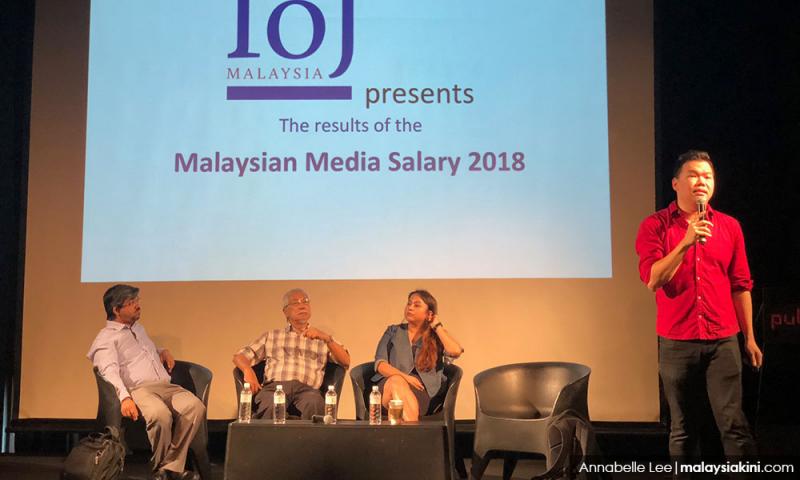
The survey results were presented by the institute’s chairperson Lau Chak Onn at the “Saving Journalism in the Age of Social Media” forum this morning.
Better local stories
During the forum, Chinese-language newspaper Sin Chew Daily’s chief operating officer Tan Lee Chin admitted that she had little control over staff salaries but opined that pay across the industry ought to be more “equitable”.
She also encouraged newsrooms to differentiate their content from the usual news cycle by reporting local issues in more innovative, in-depth ways.
“We really need to produce good local stories that are relevant [...] If we look at the news cycle, it is actually quite hard to produce in-depth investigative stories.

“I just sat through a three-day data journalism training. As a news organisation, we are actually pivoting towards that area,” she said.
Meanwhile, Malaysiakini CEO Premesh Chandran (speaking in photo) opined that newsrooms ought to diversify their income streams in order to be sustainable and independent.
“If you have really good content, the best way is to develop a membership or subscription base, or to rely on events and other types of revenue streams.
“If advertising is your main source of income, most advertisers will want you to serve their needs as opposed to your readers’ needs,” he said.
Despite challenges with salary disparity, dropping physical newspaper circulation and reduced advertising revenue, Karangkraf editor Abdul Jalil Ali believed journalism would stand the test of time.
“[...] Journalism is here to stay because I think journalists have their own function and role.
“Even though journalist salaries are not as high as those of a 1MDB officer, we need to continue to play our role to build a good society,” the veteran journalist said.
The talk was organised as part of the ongoing Cooler Lumpur festival in Publika Shopping Gallery in Kuala Lumpur.


Are you sure you want to delete this comment?
This action cannot be undone.