




Anwar's challenge against NSC Act remitted back to High Court
The challenge by PKR president-elect Anwar Ibrahim against the constitutionality of the National Security Council (NSC) Act 2016 will now be heard at the Kuala Lumpur High Court.
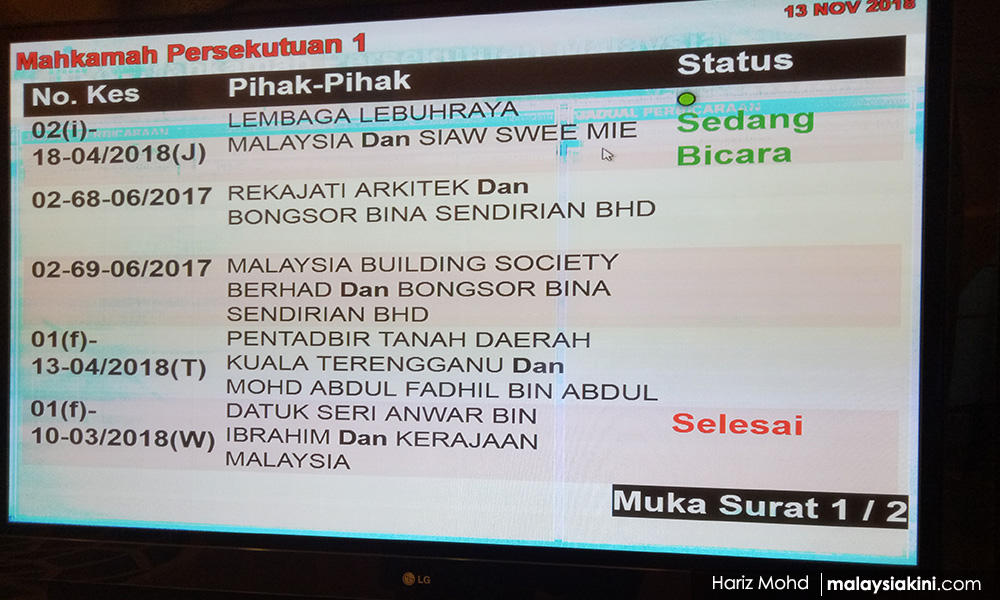
A five-member Federal Court's bench, led by Chief Justice Richard Malanjum, ruled for the case to be remitted to the lower court today, after Anwar's appeal was unopposed by senior federal counsel Mazlifah Ayob.
On March 14, Anwar was granted leave to challenge the constitutionality of the contentious act...
The challenge by PKR president-elect Anwar Ibrahim against the constitutionality of the National Security Council (NSC) Act 2016 will now be heard at the Kuala Lumpur High Court.
A five-member Federal Court's bench, led by Chief Justice Richard Malanjum, ruled for the case to be remitted to the lower court today, after Anwar's appeal was unopposed by senior federal counsel Mazlifah Ayob.
On March 14, Anwar was granted leave to challenge the constitutionality of the contentious act.
Counsel Gopal Sri Ram, representing Anwar, told the court that the government would not be opposing his client's appeal, and should thus be allowed unopposed.
Malanjum reaffirmed this with Mazlifah and allowed the appeal.
The case was then set for hearing at the High Court on Nov 21.
In August 2016, Anwar filed a judicial review to challenge the constitutionality of the NSC Act, a day after the law came into force under Article 66(4A) of the Federal Constitution.
He is also seeking to have amendments from 1993 – which states that a bill becomes law if it is not assented to by the Yang di-Pertuan Agong in 30 days – declared unconstitutional.
Anwar's case was dismissed by the High Court on Oct 14, 2016, after judge Hanipah Farikullah allowed a preliminary objection from the government on the court not having the power to strike out the case without the Federal Court's permission.
The High Court's decision was upheld by the Court of Appeal on Nov 6 last year.
With the decision today, Anwar's lawyers are set to argue that the 1993 amendments are unconstitutional and void.
In June 2016, the then-BN government had the NSC Bill 2015 gazetted into law without royal assent.
This was despite calls by the Conference of Rulers for the legislation to be refined.
According to the gazette published on June 7, 2016, the bill was declared as assented on Feb 18, 2016, under Clause 4(a) of Article 66 of the Federal Constitution.
Clause 4(a) states that a bill becomes law 30 days after it is presented to the Agong even without his assent.


Report this comment
Are you sure you want to delete this comment?
This action cannot be undone.