




Executive to try resolving 'bin Abdullah' case, as apex court grants adjournment
The Federal Court today deferred delivering its judgment in the “bin Abdullah” case although it is ready with the written grounds.
The court was supposed to deliver its verdict today on an appeal by the National Registration Department (NRD) and two others, on whether a Muslim child conceived out of wedlock could bear his father's name instead of "bin Abdullah"...
The Federal Court today deferred delivering its judgment in the “bin Abdullah” case although it is ready with the written grounds.
The court was supposed to deliver its verdict today on an appeal by the National Registration Department (NRD) and two others, on whether a Muslim child conceived out of wedlock could bear his father's name instead of "bin Abdullah".
Senior federal counsel Amarjeet Singh informed the court that the executive branch wants to address the matter carefully and consult a wide range of stakeholders.
"The government views that the delicate nature of the subject matter has far-reaching implications and requires solutions by other means," Amarjeet said.
"Other means", he reiterated here, is not through the courts, but either through executive or legislative means and the effort to achieve a solution will begin today.
His application to adjourn the delivery of the decision was not objected to by the plaintiffs, who had previously won their case at the Court of Appeal.
The plaintiffs' lawyer, K Shanmuga, told the bench that the government counsel had given an indication that the executive branch of government will try to find a solution, and they agreed to the request for a postponement as it involves the best interests of the child and other similarly affected children.
"Executive action may be a suitable avenue to resolve the problem," he added.
Objection by the Johor Islamic Council
However, the Johor Islamic Council, led by lawyer Sulaiman Abdullah, objected to the application.
The council wanted the decision to be delivered since it was ready, especially since one of the judges on the bench would be retiring soon.
Sulaiman said although the council’s presence there was as an intervenor, it should be considered a party to the court case. He also pointed out that the issue concerns Islamic laws, which are not alterable.
"Hence, the issue that arises is not something that can be settled by executive or legislative means. This matter has had a long history of arguments before the panel, and they were done in an energetic, informed and passionate manner," he added.
The senior lawyer said that the bench had received views from the various parties and had been ready to deliver the judgment today.
Sulaiman further raised the issue of why the NRD and the government had applied for a postponement at the eleventh hour when they could have brought up the issue to an enlarged bench last month.
"Against such a cause of action, that would have been the appropriate time to raise the issue but to come at the last moment is unfair to my clients, who have to deal with the situation of enhancing and enforcing the commandments of Islam," he said, warning further that the country had seen many last-minute solutions made.
He further pointed out that one of the judges in the three-member bench was retiring today and questioned what would happen if the appeal had to be heard again.
It was previously reported last month that a seven-member bench led by Chief Justice Richard Malanjum wanted to rehear the case from the beginning but as three members of the earlier five-member bench were present, he allowed the remaining three to deliver the judgment.
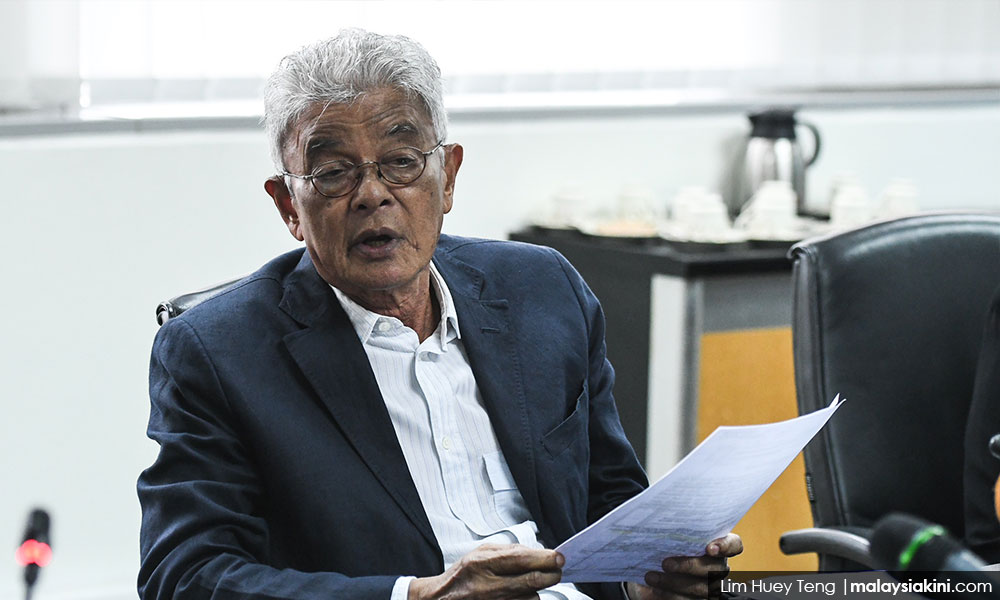
After a short break, Court of Appeal president Ahmad Maarop (below), who led the bench, allowed the adjournment.

"In fact, the written judgment is ready but having considered (senior federal counsel) Amarjeet’s application, we allow the application (to be adjourned) to a date to be fixed," Justice Ahmad said.
The other two judges sitting with him were Federal Court judges Justice Balia Yusof Wahi and Justice Aziah Ali, who are the remaining judges from the earlier five-member bench that heard the appeal from the National Registration Department.
Justice Aziah is retiring today.
Last year, the Court of Appeal in a landmark judgment ruled that a national fatwa on the issue is not law binding and that the NRD was only confined to determining whether the father had fulfilled the requirements under Section 13A(2) of the Births and Deaths Registration Act 1957.
With the judgment, the NRD was ordered to change the name of the eight-year-old child from “bin Abdullah” to that of the father's name.
The fatwa referred here is the 2003 National Fatwa Council edict which highlights that a child conceived out of wedlock (anak tak sah taraf) or one of indeterminate paternity (tidak boleh dinasabkan) cannot carry the name of the person who claims to be the father of the child if the child was born less than six months into the marriage.
The Federal Court decision, if it had been delivered today, would not only have affected the eight-year-old boy in this case, but would also be binding on Muslim children in a similar situation.
This includes 20 couples whose children were deemed to be born out of wedlock and hence carry the surnames “bin Abdullah” or “binti Abdullah” – which some argue would mean that the children would have to bear the stigma of illegitimate birth for the rest of their lives.


Are you sure you want to delete this comment?
This action cannot be undone.