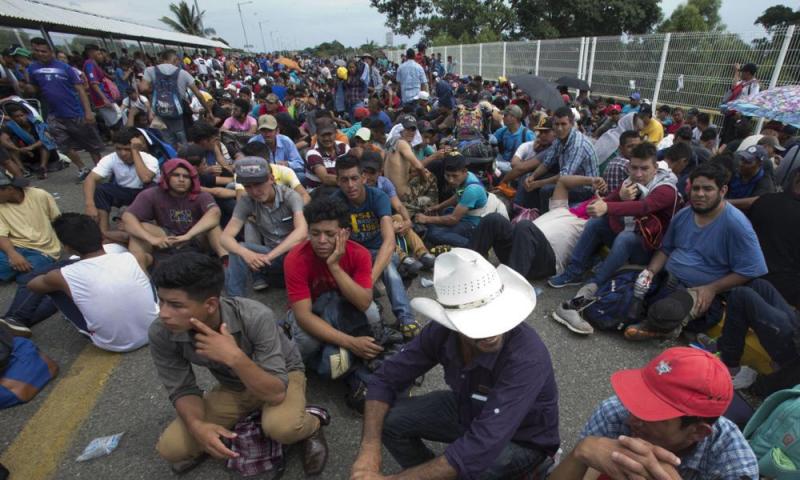
More than 150 countries will join a United Nations conference to adopt a global pact to better handle migrant flows, a senior UN official said, less than the number that initially worked on the plan.

In July, all 193 UN members, except the United States, finalised the so-called Global Compact for Safe, Orderly and Regular Migration to better handle migration.

Since then, the text has come under fire from European politicians who say it could increase immigration. At least six European Union members - mostly in formerly Communist Eastern Europe - have shunned the accord

UN Special Representative for International Migration Louise Arbour said more than 150 governments had registered for the event in the Moroccan city of Marrakesh set to adopt the accord today, without giving details.

The pact is not legally binding but can provide very useful guidance for countries facing migration, she told a news conference.

"Many challenges will stand in the way of its implementation, not least the toxic and ill-informed narrative that too often persists when it comes to migrants," she said.

In the latest political turmoil over the pact, Belgian Prime Minister Charles Michel yesterday relaunched his government as a minority administration after the biggest party in his coalition quit in a dispute over signing the compact.

The right-wing N-VA pulled its ministers after Michel refused its demand that he not agree to the pact.

In November, Austria's right-wing government, which holds the EU presidency, said it would also withdraw, saying the accord would blur the line between legal and illegal migration.

Australia also said in November would not sign the migration agreement because it would compromise its hardline immigration policy and endanger national security.

Among other leaders, German Chancellor Angela Merkel (photo), whose 13-year chancellorship has been marked by her open-door migrant policy, will attend the event.

The Global Compact for Safe, Orderly and Regular Migration is a framework for cooperation and aims to reduce illegal migration, help integrate migrants and return them to their home countries.

Chile became the latest country to pull out of the UN migration pact, its Interior Ministry indicated, provoking fury among opposition parties that accused Sebastian Pinera’s government of “shameful and authoritarian” behaviour.

Rodrigo Ubilla, Chile's Interior Ministry subsecretary, told Chilean Sunday paper El Mercurio in an interview that the country's representatives would not attend the event to adopt the pact early next week in the Moroccan city of Marrakesh.

"Our position is clear," Ubilla said. "We have said that migration is not a human right. Countries have a right to determine the entry requirements for foreign citizens."

Chile's Foreign Ministry did not immediately respond to a Reuters request for confirmation of the policy.

The migration pact addresses issues such as how to protect people who migrate, integrate them into new countries or return them to their home countries.

It is non-binding but has met fierce resistance from governments including the United States, Austria, Hungary and Poland, who frame it as encouraging migration.

If confirmed, Chile's refusal to sign reflects its hardening stance towards migrants whose population has grown five-fold in 30 years amid influxes from Venezuela, Haiti, the Dominican Republic and Colombia, among other Latin nations.

Centre-right Pinera’s government came to office in March on a promise to enforce stricter measures. In recent months, it as put on "repatriation" flights for Haitian migrants wanting to come home, tightened visa controls and deported migrants with criminal records.

Ricardo Lagos Weber, the president of the Foreign Affairs Commission for Chile's Senate, summoned foreign minister Roberto Ampuero to explain the closed-door decision.

"This is not a great way to find out about a subject of such tremendous importance," Weber told El Mercurio. "I understand that foreign policy is led by the president of the republic, but we could at least discuss it."

Hugo Gutierrez, a human rights lawyer and lawmaker for Chile's Communist Party, wrote on Twitter that Chile was advancing down "the ultraright path of Trump, Netanyahu and Bolsonaro,” referring to the US, Israeli and Brazilian presidents.

Chile's Progressive Party described the Pinera government decision as "shameful and authoritarian".

Amnesty International said it was "alarming". "Chile was an active part of this pact's negotiations and was considered one of the states that favoured its implementation," Ana Piquer, Amnesty's executive director in Chile, told La Tercera newspaper. "The last-minute decision not to participate in the Morocco summit seems a step back on its promise of affording rights to migrants."

- Reuters