


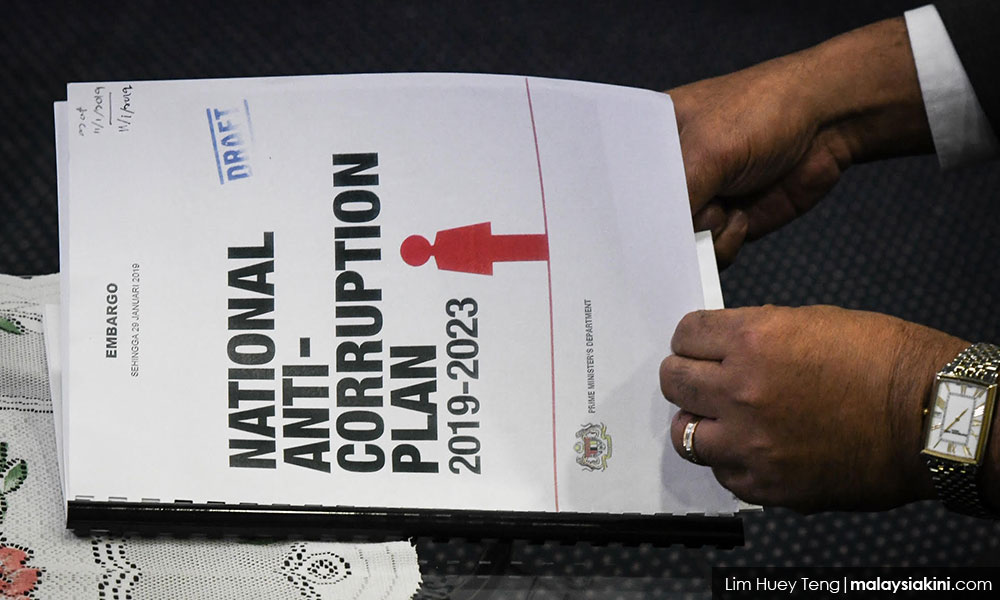

NACP will pack more punch in reducing corruption - Abu Kassim
INTERVIEW | The National Anti-Corruption Plan (NACP) slated to be launched this Jan 29 outlines a total of 115 initiatives to minimise the opportunity for corrupt practices.
According to Centre for Governance, Integrity and Anti-Corruption (GIACC) director-general Abu Kassim Mohamed, 22 out of the 115 will be the main focus of the government in the next five years.
He said the 22 initiatives were chosen based on their impact to bring down the problem of corruption in the country.
"We have more than 100 initiatives that had been identified. However, we have to bear in mind that all these cannot be achieved overnight.
"Thus, we chose a method where we identified initiatives that can be effective, that can bring big impacts and able to be carried out in a short period. (While) there are initiatives that we have to postpone for five years.
INTERVIEW | The National Anti-Corruption Plan (NACP) slated to be launched this Jan 29 outlines a total of 115 initiatives to minimise the opportunity for corrupt practices.
According to Centre for Governance, Integrity and Anti-Corruption (GIACC) director-general Abu Kassim Mohamed, 22 out of the 115 will be the main focus of the government in the next five years.
He said the 22 initiatives were chosen based on their impact to bring down the problem of corruption in the country.
"We have more than 100 initiatives that had been identified. However, we have to bear in mind that all these cannot be achieved overnight.
"Thus, we chose a method where we identified initiatives that can be effective, that can bring big impact and able to be carried out in a short period. (While) there are initiatives that we have to postpone for five years.
"By identifying (the areas to be focused), we came up with 22 initiatives that we will give more focus for the first two years of NACP, while at the same time we work on the others," he said during an interview on Monday.
Saying that the full list of NACP initiatives would only be revealed during its launching ceremony by Prime Minister Dr Mahathir Mohamad, Abu Kassim gave hints on several of NACP's focus areas.
According to him, they include legislating laws for political funding and asset declaration, as well as the law pertaining to the acceptance of gifts by civil servants, among others.
He said it would also address many loopholes in the civil service which opened room for corruption.
Abu Kassim, who is a former MACC chief commissioner, revealed that one of the biggest areas in the plan would be on political governance, describing it as an important issue that NACP would focus on.
"There are six priorities and six areas. Just as an example, the first one is political governance.
"I can say that this is one of the most important areas (outlined in NACP). Based on the history of our nation and other countries, as well as numerous studies that had been conducted, whether we like it or not (we must accept) that we are facing a clear inadequacy (of laws) on political governance.
"Political governance is a priority area. So when looking at this, our job is to increase the integrity and accountability in political governance".
He coined several examples of what the plan aims to achieve in political governance, including the recent moves to limit the terms for prime minister and menteri besar, and policy against the interference of legislative power in the appointment of key government posts.
The plan also looked at other issues including preventing politicians from interfering in the tender process, according to Abu Kassim.
"We want to make sure that these measures are documented and turned into government policies. So that whoever becomes the government in the future will have to stick to these policies.
"(So that) they can't interfere in the decision to appoint the head of government agencies or secretaries-general," he said.
Possible evolution of corruption trend and tactics
Touching on GIACC's work to formulate the NACP, Abu Kassim pointed to its collaboration with a lengthy list of stakeholders to come up with a plan that does not only address corruption issues today.
These discussions, including with NGOs that fight corruption like C4 (Centre to Combat Cronyism and Corruption) and Transparency International, saw them brainstorming on how to address possible evolution of corruption tactics in the future.
"From these meetings, we were looking at not only the problem that we have today, but also trying to foresee what could happen in the future if we do not address the problem of corruption well today.
"We have done simulations to anticipate future scenarios, and based on that we worked on what should be done from now. This is so that we can prevent such problems from stemming," he added.
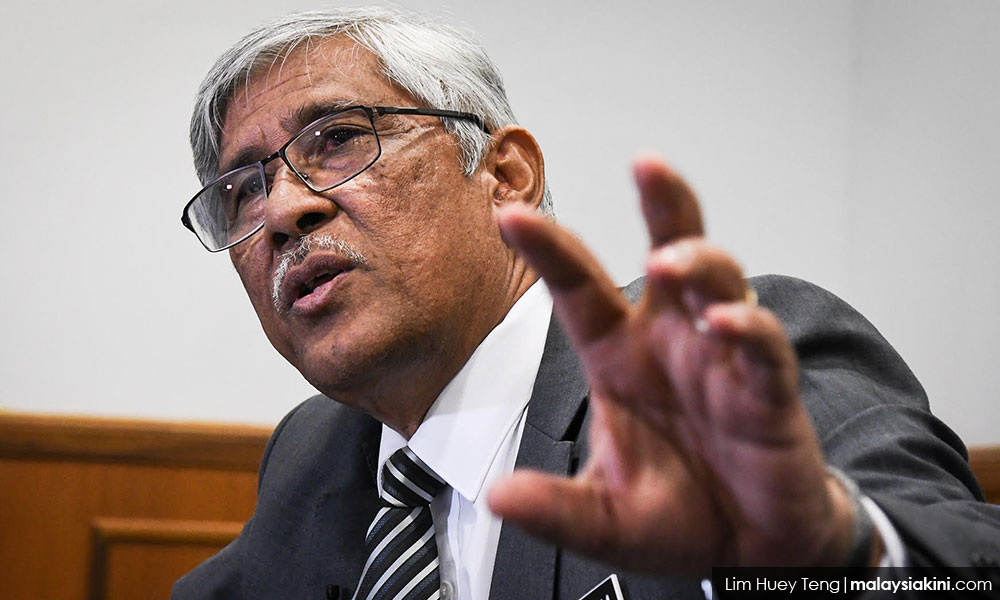
To deliver this point clearer, Abu Kassim (photo) gave an example of the rapidly evolving information technology which he said would be more and more sophisticated and needed in the future.
He said while the technology can be used to the advantage of anti-corruption strategies, the evolution might also change the method and pattern of corrupt practices.
"The use of artificial intelligence in investigations, for example, has been explored by other countries. IT tools are used to increase transparency and minimise the room for corruption to occur.
"Corruption happens when there is no transparency and the presence of opportunities to be corrupt. So IT can be used to address this.
"However, at the same time, we must also come up with a scenario planning of what could happen by then. Method and pattern of graft in the presence of sophisticated information technology.
"(So) it does not mean that (when IT is used to combat corruption) the problem would be solved. Maybe the method and pattern would also evolve. We looked into possible scenarios when IT becomes the core in all services we have," he said.
NACP would be more effective than its predecessors
During the interview, Abu Kassim said NACP was formulated based on anti-corruption plans that had existed.
However, he stressed that the difference in NACP is that it would be a plan that is going to be translated into concrete actions compared to previous efforts that had been taken by the government.
Taking the National Integrity Plan (NIP) introduced in 2004 as an example, he said it was a comprehensive, holistic and broad-based plan.
However, Abu Kassim pointed out that NIP lacked one clear thing. "It did not have administrative power," he said.
"NIP was introduced when the government (then) was concerned over BPR (MACC's predecessor Anti-Corruption Agency) findings that the younger generation had soft acceptance on the issues of corruption.
"At the same time, the government was also concerned when studies they conducted found that there was not much of a change in the level of corruption in the country.
"Thus, the government formulated a policy that is more comprehensive and inclusive of multiple agencies. It was a good plan, which is more holistic and broad-based.
"However, it became less effective when NIP was placed under an agency which did not have administrative power. Because the Integrity Institute of Malaysia was based on a consultative concept where they engaged with and tried to get agencies to bring changes," he elaborated.
Abu Kassim said this would be the difference with NACP, where issues that it identifies are taken straight to the Cabinet Special Committee on Anti-Corruption, which is chaired by the prime minister.
He gave an example of the plan to legislate laws for political funding and asset declaration, which had been long discussed, but ended only at the discussion level.
"The difference now is that issues discussed are brought straight to the cabinet. Political funding, for example, had been discussed so many times before this.
"(But now) when it is discussed, it is taken to the cabinet special committee and a policy decision was made. It had been agreed that law for political funding would be enacted.
"Now we are discussing with the Attorney-General's Chambers on how the law should be drafted. Before this, the matter did not even make it to the AGC," he said.
Summarising about NACP, Abu Kassim said its ultimate goal is to make Malaysia a country that is free from corruption.
He said while it is impossible for any nation to have zero-corruption, GIACC is aiming to bring down corruption in Malaysian to its lowest level.
The most important in this goal, Abu Kassim stressed, was to make sure that the people would feel the change.
"Whether we like it or not, the cleanest country would still have corruption. But the most important thing is for us to ensure that we bring down graft to its lowest level.
"To gauge whether our efforts are successful or not, the public must feel that the corruption problem in their country has gone down.
"We could use any apparatus or indicators (to show success), but if the public does not feel it, there is no use."
ABU KASSIM INTERVIEW
PART 1: Political funding bill to be completed by end-2020
PART 2: Abu Kassim: IPCMC will be acid test for future oversight bodies
PART 3: 'Harapan gov't needs to better communicate its anti-graft efforts'



Report this comment
Are you sure you want to delete this comment?
This action cannot be undone.