




Overseas investment forays to increase
Malaysian Deputy Prime Minister Najib Razak said today that the nation's growing current account surplus would increasingly see the country looking overseas for investment opportunities.
Malaysian Deputy Prime Minister Najib Razak said today that the nation's growing current account surplus would increasingly see the country looking overseas for investment opportunities.
Malaysia has run "persistently-large" current account surpluses since the 1997 Asian financial crisis, he told business leaders in his opening address at a conference on Malaysia's outlook.
He said construction investment would likely grow much slower going forward, reducing its contribution to economic growth since the country had largely built much of its physical infrastructure.
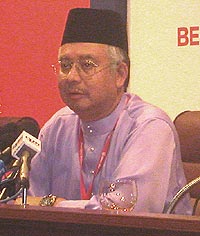 The slowdown will "leave a large gap between our national investment and savings rates reflected now in a large current account surplus of 14 percent of GDP," said Najib,
Along with a rebound in foreign direct investment flows to about four percent of GDP, Najib said the combined result was a large, basic surplus that could be "recycled" through the acquisition of foreign assets.
"Malaysia is consequently going to be a major capital exporter and foreign investor in the medium term," he said.
The deputy premier said the country had learned from its forays overseas during the 1980s and 1990s, when initiatives hinged more on "geopolitical advantages rather than our deep commercial strengths".
Buoyant growth
In the next stage of the country's development, "Malaysia Inc will need to be more hard-nosed, more analytical, more discriminating in establishing our global footprint of assets, investments and talent," he said.
Najib also said that Malaysia's economy would see reasonably buoyant growth - analysts have forecast it to grow by 5.5 percent in 2006 - but acknowledged there were perceptions the country's economy was sluggish.
"At the micro-level, there are discernible rumblings that things are not moving fast enough and that business remains slow," he said.
"This can be attributable to the export-driven feature of our growth that is skewed towards oil and gas, palm oil and electronics exports," said Najib.
He said Malaysia needed to address the situation to accelerate growth and renew confidence in Malaysia's economy.
"We need to seriously address the savings-investment gap and stimulate stronger domestic investments," he said.


