




IFL - PKR women spell out the changes needed
Amidst the recent spate of objections over the Islamic Family Law (Federal Territory) Amendment Act 2005, Parti Keadilan Rakyat (PKR) women's wing chose a quieter approach to deal with the heated situation.
Amidst the recent spate of objections over the Islamic Family Law (Federal Territory) Amendment Act 2005, Parti Keadilan Rakyat (PKR) women's wing chose a quieter approach to deal with the heated situation.
At a press conference today, its chief Fuziah Salleh revealed the contents of a study of the amended legislation and outlined "positive aspects from both the gender and syariah perspectives".
Fuziah said a memorandum will be submitted to the Council of the Malay Rulers and Ministers of the Prime Minister's Department, Nazri Abdul Aziz and Abdullah Mat Zin before the new parliamentary session begins in March.
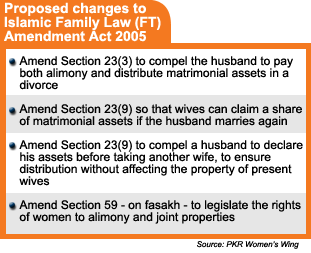 "Our proposals were made after careful two-week study of the law and discussions with a group of syariah law academicians and practitioners," she said. (See chart)
She was quick to clarify that the party was not downplaying the concerns of women's groups and others who claimed that the law would restrict the rights of Muslim women. Enforcement of the recently-amended law has been deferred to enable a review.
"We are not saying that the complaints are unjustified. Admittedly, the amended version does raise cause for concern but that does not mean that it has to be scrapped completely," she said at the party headquarters in Kuala Lumpur.
She said objective responses could have been obtained if the government had educated the public on the amendments before tabling it in Parliament and forcing it through both chambers.
However, she described the responses of particular ministers as "pathetic" for the failure to clarify the confusion.
"The minister who has jurisdiction for women's interests, Shahrizat Abdul Jalil, washed her hands off the matter by saying she does not have expertise in Syariah law to comment... she could have asked for a further study of the amendments and at least try to find a solution."
Acceptable provisions
Asked to elaborate on the "positive aspects" of the amended law, she pointed out that it will help establish a uniform family law nationwide for Muslims - something that women's organisations have been seeking.
She cited, too, the provision which now allows men to initiate fasakh (an application for annulment of marriage) - a right which was exclusive to women earlier.
"Many feel that it is unfair to open fasakh to men who already have rights to talaq (divorce decree). But the extension of fasakh to men allows a wife to challenge the husband's divorce application before a syariah judge," she said.
She also claimed that the amended law also provided "more stringent procedures" for Muslim men to marry again.
"The men have to provide an iqrar (sworn statement) as opposed to only the financial status report required up to now. The court will then summon five people - the husband, the wife, the wife-to-be and her father and a neutral person - to hear the arguments.
"Only then can the court make a decision. And if a party is dissatisfied, they have 14 days to appeal. So I think it's a good move to overcome the situation in states like Perlis where men don't even have to get their wife's consent."
She emphasised, though, that these measures require stringent enforcement to be effective.
'See to needs'
 Fuziah also called on the government to take steps to ensure that the contentious provisions be amended and have the act be enforced as soon as possible.
"The uniformity of Islamic family laws in all states must be expedited and coincide with other Islamic laws including criminal laws.
"There is also a need for have the enforcement of syariah laws be made under the federal jurisdiction. We should emulate the National Land Code which allows the federal to enforce land laws as the state acts as a guardian of the land."
However, she pointed out that even a perfect law cannot lead to justice if the administrators are not properly trained or are sidelined in terms of resources, especially finance.
"There is a need to increase the numbers of syariah judges and revise their salary scale as they are earning much less than their civil counterparts. This is despite the fact that their volume of work is equally heavy."
She said the government must provide training to all syariah judges so that they can be more creative and proactive in arriving at their decisions.
"Attention must be given to the need of support, who cannot cope with the work load. This leads to a backlog being created," she added.
"It is indeed frustrating when a case is delayed for years. I am told that some litigants have had to locate their own files because of staff shortage. This is absurd!"


Are you sure you want to delete this comment?
This action cannot be undone.