




Senior judge - Harapan win rattled judges, but now 'business as usual'
Court of Appeal Judge Hamid Sultan Abu Backer has claimed that top members of the judiciary and their associates were concerned about the prospect of Pakatan Harapan winning the last general election.
He said this was expressed as early as April 2018 where at a monthly lunch organised at an Italian restaurant, one top judge was worried that an opposition victory could see them being tribunalised.
"It is one of common sense to me that only those who have committed ghastly constitutional crimes would fear being booted out," he added in an affidavit.
However, Hamid said the judges were "extremely happy" when members of the old regime were elevated.
"The talk among the judicial members was that they were appointed because of the influence of an ex-minister who they served earlier. I will reserve my right to say further to an Royal Commission of Inquiry (RCI).
"They all knew it was business as usual and all the fear of tribunalisation had disappeared overnight and now they are looking forward to top positions upon vacancy.
"To me, I see it as one movement from a kleptocracy regime to another and nothing more," he added.
Hamid's affidavit was filed today in support of lawyer Sangeet Kaur Deo's application to declare that the chief justice failed to defend the integrity and credibility of the judiciary...
Court of Appeal Judge Hamid Sultan Abu Backer has claimed that top members of the judiciary and their associates were concerned about the prospect of Pakatan Harapan winning the last general election.
He said this was expressed as early as April 2018 when, at a monthly lunch organised at an Italian restaurant, one top judge was worried that an opposition victory could see them being tribunalised.
"It is one of common sense to me that only those who have committed ghastly constitutional crimes would fear being booted out," he added in an affidavit.
However, Hamid said the judges were "extremely happy" when members of the old regime were elevated.
"The talk among the judicial members was that they were appointed because of the influence of an ex-minister who they served earlier. I will reserve my right to say further to an Royal Commission of Inquiry (RCI).
"They all knew it was business as usual and all the fear of tribunalisation had disappeared overnight and now they are looking forward to top positions upon vacancy.
"To me, I see it as one movement from a kleptocracy regime to another and nothing more," he added.
Hamid's affidavit was filed today in support of lawyer Sangeet Kaur Deo's application to declare that the chief justice failed to defend the integrity and credibility of the judiciary.
He also detailed what he claimed were several instances of judicial interference.
An example he claimed, was that top judges were regularly summoned to the Court of Appeal panel hearing Anwar Ibrahim's Sodomy II case to brief them on how to conduct themselves.
"A senior most judge of the Court of Appeal, after the (last general) election, had informed me (of) wrongdoings by top judicial members and judges which were within his own knowledge.
"The judge told me that the Court of Appeal coram was called to the chambers of top judges regularly and briefed on what to do.
"There is more I would like to say in relation to this, but I will reserve it to say it to (a) RCI," he added.
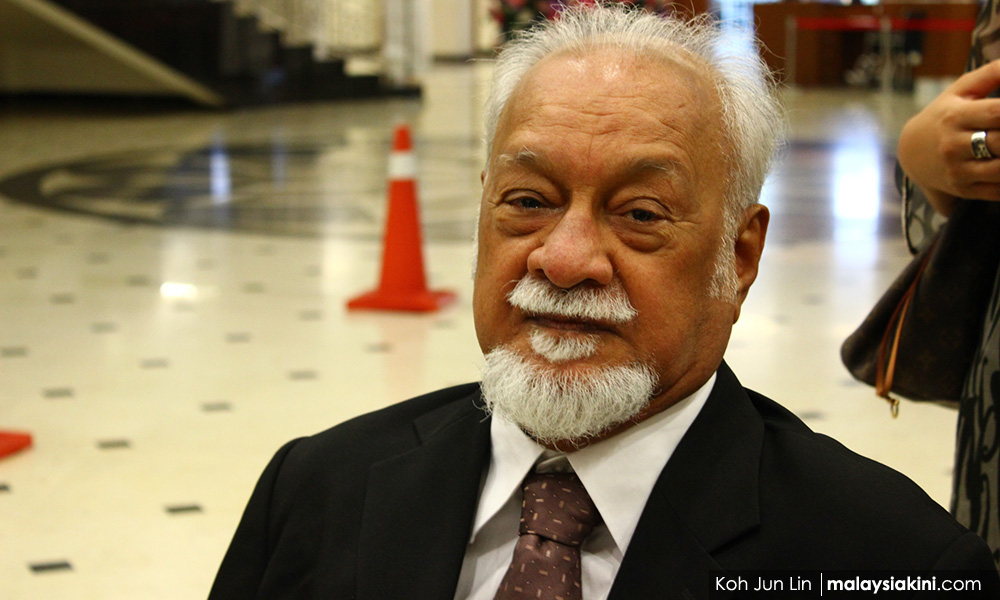
Hamid also confirmed senior lawyer Haniff Khatri's allegation that a top judge interfered in a majority decision which was initially to acquit the late DAP national chairperson Karpal Singh (photo) of his charge under the Sedition Act.
He referred to the top judge involved in the alleged interference as 'ARLC.'
"The second information was actually a confession of a constitutional crime orchestrated by ARLC.
"The judge who had informed me was a coram member of Karpal's appeal in the sedition case.
"He said the decision of the Court of Appeal before pronouncement was an acquittal by majority.
"However, one top judge called the coram requesting to dismiss the appeal, which means the conviction stands," he alleged.
Hamid claimed that the judge refused to abide by the request, but the others agreed to change the acquittal to a conviction.
"In consequence, the majority affirmed the conviction," he added.
In his affidavit, Hamid also related his personal experiences of judicial interference.
"There was also a general perception that the apex court coram in civil and commercial cases related to important personalities were made in favour of them, and on the face of record it will appear to be the result of judicial interference or manipulation.
"I can give some examples to the RCI and I am sure other right-minded judges will also be happy to give information to the RCI," he added.
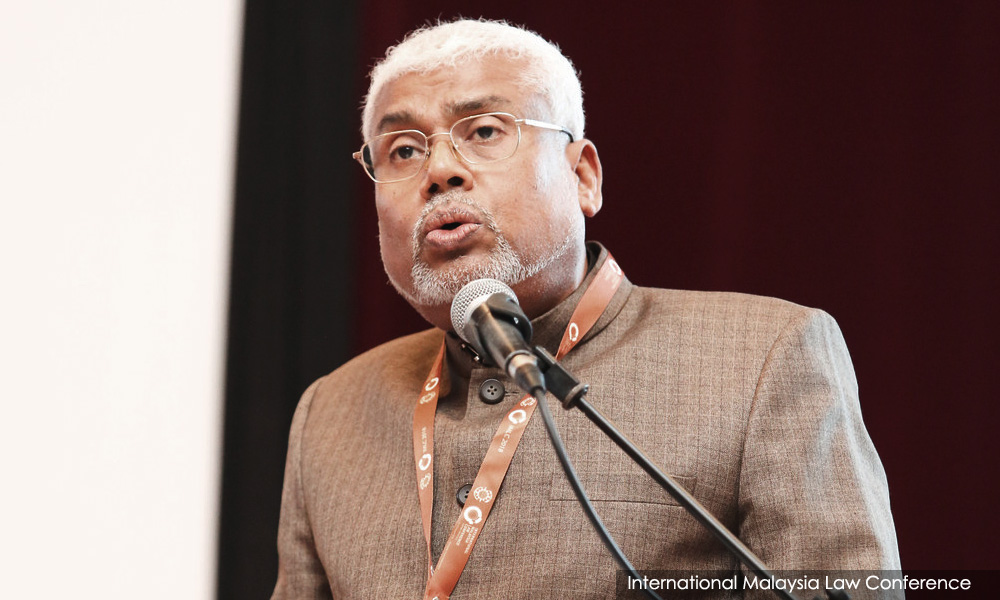
Hamid (photo) said the first case which courted trouble for him was his decision on the constitutionality of Section 27 of the Police Act 1967, which required a police permit for an assembly. It has since been repealed and replaced with the Peaceful Assembly Act 2012.
In that case, Hamid said the trial court convicted the accused, and the appeal came before the Court of Appeal where he was part of the coram. He was asked to draft the judgment and circulate it to other coram members.
"I wrote the judgment articulating the jurisprudence relating to constitutional supremacy and concluded that the section was unconstitutional.
"Upon circulation, one coram member approved the draft. However, the other member informed that he did not agree and would write his draft and circulate it.
"During the discussion, the member who had a draft disagreeing with me told the other member, 'If you follow Hamid's draft, it will create an 'Arab Spring' and there will be unrest to topple the government'," he added.
Hamid said when he refused to change his position, one of the judges told him that "if you write like this, you will have no future in the judiciary."
Following this incident, Hamid said the chief justice at the time called him for a meeting and told him in a "friendly manner" that "if the government is not happy with you, if I recommend a promotion, it will be rejected."
"Hell turned loose when I delivered my dissenting judgment in (the) M Indira Gandhi appeal. My coram was called up by ARLC.
"ARLC reprimanded me with words which impinged judicial independence and that is where he disclosed the unhappiness of top judges and Federal Court judges in respect of my important constitutional judgments.
"He also threw tantrums at me in an uncivilised manner in front of the other panel members,” he added.
The senior judge had previously disclosed the alleged interference in Indira's case at a Malaysian Bar function.
RELATED REPORTS





Report this comment
Are you sure you want to delete this comment?
This action cannot be undone.