




Mitsubishi deal key to Proton's survival?
Proton's new tie-up with Mitsubishi could give the troubled national carmaker a new lease on life by helping it roll out new models, even if the alliance is looser than hoped for, analysts say.
Proton's new tie-up with Mitsubishi could give the troubled national carmaker a new lease on life by helping it roll out new models, even if the alliance is looser than hoped for, analysts say.
The deal signed on Friday covers the development of new Proton cars, technology transfer and the mutual supply of auto parts. It also allows Mitsubishi to produce its own models in Proton plants.
 The pact revives a 1980s partnership between Malaysia's state-run carmaker and the Japanese auto giant, and comes after Proton failed to strike a deal with Germany's Volkswagen.
"I sense that Proton feels more comfortable with the Japanese than the Europeans," Chips Yap, web editor of Malaysian Motor Trader magazine, told the Edge financial weekly.
"Indeed it was a one-way thing before, where Mitsubishi was teaching Proton how to build cars, but I think now Mitsubishi respects and acknowledges that its student has grown up and therefore regards it as an equal."
One analyst said the revived Mitsubishi-Proton ties would benefit the technologically-weak Malaysian carmaker despite it being less wide-ranging than the venture that had been eyed with Volkswagen.
"It is better than not having a partner," the analyst, who asked not to be named, told AFP . "They don't have much choice at this juncture so they'll have to take whatever they can."
No new model
She said Proton, which has not come up with a new model for nearly a year, badly needs a foreign partner to help boost flagging sales.
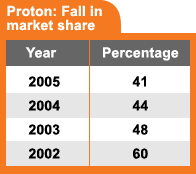 Proton used to sell six out of every 10 new cars in Malaysia - but sales have tumbled, from a market share of 60 percent in 2002 to 44 percent in 2004.
"To remain competitive, it's crucial that Proton comes up with a stream of new models," the analyst said. "This tie-up is one way to get new models out."
However, there is concern that the agreement does not involve an equity stake in Proton, an issue the Volkswagen deal is said to have collapsed over.
Mitsubishi held a 7.9 percent stake in Proton until 2004 when the Japanese firm sold its holding as part of a strategy to emerge from the red.
"Even with the previous arrangement... technology transfer was slower than expected until (Proton) bought Lotus to enhance its technology and engineering capabilities," TA Securities said in a research note.
Other observers have said that, this time around, Mitsubishi will be even more reluctant to share much of its technology as long as there is no equity participation.
Proton has said it will start jointly producing cars with Mitsubishi by early 2007. Analysts speculate the first model could be a multi-purpose vehicle, a segment yet to be explored by the state-controlled carmaker.
Proton has a manufacturing plant in northern Tanjung Malim capable of producing 300,000 cars a year. However, it is currently only producing 100,000 units annually.
A step backwards
Under the pact, Mitsubishi would transfer technical expertise to Proton and, in return, the national carmaker would allow Mitsubishi access to its facilities to expand in the Malaysian and regional markets.
But another analyst quoted by the New Straits Times warned that, "It will be a step backwards for Proton if it does the assembly of Mitsubishi cars again."
The opposition DAP has criticised the hastily arranged deal.
"Proton should be looking at carmakers with greater credentials in order to compete in the world auto trade," said the DAP's Ronnie Liu.
The carmaker should take a "bolder approach for its long-term survival," including allowing a "stronger carmaker like Volkswagen to take up a controlling stake," he said.
For Mitsubishi there are hopes the deal will help it expand in Malaysia, the biggest car market in the region. It is the only Japanese carmaker that has yet to set up plants in Southeast Asia.
The two firms are reviving a relationship which began in 1983 when Mitsubishi helped set up Proton, which rolled out its first car, the Saga, in 1985.
Proton, which was created as part of Malaysia's drive into heavy industry, has suffered at home amid stiff competition from Japanese and South Korean makes pouring into the increasingly liberalised market.
The collapse last month of the Volkswagen deal, seen as critical to the company's revival by ridding it of its reputation for cheap, unimaginative cars, caused Proton shares to plunge to their lowest in four years.


