




Family law is rock-steady, says Shahrizat
The controversy surrounding the Islamic Family Law (Federal Territories) (Amendment ) Act 2005 was due merely to "different interpretations" of provisions that, in principle, are sound laws that would protect Muslim women and children.
The controversy surrounding the Islamic Family Law (Federal Territories) (Amendment ) Act 2005 was due merely to "different interpretations" of provisions that, in principle, are sound laws that would protect Muslim women and children.
In defending the act, Women, Family and Community Development Minister Shahrizat Abdul Jalil described it as "rock-steady and Syariah-compliant" and was a vast improvement on the current, and differing, Syariah laws found in the various states.
"These laws, other than to standardise and streamline Islamic family laws throughout Malaysia, is meant to protect and promote the rights and interests of women, particularly in regulating polygamy, distribution of joint-property, maintenance, and improving the administration of the Syariah courts.
"Feedback received from the states that have enforced the Act have shown that the Act has positive effects if implemented well. You must accept that, (on the) one (hand) is the law, (the other) one is the implementation (of the law)," said Shahrizat.
"If you implement (the Act) according to the spirit and letter of the law, a lot of good would come out of it," she added.
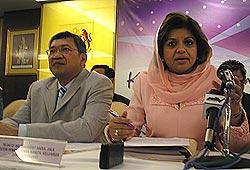 She said this in a press conference jointly held at her ministry in Kuala Lumpur with the Attorney-General Abdul Ghani Patail.
The bill was passed last December by the Senate despite an outcry over its provisions by women's groups that alleged that it discriminated and would be unjust against women.
According to Shahrizat, opposition to the legislation by women's non-governmental organisations (NGOs) was due merely to misunderstanding and misinterpretation of the proposed laws.
"Many of the problems raised pertained to interpretations that are not accurate and the (issue of proper) implementation of the Islamic family laws by the Syariah court. It is the question of who is interpreting and in what context," said Shahrizat.
"...It is not good enough to attain a degree of precision which a person reading in good faith can understand, but it is necessary to attain if possible to a degree of precision which a person reading in bad faith cannot misunderstand,'" said Shahrizat citing a 19th century case.
Although the act was not perfect, laws can never be perfect as law-making is a continual process of refining and perfecting, she said.
"We all aspire to reach that level of precision, but sometimes it's hard to achieve."
No conflict
Citing the issue of property jointly-acquired during marriage, many had expressed fears that the laws would lead, upon their husbands marrying another woman, to the loss of their own property, inherited property, and property given as gifts, said Shahrizat.
"Based on the findings of meetings between the AG and Syariah experts, the said laws do not conflict with Syariah laws. The interpretation of jointly-acquired property does not include (a woman's) inherited property, her own property, or property given to her as gifts," she said.
On this point, Abdul Ghani said both common law and Syariah-law provided for parties with a share to jointly-acquired property to claim their rights.
This was different, of course, to property that was owned or acquired solely by a woman, he said in response to a question from a reporter.
"So long as it's yours, it's yours," said the AG.
On the issue of 'grey areas' in the law, Abdul Ghani pointed out that there would always be differences in the application of legal principles.
"Beyond reasonable doubt, that's a grey area. Contempt (of court) is very grey. When you have concepts like that, you have fluidity," he said.
Shahrizat also said that contrary to claims that the Act facilitated polygamy, the Act would actually make procedures more stringent for men seeking an additional wife.
With this act, Syariah courts would have to summon the testimony of a man's present wife or wives, his future wife, his future father-in-law, and other "interested parties" to determine the ability and justice of the husband seeking another wife, she said.
Better protection
She also said the Act would provide for a division of jointly-acquired property in such a case where a husband seeks another wife, whereas women presently can only acquire such assets upon divorce or the death of her husband.
"(Women can now say) 'Ok, lah, you want to go and marry another one, I want my share now'. That makes sense, doesn't it? Instead, what is happening now, they go and marry and God knows what's going to happen to the property.
"'You want to remarry? Excuse, me - what is mine, you have to give it to me now,'" she said.
In relation to the case brought up by women's groups that a Syariah court in Johor had issued an injunction upon a wife's property that was not jointly-acquired with her husband, Shahrizat said it was isolated and should not be used to condemn the whole of Syariah laws.
"Investigations have shown that the said judge had erred in interpreting Section 107 (A). This case is an isolated case that cannot be used to judge the effectiveness and potentially positive effects of these laws," said Shahrizat.
Shahrizat also said she did not want to hear people claiming that her ministry had not acted sufficiently to protect and promote women's rights and interests.
The current Act was the product of many discussions between the Department of Islamic Development (Jakim), her ministry, and many other bodies and individuals since 2002, she added.
"Basically, we were not keeping quiet. We were very vigilant in our work, very responsible."


Are you sure you want to delete this comment?
This action cannot be undone.