


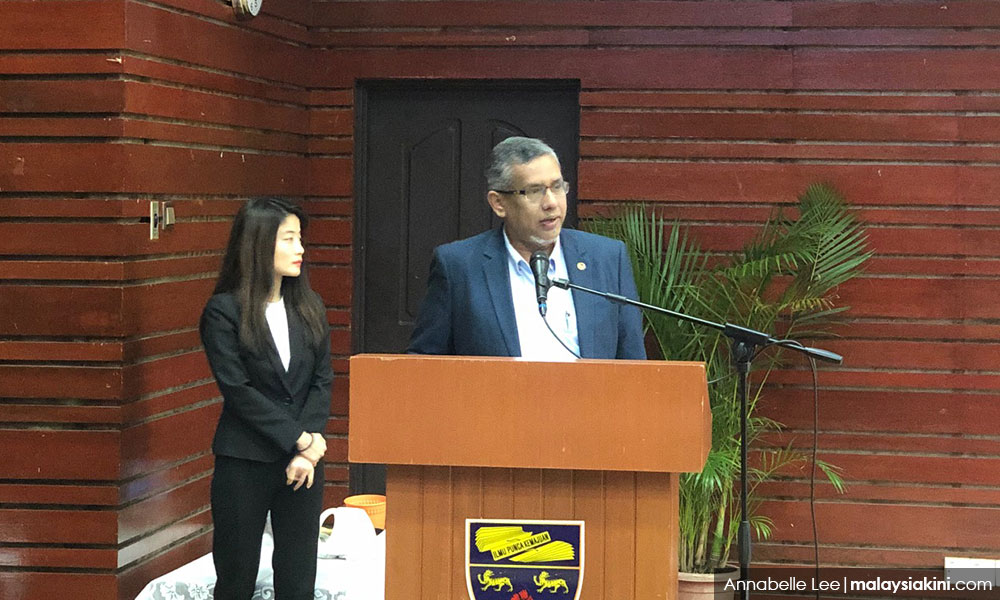

Abolishing mandatory death penalty allows time for education, says Hanipa
Rather than entirely abolishing the death penalty, the government opted for the less “drastic” step of removing the mandatory element to allow more time for public education.
Speaking at a townhall session in Universiti Malaya today, Deputy Minister in the Prime Minister’s Department for Law Hanipa Maidin added that the move was in line with Pakatan Harapan’s GE14 manifesto.
“We don’t want to have a drastic abolishment of the death penalty because we feel that the people are not ready yet. ...
Rather than entirely abolishing the death penalty, the government opted for the less “drastic” step of removing the mandatory element to allow more time for public education.
Speaking at a townhall session in Universiti Malaya today, Deputy Minister in the Prime Minister’s Department for Law Hanipa Maidin added that the move was in line with Pakatan Harapan’s GE14 manifesto.
“We don’t want to have a drastic abolishment of the death penalty because we feel that the people are not ready yet.
“In fact, when I met my counterpart in Australia, they were stunned when they heard we are going to abolish the death penalty. People in Australia took several years in order to educate people to abolish the death penalty.
“It’s not a 24-hour business, you need many years in order to educate people. We are in the process of educating people as to why the death penalty is not good,” he said at “Constitutional Carnival” organised by the university’s law faculty.
The government had initially planned to abolish the death penalty in full but backtracked following strong opposition.
Earlier this month, Hanipa announced that the mandatory death penalty will be repealed to allow judicial discretion for 11 criminal offences.
Today, he explained why Harapan had included abolishing the mandatory death penalty as one of its election promises.
“Actually, before we drafted the manifesto, we were approached by some judges. Some judges shared their plight in imposing the (mandatory) death penalty.
“Because we had the mandatory death penalty (at the time), it did not give the judges discretionary power to impose other punishments,” he said.
LGBT can seek court declaration
During the townhall, Hanipa was also asked to comment on whether the unequal treatment of LGBT people contradicted with Article 8 of the Federal Constitution, which guarantees equality for Malaysians of all genders.
He responded saying that aggrieved members of the LGBT community could seek legal redress.
“If the LGBT community feel that they are being treated unequally infringing Article 8 of the Federal Constitution, they have every right to go to court and seek a declaration.
“Go to the Federal Court or the High Court and seek a declaration that you are being discriminated against. That is the best way,” he suggested.
The former lawyer maintained that the community had a right to freedom of speech and should not be discriminated against.
“As a Muslim, of course, I have some reservations on the LGBT community but at the same time, we shouldn’t discriminate against them.
“They should be given an opportunity to voice out their grievances [...] They have freedom of speech and they can say anything so long they don’t promote any violence,” he said.
Earlier this month, the participation of pro-LGBT demonstrators at the Women’s March in Kuala Lumpur received intense criticism from Harapan and Opposition politicians.






Are you sure you want to delete this comment?
This action cannot be undone.