




Q&A: Soros on opening up closed societies
exclusive Renowned financier George Soros explains what drives him in supporting the global movement for an 'open society'.
Malaysiakini: You have invested a significant part of your wealth into promoting an 'open society'. What prompted you to do this?
I was born in Hungary in 1930 and I am Jewish. When I was 14, the Germans occupied Hungary and I would have been deported to Auschwitz and probably killed, if my father hadn't arranged for the family to take on a false identity. Later, I had a taste of a communist regime and I found it very stifling.
 I left Hungary and went to England, studied at the London School of Economics and I read a book by Karl Popper, 'Open Society and its Enemies', and it had a very big impact on me. I actually spent a year as his (student), he was my tutor during my last year of my studies. He said that fascism and communism have something in common. They have the recipe for a perfect society, and Popper argued that perfection is not obtainable.
We all act on the basis of imperfect understanding and all human constructs are flawed and therefore if you have the 'final' answer, you can only impose it by compulsion. And that's what causes a lot of grief. Since I personally experienced it, this made a big impact on me.
Following Popper - who was a philosopher of science - I developed my own ideas about fallibility and the concept of reflexivity and of course, the importance of an open society. This then guided me in my business as a participant in financial markets. I exploited the imperfections of those markets.
And then when I made enough money, I wondered what I should do with that money - why should I knock myself out making more money - and that's when I decided to set up a foundation to promote the ideas of an open society.
exclusive Renowned financier George Soros explains what drives him in supporting the global movement for an 'open society'.
Malaysiakini: You have invested a significant part of your wealth into promoting an 'open society'. What prompted you to do this?
I was born in Hungary in 1930 and I am Jewish. When I was 14, the Germans occupied Hungary and I would have been deported to Auschwitz and probably killed, if my father hadn't arranged for the family to take on a false identity. Later, I had a taste of a communist regime and I found it very stifling.
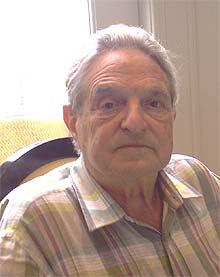 I left Hungary and went to England, studied at the London School of Economics and I read a book by Karl Popper, 'Open Society and its Enemies', and it had a very big impact on me. I actually spent a year as his (student), he was my tutor during my last year of my studies. He said that fascism and communism have something in common. They have the recipe for a perfect society, and Popper argued that perfection is not obtainable.
We all act on the basis of imperfect understanding and all human constructs are flawed and therefore if you have the 'final' answer, you can only impose it by compulsion. And that's what causes a lot of grief. Since I personally experienced it, this made a big impact on me.
Following Popper - who was a philosopher of science - I developed my own ideas about fallibility and the concept of reflexivity and of course, the importance of an open society. This then guided me in my business as a participant in financial markets. I exploited the imperfections of those markets.
And then when I made enough money, I wondered what I should do with that money - why should I knock myself out making more money - and that's when I decided to set up a foundation to promote the ideas of an open society.
How old is the Open Society Foundation?
I set it up in 1979, so it's now 26 years old. Well, it took me some years as an apprentice. Then in 1984, I set up a foundation in Hungary, which was then still under communist rule, and that foundation was very successful - unusually successful. The basic idea was the party-state ideology is false and any activity which offers an alternative to the party state ideology will reveal the falsehood of the party-state ideology. So the foundation supported any initiative which was outside the party-state.
The foundation became an institution supporting civil society and it was supported and protected by civil society. So it avoided many of the pitfalls that foundations suffer from we promoted civil society and the civil society protected the foundation against the misuse of funds, so we didn't need any kind of controls. So it was really a very positive and exciting experience, so that gave me the appetite to try to do it in other countries. We set up in Poland and in China, but usually when you have a good idea, you do too much of it and it turns into a bad idea and that is what happened in China.
But then the foundation in Soviet Union, which was set up in 1987, quite early and in other parts of the former Soviet Empire, they were successful, most of them, in helping build an open society. Then there was a revolutionary atmosphere, so the foundation network grew very fast, so my spending grew from US$3 million a year, to US$300 million a year. This was between 1989 and 1992.
I got very, very involved and I handed over the day-to-day management of my business to my partner and I worked on the foundations full-time. And then things calmed down, the foundations settled down and became more organised, and so I had a more balanced life. I spent some time in business, but I remained very much involved in the foundations.
Looking back, what do you think were some of the failures? What would you do differently?
Our biggest failure was in China, because we introduced some foreign ideas, they were not native to China, for instance we wanted to give grants on the basis of merit and not connections. And that was alien to Chinese tradition. In China, (there is) what I call the feudalism of the mind - if someone helps you, then you owe him allegiance and he or she also owes you allegiance, because you are a 'clique' a fiefdom, so that doesn't mesh with the idea of an open society. So it was an alien idea, and the foundation failed in China. I think it was a mistake to introduce that idea at that time in China.
Have you gone back into China since?
I have gone back. In 2001, I was invited to address China at a conference on China's future and that was reconciliation.
You speak of an Open Society and yet, in the context of the current global war on terror, we have seen countries like the US, Britain and other democratic countries reverse and impose more restrictions on civil liberties. Do you think the Open Society concept can be still practised in the context of the war on terror?
Let me clarify the Open Society concept. It was first used by Ori Backson, French philosopher, in his book 'Two Sources of Morality and Religion'. He argued that one of the sources was tribal allegiance and that leads to a closed society where you treat members of the tribe differently than those who are not members. The other is universal, where you have universal principles - human rights - where you treat all people equally and that is a foundation of an open society.
Then Karl Popper pointed out that some universal ideas can also be dangerous to Open Society, such as fascism and communism because they think they have the ultimate truth. So based on his ideas, I developed this frame work of open and closed societies, and was the framework that guided me in setting up the foundations.
(When) working in the former Soviet Union, I discovered that Open Society is not only threatened by strong states and repressive ideology but they are also threatened by weak states, failed states and disintegrating societies. So, I had to revise the concept. And to my greatest surprise, when (US President George W) Bush came to power, particularly when he declared his 'war on terror', I realised that Open Society can be endangered in the most established, most successful open society.
So the fact is the Open Society is always endangered because Open Society brings uncertainty, brings recognition that nobody has the final answer, that there are problems which don't have solutions and we have to live with them and learn from experience, and engage in critical thinking and come closer to reality that way, but we have to live with uncertainty.
 (However) people want to escape from uncertainty, and that's why they turn to a charismatic leader. Bush presented himself as such a leader and exploited and emphasised the fears generated by the terrorists to actually undermine the principles of Open Society and I discovered that American, the most successful Open Society, doesn't understand the concept of Open Society and doesn't abide by its principles.
Does that mean the concept of Open Society is not relevant? No. It just means that it is always in danger and commit ourselves, and choose an Open Society, democracy, market economy and so on, consciously and be willing to make some sacrifices to maintain it. And this has led me to take issue with President Bush.
Actually, it's not President Bush, it's (US vice-president Dick) Cheney who is the real evil spirit; (Defence Secretary Donald) Rumsfeld, and Bush are really puppets whose strings are pulled by Cheney. Just for simplicity, we call it the Bush administration.
Bush has now been re-elected. He will not contest the next election. What is your position on the US administration, now that Bush will be in power for the next few years?
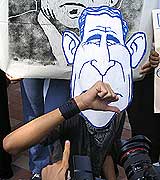 I think the fact that he was re-elected has led me to question what is wrong with America. I tried to blame Bush for all the mistakes in American policy, but the fact is his policies were endorsed and therefore now these are the responsibility of American society. American society has to recognise the mistakes that it has made and correct them, in the spirit of an Open Society and critical thinking.
One year after re-election, I think the majority of Americans now realise that going into Iraq was a colossal blunder, and public opinion has turned against Bush, his support has dropped. People in America have not realised the source - where America has lost its way - and this is with the war on terror. The war on terror is still accepted as the cornerstone of American policy and I'm trying to convince the American public of the error, of trying to deal with terrorism by waging war.
We reject terrorism because terrorists kill innocent people for a political goal, irrespective of whether the goal is justified or not. Killing people is a crime against humanity and cannot be accepted. But when dealing with it, we must not fall into the trap of doing the same thing as a terrorist and waging war inevitably claims innocent victims.
Waging war against terrorists is more likely to claim innocent victims because terrorists by profession, keep themselves hidden, (to make it) difficult to hit them. Then, waging war undermines the civil rights and balance of power and freedom of expression, which is characteristic of peace time. In wartime, you can suspend (these liberties) and that is in fact what the Bush administration has done.
For the concept of Open Society to work, you would need some sort of electoral system, to allow for people to vote in people in power. Instead, we now have a clash between America, its aspirations and its ability to be a hegemon. Its national interest takes the form of American hegemony. Currently there is no global government, no global election, to create an Open Society at the global level. How do we deal with this?
There can be no question of creating direct elections at the global level. That is unrealistic. Actually, global government would be difficult to reconcile with Open Society. You would just have one government and that would curtail freedoms which exist when you have multiplicity of governments. (For example), as an individual, if you feel oppressed in Hungary, you can emigrate to America. So, I am not advocating global government. But you do need international co-operation, to deal with problems, which concern all of humanity.
With globalisation, these problems have become larger and we don't have the mechanisms to deal with them. America, which is the dominant power in the world, has set the world the wrong agenda, because it has been pursuing national interests, instead of leading the world in dealing with issues of common interest. I argue that being the dominant power, the United States has a unique responsibility to pay attention to the interests of the world.
In the present world order, Washington calls the tune, but the rest of the world doesn't have a vote in Congress. So therefore, if America wants to retain its dominant position, it has to go out of its way to pay attention to the rest of the world, which does not have a vote in America.
But isn't that a contradiction? The American president is responsible to the American people, to American interests. How does he transcend that, to take into global interests into consideration? That is what is not happening.
Yes, that is not happening and that is what needs to happen if America wants to retain its dominant role in the world. I think that as a result of the Bush administration's mistaken policies, American dominance in the world is declining more rapidly than even I thought possible. In five years, America has lost tremendous amount of influence.
So the pursuit of American supremacy has had the opposite result. Instead of dominating the world, they are losing their legitimacy to lead the world. If you look at Asia, the East Asian Summit, the main thing that holds it together is that America is not part of it.
Former Malaysian prime minister Dr Mahathir Mohamad has also spoken about American hegemony a lot. Recently, he organised a global forum where he called for war to be declared illegal. In other areas, you also have similar views - the need to control financial speculation, hot flow of capital... How do you see Mahathir today, especially his push against the war on terror and for global peace?
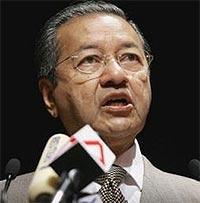 I didn't know Mahathir until he accused me of causing the Asian financial crisis. As you say, I agreed with him on how he responded to the financial crisis, more than I agreed with the IMF (International Monetary Fund) advice. So there are areas where we agree.
Dr Mahathir feels very strongly that Malaysia has been a victim of colonialism, and as a victim he ought to be careful not victimise others. I think Mahathir has made a great contribution to Malaysia's material development but like all great men, he has made some great mistakes. There are many areas where we think alike, and I'll be happy to engage in a dialogue with him.
Despite being Jewish and witnessing the atrocities against Jews during World War II, I understand that your position on Israel differs from the Jewish mainstream position. Would you care to elaborate?
It's a mind boggling problem. I think it takes two to tango, that both sides have to take responsibility for the conflict. This may rub up some of my co-religionists the wrong way, who think that it is our country, right or wrong. That attitude, to my mind, is contrary to the concept of an Open Society, which is meant to have universal values and standards.
Do you see the need to have a solution to the Israel-Palestinian problem, as part of the solution to the war on terror, and the larger tensions in the world today?
Definitely, and it cannot be a military solution, it has to be a political solution. And even (Israeli Prime Minister Ariel) Sharon who is responsible for some very severe repressive measures, has realised this. He was now leading the country to some sought of political settlement. Now that he is incapacitated, this process is in danger. But I think that it will continue even without him.
Do you have a candidate that you would support for the American 2008 presidential election?
I became involved in American politics because I felt that Bush was violating the principles of an Open Society. My interests is to re-establish those principles. And that requires that the present leadership of the Republican party has to be defeated politically.
Actually, the most important objective is to recapture the leadership of the Republican Party from extremists. American democracy is built on a two-party system - the two parties compete for the middle ground. But the Republican Party has fallen into the hands of extremists that has pulled it very far to the right, and Democrats have been trying to catch up with them, to find the middle ground. But it keeps moving further and further to the right.
First you had the promotion of business interests through market fundamentalism, and then you had the extreme promotion of national interests through military power, and that is what is endangering America and the world. You need to re-establish the Republication Party that seeks to capture the middle ground, instead of going to extremes.
Would you characterise the 'extremists' in the Republication Party as neo-conservatives?
Absolutely. It is difficult to identify the ideology that guides this extremist tendency because it's a composite - it has elements of market fundamentalism, religious fundamentalism and a belief in military supremacy. Those are the three main components of this coalition of extremists.
Among the American presidents that you have known, who would say was the best?
Probably (Harry S) Truman (the 33rd US president, 1945-1953).
I understand that you were in Timor Leste before you came to Singapore. Do you plan to do anything there, do you have a passion for Timor?
No, as a matter of fact, I am very reluctant to get involved in Timor because there are too many cooks. That makes it difficult, so my contribution would be not to become one of the cooks.
But there is one particular aspect where we can make a contribution - that is in establishing a Revenue Watch. East Timor is fortunate in having very large current and prospective revenues from oil and gas, and how those funds are used, needs to involve civil society.
Civil society needs to understand how the budget is made up and how it is spent. That is something that the foundation can help to do.
After Timor, I understand you went to Jakarta and Aceh, and then came here in Singapore. Could you tell me about your trip?
There is a foundation committed to strengthening democracy and Open Society in Indonesia, which I have supported since its inception, and I visited Tifa Foundation to see what they are doing. In Aceh, Tifa Foundation was very much involved, and the Open Society Foundation was also involved is providing assistance in dealing with the Aceh crisis. I was very much encouraged by the work of the foundation.
I came here to Singapore and here they seem to be more interested in my views on the market, rather then on Open Society.
You have just met with Singapore's Mentor Minister Lee Kuan Yew. I understand he has strong views opposing the idea of an Open Society? What was his response to your views?
 I think both of us have mellowed. While Singapore cannot be described as an Open Society, I think that we have to be rather moderate in criticising Singapore because no society is perfect. My definition of an Open Society as an imperfect society that holds itself open to improvement.
So Singapore made tremendous strides in 20 years, in material progress. While it is well short of perfect as far as civil liberties are concerned, one can argue that is the next area, where Singapore ought to focus for improvement. If you believe that no society is perfect, than you shouldn't be too harsh in your criticism. I have now dealt in many countries and I can tell you that are much graver issues of civil liberties in many of those countries.
What is your favourite movie of all time?
'Sunshine' - it's a very honest movie about three generations of Jewish assimilation in Hungary. It was made by a Canadian. It is a movie that really touched me personally.
What city do you like to live in?
I am very fond of London.


Report this comment
Are you sure you want to delete this comment?
This action cannot be undone.