




New water bills 'abandon' RM500m sewerage debts
More than RM500 million chalked up since 1997 as uncollected sewerage charges will not be shoved down defaulters' throats once the new water bills become law.
More than RM500 million chalked up since 1997 as uncollected sewerage charges will not be shoved down defaulters' throats once the new water bills become law.
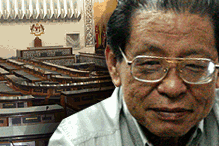
 Parliamentary Opposition Leader Lim Kit Siang said Energy, Water and Communications Minister Dr Lim Keng Yaik gave this assurance when briefing opposition MPs on the two water bills in Kuala Lumpur yesterday.
Quoting the minister, Lim said although the new law provides for the joint billing of both water and sewerage services, the collection of outstanding Indah Water Konsortium (IWK) charges will not be forced onto defaulters.
The law also allows for water supply to be disconnected if the IWK charges are not paid.
"The minister said the over RM500 million outstanding IWK charges going as far back as 1997 would have to be collected by other means," Lim said in a statement.
The Water Services Industry and the National Water Services Commission Bills 2005 are scheduled to be tabled next month.
From the time the draft proposals were made public late last year, a public debate has ensued over the veiled attempt at backdoor privatisation of water services management.
Under section 89(2) of the WSI Bill, he said the supply can be cut for non-payment of the water supplied, the supply services rendered, the sewerage services rendered and the deposit for both the services rendered.
"It would be most unacceptable if this provision in the proposed water legislation is used to compel collection of (the sewerage debts)."
Separate charges
Lim said he suggested separate bills for the two different services rendered by different licensees.
 The opposition MPs also wanted the preamble of the WSI Bill to clearly stipulate the policy of water as a human right and a public good, and to make it incumbent on the government to provide access to clear, colourless and odourless water in affordable and adequate quantity.
"As water service is a public service, countries like Uruguay and the Netherlands have pioneered legislation to make water privatisation illegal."
He said the discussion focused on privatisation, the composition and scope of the water forum, parliamentary oversight, compensation for poor customer service and transparency in the new mechanism once the laws come into effect.
The ministry has claimed credit for de-classifying the two draft laws late last year, and that it had led to an extensive consultation process involving 41 briefings, seminars and workshops with stakeholders.
Negligence ignored
In a related development, the Coalition Against Water Privatisation is demanding full disclosure of the government's 30-year concession agreement with Syarikat Bekalan Air Selangor Sdn Bhd (Syabas) signed in January last year.
 Referring to the recent 'smelly water' incident, coalition co-ordinator Charles Santiago (right) said the government should launch an immediate probe to determine responsibility and accountability.
"Was Syabas negligent?" he asked, noting that Syabas was responsible for providing drinking water in Selangor.
"It has been two weeks since that episode but the ministry and Jabatan Kawal Selia Air Selangor have yet to investigate the matter," he said in a statement.
"We therefore call upon the Cabinet Committee on Environment to investigate and take appropriate action against Syabas for supplying water that violated the standards set by the Health Ministry."
He said Syabas had clearly breached the government standard that requires drinking water supply to be clear, colourless and odourless.
The Malaysian Trades Union Congress has consistently opposed privatisation of essential services in any form and has taken an active role against water privatisation.


