




Can't get registered and recognised
What's in a name? Or as the Malay version goes, 'Apa ada pada nama'? Everything, if past developments in Malaysia are any indication.
What's in a name? Or as the Malay version goes, 'Apa ada pada nama'? Everything, if past developments in Malaysia are any indication.
A roundtable discussion on Article 10 of the Federal Constitution on freedom of association today showed just how much was riding on a name that is pitched for registration as a society or a political party, and which words red flag the authorities.
The cases of Parti Sosialis Malaysia (PSM) and Amnesty International Malaysia (AIM) who have been struggling for the past eight and 15 years respectively provide classic case studies.
 PSM
pro tem
secretary S Arutchelvan explained the role played by the word 'sosialis' in the application to be registered as a political party.
PSM
pro tem
secretary S Arutchelvan explained the role played by the word 'sosialis' in the application to be registered as a political party.
"We were told that it would take 4-6 months to register a political party although the Registrar of Societies client's charter clearly states that a four-month period provided all documents were in order.
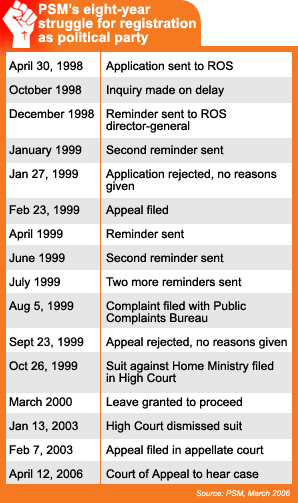 "Since 1994, 23 organisations have applied to register as political parties. Out of these, 11 were rejected without any reason, two were accepted while the rest were left in limbo," he said in his presentation in Petaling Jaya.
"In fact, ROS officials had advised us on a short-cut by taking one of the many shell parties that were going defunct and convert it by changing the name."
Fortune tellers
Criticising the wide powers granted under the Societies Act 1966, he said the minister "must be a fortune teller" to discharge his duties due to phrases like "absolute discretion" and "in his opinion".
The 1966 Act grants the minister and the registrar powers to junk an application if the society "appears" unlawful or "is likely" to be misused and hence, poses a threat to national security, peace, welfare, public order or morality.
"The amendments initiated by then prime minister Dr Mahathir (Mohamad) in 1981-1982 forced parties to make a clear stand on their political leanings.
"PSM is the first political party to take the home ministry to court on the issue of the right to association."
Quoting the opening remarks in the High Court, Arutchelvan said the judge cynically referred to the word 'sosialis' and said that "it must be the name... maybe they don't like your name".
"PSM is definitely not the first party and we won't be the last either. Many parties before us have been declared illegal because they don't share the same aspirations as the ruling party."
He noted that three political parties were formed within two weeks to totally eliminate Parti Bersatu Sabah's influence in the state following its withdrawal from the Barisan Nasional coalition in 1990.
Double standards
"The double standards are very obvious. For example, the Sabah Progressive Party was registered within 24 hours in 1994.
"Another example is when the High Court declared Umno illegal in 1988. Attempts by two former prime ministers to register Umno Malaysia failed but Mahathir and Ghafar Baba managed to register Umno Baru."
PSM's appeal against the home minister's rejection order will be heard on April 10.
The 30-odd participants at the half-day roundtable discussion on the freedom of association were also concerned about an uncertain future given the deeply oppressed state of the Malaysian society.
Stories abounded of how tertiary students to opposition parties and non-governmental organisations had been subjected to excessive bureaucracy and abuse of power in trying to get organised.
In reality, said Arutchelvan, the right to form an association was an executive power.
"It is not in the hands of the individuals, the programme, the members, the application forms or the rules and regulations. It's all in the hands of the minister."
He suggested that the registration process be simplified, that the Election Commission be made the registration body and to curb the excessive powers of the director-general of trade unions, education minister, human resources minister and the home affairs minister.
Use Suhakam
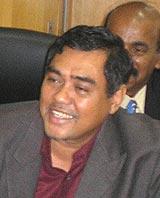 During the roundtable, Human Rights Commission of Malaysia public complaints and inquiry working group chairperson Prof Mohd Hamdan Adnan urged those who have been denied their rights to form associations to file their complaints.
"It is important to continue putting pressure on the authorities and reminding the relevant agencies. Many feel the present administration is more open but that must be put in writing," he said, adding that students should be allowed to register their own organisations.
From a legal standpoint, human rights lawyer Amer Hamzah Arshad said that if restrictions render rights ineffective or illusory, then it is unconstitutional.
"How can you say that by registering a political party that promotes social justice and democracy, the party poses a threat to national security? The courts must take a liberal approach when interpreting constitutional rights."
He said one way to overcome the impasse in registration was to mount more challenges against the authorities in court by filing for judicial review.
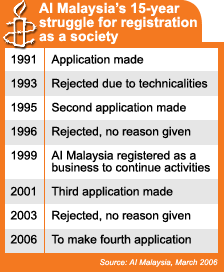 Amnesty International Malaysia executive director Josef Roy blamed the severe restrictions in the 1966 Act when outlining the 15-year struggle to be registered as a society. Not wanting to wait any longer, AI was registered as a business in 1999.
"But we're still trying to be registered as a society. We will be filing the fourth application by the middle of the year once we get all the papers in order," noting that only 100 out of almost 30,000 societies registered in 1998 were non-governmental organisations.
Forced into 'business'
To circumvent the restrictions, he said many had resorted to registering as businesses in order to continue with their daily and fund-raising activities.
"But registering as a business entailed problems of its own, one of which is the failure to get permits for foreign fund-raising and being slapped with accusations of operating as foreign agents."
Malaysian Trades Union Congress president Syed Shahir Syed Mohamud referred to the 30-year fight by workers in the electronics sector to get organised and recognised.
"Until today, the government has not ratified Convention 87. Furthermore, in this era of globalisation, corporate restructuring and changes in management or company names has become common.
"But it's not as easy for the trade unions because they can't keep changing names every time the company changes its name, such as six times in the Harris case, effectively forcing the union into redundancy."
The International Labour Organisation has repeatedly chastised Malaysia for not giving up executive control over trade unions by refusing to ratify the convention on the Freedom of Association and Protection of the Right to Organise 1948, better known as Convention 87.
The government has openly vowed not to bow to pressure from the world labour body.
The ILO recommendations were aimed at harmonising labour laws and international standards on freedom of association following a series of complaints from the MTUC over the last 15 years, but the government has ignored them.
Representatives of human rights movements and university students also shared the problems they have been facing in getting organised and registered.
PSM pro tem chairperson Dr Nasir Hashim gave the opening remarks while Malaysian Human Rights Society secretary-general Elizabeth Wong chaired the roundtable discussion.


Are you sure you want to delete this comment?
This action cannot be undone.