




Govt slashes taxes for foreign cars
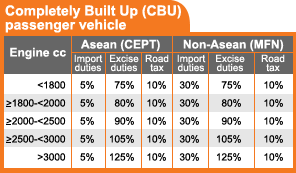
The Finance Ministry today announced that the import duties for cars assembled in the Asean region has been slashed from 15 percent to 5 percent.
The Finance Ministry today announced that the import duties for cars assembled in the Asean region has been slashed from 15 percent to 5 percent.
This applies to completely built-up (CBU) - fully imported - cars and will be effective immediately. Among the models involved include those from Toyota and Honda which are assembled in Thailand and several from Chevrolet which are from Indonesia.
 According to the ministry, with
this move
, the government had fully met its commitment to reduce the Asean CEPT (Common Effective Preferential Tariff).
According to the ministry, with
this move
, the government had fully met its commitment to reduce the Asean CEPT (Common Effective Preferential Tariff).
The move has been brought forward from the initial date of Jan 1, 2008.
The ministry has also streamlined and reduced excise duties for cars in a number of categories.
The difference in excise duties between vehicles with lower engine capacity and those with higher engine capacity has also been lowered, it added.
Also reduced is the excise duty for MPV (multi-purpose vehicles) and 4WD (four-wheel drive) vehicles.
Under-declaration problem
The ministry said that a study had been carried out to examine the problem of under-declaration of the net value of imported cars.
"Based on this study, the government has now fixed the value of new CBU vehicles for the purpose of paying import and excise duties.
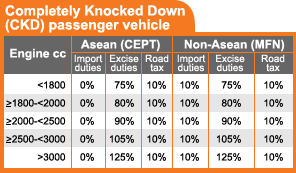 The CIF (cost, insurance and freight) value has been gazetted and will come into effect starting tomorrow, it added.
In another statement, the Prime Minister's Department said the government had decided to revamp the national automotive policy as the sector played an important economic role.
For this purpose, a cabinet committee has been formed chaired by Prime Minister Abdullah Ahmad Badawi.
The new policy, approved by the cabinet today, contained six objectives to be undertaken by the government to develop the automotive industry.
No new licenses
The government also said new auto manufacturing licences would only be issued after 'over-capacity in the domestic automotive sector was resolved'.
Vehicle assemblers in the meantime will not be allowed to use or make available their existing excess capacity to third parties to assemble new makes or models that compete directly with those produced by national car manufacturers.
"Where an increase in production capacity is required, companies in the high-volume and middle-volume segments will be encouraged to use existing excess capacity.
"New assembly facilities will only be allowed on a strictly case-by-case basis," it said.


Are you sure you want to delete this comment?
This action cannot be undone.