




Pak Lah losing his soul in IPCMC battle
If a vote was to be taken among Umno members of Parliament on the Independent Police Complaints and Misconduct Commission (IPCMC), Prime Minister Abdullah Ahmad Badawi would not get majority support.
If a vote was to be taken among Umno members of Parliament on the Independent Police Complaints and Misconduct Commission (IPCMC), Prime Minister Abdullah Ahmad Badawi would not get majority support.
This is the view of Opposition Leader Lim Kit Siang after the police top brass appeared to have successfully lobbied ruling Barisan Nasional MPs to oppose the controversial plan to set up the powerful police watchdog.
"In fact, I wonder whether Abdullah would be able to get majority support from Umno ministers in cabinet for the establishment of IPCMC," said Lim in a statement released yesterday.
 According to the opposition leader, Abdullah is "losing the fight for the soul of his premiership".
Two months ago, Abdullah had vowed that the government would set up the IPCMC, which is the major plank of the recommendations made by the Royal Police Commission.
The commission, which was set up soon after Abdullah became prime minister in 2004, submitted its final report last year with 125 recommendations to improve the operations of the police force.
The IPCMC is arguably the most powerful watchdog ever proposed in Malaysia.
Unlike existing agencies, it reports not to the prime minister but directly to Parliament, which ensures its investigations are made public.
However, Abdullah appeared to be losing the battle as members from his own party, having met with the top brass from the police force, came out to reject the IPCMC.
MPs turned over by police
Lim said that on last Monday - the first day of the current parliamentary sitting - police chief Mohd Bakri Omar gave Barisan Nasional MPs a night briefing and had succeeded in "brainwashing" them to "champion the police cause to oppose IPCMC".
According to the veteran politician, the move by the police and BN MPs to go against their top leader's stand on this crucial issue is "most unprecedented".
Yesterday in Parliament, Wan Junaidi Tuanku Jaafar (Umno-Santubong) and Razali Ibrahim (Umno-Muar) led the charge in lambasting the IPCMC.
The opposition, led by Lim, defended the IPCMC against the onslaught.
"I asked Wan Junaidi why BN MPs, particularly from Umno, are taking an open stand to break from the prime minister's support 'in principle' for the IPCMC proposal, only to get the lame answer that he had not heard the prime minister expressing support for IPCMC," said Lim.
"In my interjection, I noted that there was no objection from the BN and Umno MPs to the establishment of the Royal Police Commission in the past 26 months and to its 125 recommendations in the past 10 months, but everything changed after the police briefing for BN MPs 10 days ago."
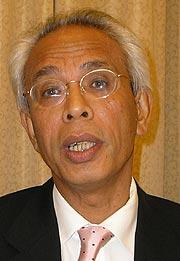 Barisan Nasional BackBenchers Club chairman,
Shahrir Samad
,
who had publicly declared his support for IPCMC, has today appeared to distance himself from his earlier stand.
Barisan Nasional BackBenchers Club chairman,
Shahrir Samad
,
who had publicly declared his support for IPCMC, has today appeared to distance himself from his earlier stand.
The fight over IPCMC has produced the strange spectacle of opposition party DAP, of which Lim is a key leader, to defend Abdullah against "the betrayal of his own backbenchers".
Don't backtrack, Pak Lah told
Meanwhile, the Police Watch and Human Rights Committee - a non-governmental body which monitors cases of alleged police abuses - has written a letter to Abdullah urging him not to backtrack on his promise.
"We are aware of the police lobby against the formation of the IPCMC which has been recommended by two royal commissions on the police. We do not have the resources to do the same, but we have faith in you...," said lawyer P Uthayakumar in the March 23 letter.
"Please do not backtrack on your promise to implement the IPCMC on or before May 31, 2006."
 Uthayakumar said that the discovery of two deaths under police custody over the past few days have highlighted the need for an independent police watchdog to be set up immediately.
"Monitoring the police force 'from within' has not worked all these years and neither has the Public Complaints Bureau, Disciplinary Unit in the police headquarters, Police Services Commission and Suhakam helped..." he lamented.
According to the Human Rights Commission (Suhakam), there have been 80 custodial deaths between 2000 and 2004 while only eight inquests were carried out.


Are you sure you want to delete this comment?
This action cannot be undone.