




Opposition front targets land issues
A new political grouping calling itself the Barisan Bersatu Sarawak (BBS) has offered itself as the alternative government to the state Barisan Nasional, and making land-related issues a key plank of its polls campaign.
A new political grouping calling itself the Barisan Bersatu Sarawak (BBS) has offered itself as the alternative government to the state Barisan Nasional, and making land-related issues a key plank of its polls campaign.
"We're not just an opposition front. We are the government-in-waiting," a spokesperson for the BBS said this morning at a press conference to loud applause from supporters.
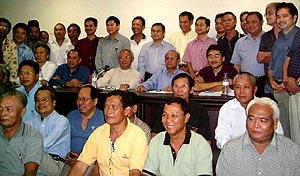 It has adopted a new land policy for Sarawak as the main thrust of its campaign strategy for the upcoming state elections, expected in May.
In the absence of access to the state-controlled electronic and print media, it intends to spread its message "'by making use of human resources".
BBS comprises Sarawak National Party (Snap), state Parti Keadilan Rakyat (PKRS), yet-to-be-registered Malaysian Dayak Congress (MDC), and members of the now-defunct Parti Bansa Dayak Sarawak (PBDS), as well as like-minded individuals.
Present at the press conference at Snap headquarters in Kuching were MDC pro-tem chairperson Nicholas Bawin, deputy chairperson Johnicol Rayong and information chief Joseph Tawie; PKRS liaison committee chairperson Wan Zainal Wan Sanusi; and Snap president Edwin Dundang, deputy president Justine Jinggut and secretary-general Stanley Jugol.
New land policy
Adviser Daniel Tajem, a former deputy chief minister and former PBDS president, told reporters that the opposition front - if given a mandate - would implement a land policy that guarantees the rights of the indigenous peoples as well as renewal of land leases for urban landowners.
He said the current land policy has created widespread concern among the people, especially native customary rights landowners, to a point that is "beyond tolerance".
 Tajem said a BBS government would set up a native land commission or native land tribunals along the same lines as in New Zealand to arbitrate on native customary rights claims, instead of burdening the courts as is now the case in Sarawak.
However, he said a BBS government would not force landlease-holder investor companies such as those in the plantation and agriculture sectors to return the land.
"Instead, we will ask them to negotiate with NCR landowners, if the leased lands include NCR lands, and reach an agreement that is mutually beneficial," he explained.
Asked about BBS' relationship with opposition party DAP, Tajem said: "We are on talking terms."
DAP will contest 14 Chinese-majority seats. Its state leader Wong Ho Leng said yesterday that the party would not field candidates in other constituencies.
'Change definition'
The BBS had earlier organised a seminar for more than 100 people, including branch leaders and potential leaders, so that they would be more aware of land laws and and administration matters.
Tajem pointed out that "land is the most important asset to the Dayaks", who have been the worst affected by the issuance of a larger number of provisional land leases to plantation companies throughout Sarawak.
"Land is a basic factor in Sarawak's economic development and land has been an issue for a long time," he said.
Very few titles, if any, have been issued especially to the Iban who live in rural areas. Under the current definition in the land policy, 80 percent of the Iban are deemed to be squatters.
During the seminar, legal experts Baru Bian, Paul Rajah and Dominique Ng gave briefings on Sarawak land laws and land-related cases now before the courts.
 Ng said the term 'state land' should be changed to 'people's land'.
"This is to reflect the original and traditional state and status of land in Sarawak - which is that the government has never owned land in Sarawak but holds all land in trust for the people of Sarawak," he said.
"Land should be made available to all landless and needy Sarawakian families. No Sarawak family should become squatters in their own land."
Ng said the BBS policy is that all land, especially of the residential category, should be issued with titles in perpetuity or for 999 years.
"All land currently under other lease periods should be automatically converted to titles with such leases, with no further payment of premium except for a nominal administrative charge."
Ng said the government should confirm or deny rumours that the rate of premiums for renewal of land leases would be based on a percentage of valuation on land taken with building(s) on it.
Even without the inclusion of valuation of building(s), the current approved premium rates are already very high at between 40-60 percent for residential land and as high as 70 percent for commercial and industrial lands in urban centres, he added.
TONY THIEN is malaysiakini 's Sarawak-based stringer.


