



Every day, two Bangladeshi workers die in Malaysia
SPECIAL REPORT | By the time Abdur Razzak passed his higher secondary school exam (HSC) in 2018, his future had already been decided.
Already in a cash crisis, his father had taken on high-interest loans and mortgaged his land to raise some 400,000 Bangladeshi taka (approximately RM20,000).
The money was to pay for Razzak’s passage to Malaysia, along with thousands of other labourers recruited under the Government-to-Government Plus (G2G+) agreement brokered between Dhaka and Putrajaya...
SPECIAL REPORT | By the time Abdur Razzak passed his higher secondary school exam (HSC) in 2018, his future had already been decided.
Already in a cash crisis, his father had taken on high-interest loans and mortgaged his land to raise some 400,000 Bangladeshi taka (approximately RM20,000).
The money was to pay for Razzak’s passage to Malaysia, along with thousands of other labourers recruited under the Government-to-Government Plus (G2G+) agreement brokered between Dhaka and Putrajaya.
Through a recruiting agency called Rabbi International, Razzak secured a job in Sindali Minerals Sdn Bhd and left for Malaysia last October.
It was his parents’ dream that their son would go to Malaysia, earn a good amount of money and send it home. With that, their loans would be paid, and most importantly, they would have food on the table.
But within four months, Razzak returned. He was dead.

His entire family was unable to accept the untimely demise of their son. His mother, who did not want to be named, broke down every time someone mentioned his name.
“The last time I spoke to him, he told me not to worry. He told me he would pay back all the loans and asked me to pray for him! And he was gone the next day.
“My son couldn’t bear the burden of the loans he took and now he’s dead!” the mother said, weeping.
Soon after Razzak’s passing, his father fell sick. Still, he visits his boy’s tomb frequently and weeps by the grave.
“He only went to Malaysia so he could fend for us. Even the medical tests said he was completely fit to go.
“And now my young boy is dead from a stroke! He was constantly worried because of all the loans he had to pay. These thoughts took his life in the end.”
The crippling toll of debts
According to documents signed by officials of the Bangladesh High Commission, Razzak died on Jan 27 this year, from oxygen deficiency and inflammation of the brain.
He is one of 96 Bangladeshi workers who died in Malaysia that month alone. Out of these, 51 died of strokes.
Since 2005, a total of 4,321 Bangladeshi workers have died in Malaysia, with the numbers growing over the years.
In 2012, 340 workers had died. By last year, that number stood at 736 workers.
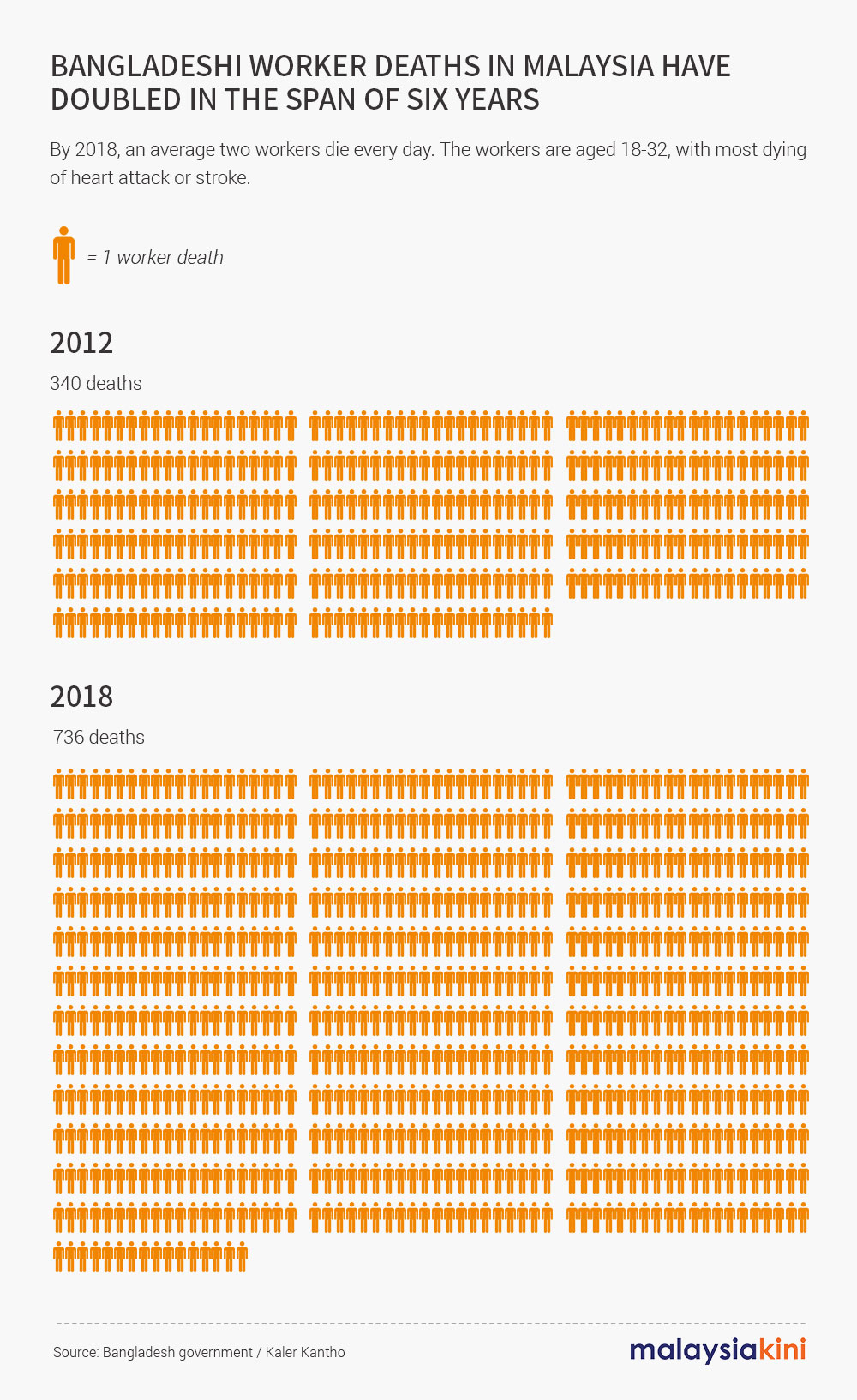
According to the Bangladeshi government’s Expatriate Welfare Desk assistant director Md Tanvir, 393 of his country's workers died in Malaysia from January to June 2019.
This means that on average, two Bangladeshi workers die every day in Malaysia. Most were aged 18 to 32.
Many of those men shared the same story of how high-interest loans at home took a crippling toll.
Mirazul Islam, hailing from Shibganj - bordering India to its North - left for Malaysia on the same flight as Abdur Razzak.
He said it was a mistake to come to Malaysia.
“I shouldn’t have spent so much money to come here. All I think about all day is how I’m going to pay off these loans.
The same worries had also plagued Razzak’s mind before his death, Mirazul recalled.
“He used to tell me always, ‘How am I going to pay off my debts?’
“The other day he wasn’t feeling well at work and said he had a bad headache. He began to sweat profusely, and when his supervisor heard he wasn’t well, he let him off work. He went home after that,” said Mirazul recalling Razzak’s last day.
“And soon after, my friend was no more.”
Passed around between firms
Razzak was also a victim of poor labour management, evident in a letter from the Bangladesh High Commission and an extensive investigation by Bangladeshi media Kaler Kantho.
READ MORE - BEING PASSED AROUND
Under the G2G+ Agreement, Razzak was recruited to work for Sindali Minerals in Perak, but when he died, High Commission documents showed that he was working at Fu Yin Furniture in Johor.
Interestingly, the High Commission document states that he was working legally. This was despite Malaysian regulations stating that workers can only work for the company named in their visa documents.
To further complicate matters, Razzak’s wages were not paid by Fu Yin or Sindali but by a third party company, as evident from his salary slips.
Like many other workers whose salary slips were sighted by Kaler Kantho, random deductions were made from his pay.

Nur Hossain from Lakshmipur had a similar story as Abdur Razzak's. He went to Malaysia at a cost of 350,000 taka (approximately RM17,570) through G2G+ via an agency called Al Islam Overseas in August 2017, and he was placed to work at a plantation owned by Felda Global Ventures.
Nur Hossain died of heart failure on Sept 7, 2018, at the age of 35. His body was eventually returned to Bangladesh on March 21 this year.
His wife, Rehana Begum, said like Razzak, Nur used to be worried sick about his debts.
“He was rarely sick when he was home. How are our children going to survive without him?” she said in tears.
So many young men dying of heart attacks?
Bangladesh’s Expatriates Welfare Ministry Wage Earners’ Welfare Board director, Gazi Mohammad Xulhaz, said what is shocking about these deaths is not just the volume but their causes.
“Men their age aren’t supposed to die of strokes or heart attacks, which are two of the prime causes of deaths among Bangladeshi expatriates.
“This is why we’re trying to put efforts towards helping these men become more aware of the laws of the country to which they’re migrating,” Gazi said.
There is a belief that the high immigration cost, coupled with exploitation in the Malaysian labour market, is driving these workers to an early grave.

But whether or not a heart attack and stroke are the actual causes of death remain questionable, said Refugee and Migratory Movements Research Unit chairperson Tasneem Siddiqui.
She said in some cases, family members suspect physical torture against workers, but this cannot be proven in the absence of a second autopsy when the body arrives in Bangladesh.
“Proper autopsy must be conducted on the bodies when they are returned. Reports here must be cross-matched with the reports in Malaysia.
“Only this can reveal the real causes of deaths,” Tasneem stressed.
TRAPPED AND TRADED
Part 1: Exposed - 'trade' in Bangladeshi workers, slave-like work conditions
Part 2: At RM4,000 a head, Bangladeshi workers juicy prey for brokers
Part 3: Every day two Bangladeshi workers die every day
Part 4: Migrant workers forced to live in jungle shacks after fleeing exploitation
Photo essay: Trapped and traded: The story of exploited Bangladeshi workers



Report this comment
Are you sure you want to delete this comment?
This action cannot be undone.