




Activist pushes for forum on Sabah's street kids
A well-known Sabah-based activist has proposed that a forum be organised in the state as soon as possible to discuss human rights and citizenship with the focus being on street children.
A well-known Sabah-based activist has proposed that a forum be organised in the state as soon as possible to discuss human rights and citizenship with the focus being on street children.
There are an estimated 10,000 street children in the state.
Patrick Sindu, who heads the Patriotic Citizens Forum on Identity Cards (Pacific), said he had proposed this to Human Rights Commission of Malaysia (Suhakam) vice-chairperson Simon Sipaun and commissioner Dr Hamdan Adnan.
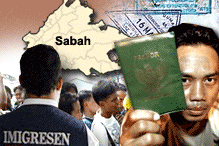 Sindu, who also helms the Consumers Association of Sabah and Labuan (Cash), said the forum, which he hoped would be held this month in Kota Kinabalu, was important due to the problems posed by illegal immigrants, especially the stateless children.
He said the response from Suhakam was positive.
Sindu had also proposed that state and federal government officials, especially those from the chief minister's department, home and internal security ministries and the immigration department as well as representative from various non-governmental organisations (NGOs) such as Tenaganita and the United Nations High Commissioner for Refugees (UNHCR) be invited.
"I have proposed that Sabah Chief Minister Musa Aman be invited to officiate the opening of the forum," he told malaysiakini.
Recently, the issue of Sabah's street children, mostly of Filipino descent, has been in the limelight after the Philippines refused to tack back a group of 65 children.
The 65 were among those held following a crackdown on illegal immigrants in the state.
Sindu said some of the street children were abandoned by their parents, who were issued with IMM13 passes, or left in the care of relatives in squatter colonies.
Various suggestions have been made by local NGOs on the best way to deal with the problem.
'Don't treat them like animals'
Sindu said the needs of the street children must be provided for such as proper living places, education and other amenities.
He felt that the UNHCR should do more to help the street children settle down.
"We don't want the street children to roam aimlessly and become street urchins and join criminal gangs and even go into prostitution.
"Neither do I want to seem them being treated like animals and put in cages," he said, referring to many undocumented street children being held in immigration holding centres.
"After all, they are also human beings, even though their country of origin may be refusing to take them back under one pretext or another," he added.
Meanwhile, a study carried out by Universiti Malaysia Sabah (UMS) lecturers found there were 3,879 squatter homes, occupied mostly by Filipino and Indonesian immigrants, in six zones in the Kota Kinabalu area.
There has been conflicting figures on the number of illegal immigrants in Sabah which borders southern Philippines and the eastern part of Indonesian Kalimantan.
The chief minister recently estimated the number at 100,000 but most locals, NGOs and academics disagree. Some quarters have put the figure as high as one million.
This has presented a problem when it comes to repatriation because the Philippines which still has a claim over Sabah does not maintain a consulate in Kota Kinabalu to process travel documents on the spot and is not keen to do so.


