




Sin Chew boss told to give up Nanyang stake
There is room for grave concern when four of the five Chinese dailies in this country are owned by the same person, said the Writers Alliance for Media Independence (Wami) today.
There is room for grave concern when four of the five Chinese dailies in this country are owned by the same person, said the Writers Alliance for Media Independence (Wami) today.
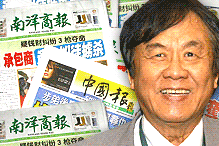 Wami was responding to the
report
that timber tycoon Tiong Hiew King recently acquired a 20.44 percent stake in Nanyang Holdings, making him the second largest shareholder in the publishing company.
Wami was responding to the
report
that timber tycoon Tiong Hiew King recently acquired a 20.44 percent stake in Nanyang Holdings, making him the second largest shareholder in the publishing company.
The Sarawak-based billionaire also owns Sin Chew Media Corporation which publishes Sinchew Daily and Guangming Daily . He also owns an English daily in Papua New Guinea and a Hong Kong-based Chinese newspaper.
Nanyang - which was taken over by political party MCA amidst widespread concern in 2001 - publishes Nanyang Siang Pau and China Press .
Reducing competition
"Few developments could be more detrimental to the media industry's freedom and competitiveness than when four out of five national Chinese dailies are owned by the same boss.
"Undoubtedly, this reduces diversity and competition in content, eventually harmful to both the media industry and public interest," said Wami in a statement.
In view of this, the alliance urged Tiong to relinquish all his shares in Nanyang. It also cast aspersions on Sin Chew's denial of having a hand in MCA's strongly opposed acquisition of Nanyang.
"Sin Chew has been frequently denying for the past five years its tacit collaboration with the MCA in the latter's takeover of Nanyang Press.
"Such a denial is feebler (now) than ever. As a matter of fact, Sin Chew Media Corporation seemingly no longer worries about public backlash," it added.
'Frog in a pot'
Wami argued that the laws which restrict media independence in this country nullifies any argument based on market logic behind Tiong's decision.
"The reality is that well-connected big players are often protected from new players and selective application of laws. It is not surprising that they have to pay back their favours by being the state's mouthpiece, hence creating political-business complexes in the industry.
"Insofar these big players need to compete amongst themselves for readership and advertisement revenues, they are conditioned by the market force to compete in professional and independent journalism. There is a conflict between the media's commercial interest and their political patron's partisan interest," it said.
Conglomeration and mergers, it added, reconcile this conflict by transferring the freedom to choose from consumers to the producers.
"Consumers are presented with monolithic products disguised with superficial differentiation. Agenda setting in media has never become easier. Such pseudo-market logic is therefore no lesser an evil to media freedom than overt political interference in news rooms," it said.
Wami said Tiong's acquisition of Nanyang Press shares had not raised too many eyebrows and this itself was an illustration of the dangers of media control through conglomeration.
The public has become insensitive to the consequences of an acquisition because the monopolised Chinese dailies have filtered information available to the readers.
"Like a frog swimming in a pot being gradually heated up, the public has shown little consciousness of a deepening crisis," it added.
Dangerous bedfellows
Wami said the danger of having media tycoons and political parties as bedfellows are enormous and cited several issues of public interest such as the language switch and the predicament of pig farmers in Melaka being played down by the politically-connected Chinese dailies.
It also noted instances of editors and columnists being axed upon orders from 'higher up'.
According to the writers alliance, the time is ripe to resound the anti-takeover clarion call of 2001 following the latest developments in Nanyang.
Wami is a group of writers for the Chinese media in Malaysia, which aims to defend and promote media independence for freer public discussion and wider democratic space.
It was formed by about 90 writers who quit writing for the mainstream Chinese media in protest of the Nanyang take over by MCA.


Are you sure you want to delete this comment?
This action cannot be undone.