




Highland Towers residents lose review bid
The status quo remains in the Highland Towers case as the Federal Court dismissed the residents' bid to review a decision to absolve the Ampang Jaya Municipal Council (MPAJ) of liability for losses sustained in 1993.
The status quo remains in the Highland Towers case as the Federal Court dismissed the residents' bid to review a decision to absolve the Ampang Jaya Municipal Council (MPAJ) of liability for losses sustained in 1993.
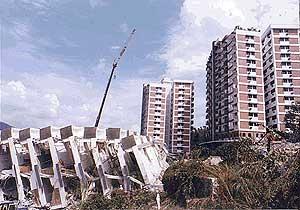
This means MPAJ will not have to pay compensation for loss of property due to the collapse of one block and the declaration that two adjoining blocks were deemed unsafe for occupation. In the incident on Dec 11, 1993, 48 people died.
It also means an end to a protracted series of legal suits by 73 residents of Block 2 and 3 to establish the parties responsible for circumstances leading to the incident and then to claim compensation.
 Federal Court judges Allaudin Mohd Sherif, Nik Hashim Nik Abdul Rahmand and S Augustine Paul unanimously rejected the residents' application, stating that there were no grounds to disturb the same court's earlier decision.
"The findings of the Federal Court are a question of facts and law, We may disagree with the facts but that is only a matter of opinion. That is not a ground for review," said Alauddin after hearing arguments.
On Feb 17, the Federal Court had allowed MPAJ's appeal to set aside the Court of Appeal's decision holding it 15 percent responsible in the pre- and post-collapse period for Block 1 of Highland Towers. Following this, the residents applied for a review of the decision.
This morning, counsel for the residents N Rajendra said there is a need to correct the judgment as it was to be deemed "unfair", based on "the flood of public dissatisfaction" as published in the media.
He argued that the court had wrongly assumed that the High Court trial judge had found MPAJ liable for failure to carry out work on the master drainage plan.
"This is a wrong assumption because in fact the trial judge found MPAJ had failed to ensure that its consultants prepared the master drainage plan as promised. There was no explanation as to why the master plan was never issued.
"What inference can we make? It shows that there is inefficiency on the part of the local council. Can this court condone such inefficiency?"
Attacking the judgment which had stated that allowing claims against MPAJ would open a floodgate, Rajendra said the MPAJ had statutory powers to ensure that landowners bear the cost of any drainage work.
"In the circumstances, the question of any possible pressure on the council's fund does not arise."
Doctrine of finality
MPAJ's counsel VS Viswanathan stated that the circumstances of the case failed to meet the strict requirements that would allow the court to review its decision.
"The Federal Court cannot review its decision unless it can be shown that the court lacked jurisdiction,...(that) unfair procedures were adopted and (there were) grounds of illegality," he said.
 In the present case, he claimed that all issues brought up had been addressed and that there was no error in the decision.
He said it was important for the court to preserve the "doctrine of finality" to avoid chaos in the administration of justice.
"The losing party may apply for review and there's nothing to stop the other party for filing another review to set the decision aside. It will go on and on and on," he said.
The MPAJ, formerly known as the Gombak District Council, had been found negligent by the Kuala Lumpur High Court in 2000 for circumstances linked to the collapse of Block 1. It was also found negligent in not doing its part to ensure Blocks 2 and 3 were stabilised and safe.
In 2004, a defendant, finance company AmFinance Bhd, settled out of court with 139 plaintiffs for RM52 million. The company owns the hill slope behind Block 1.
The MPAJ, which was assigned 15 percent of the liability, lost at the Court of Appeal in 2002 and appealed to the Federal Court where it succeeded.


Are you sure you want to delete this comment?
This action cannot be undone.