




Trust survey: Politicians at the bottom
If truth be told... Who would you generally trust to tell the truth?
It appears that few people believe what politicians, business leaders and government ministers had to say in public, a local survey conducted within the Klang Valley last year has revealed.
If truth be told... Who would you generally trust to tell the truth?
It appears that few people believe what politicians, business leaders and government ministers had to say in public, a local survey conducted within the Klang Valley last year has revealed.
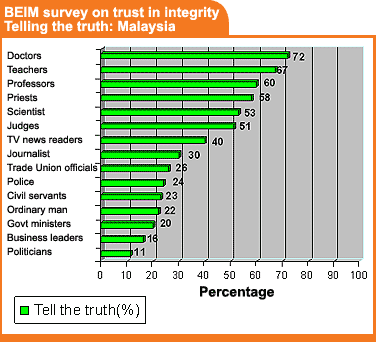
The opinion poll on 'Trust in Integrity', which replicated a UK survey format, found doctors, teachers and professors scoring the highest marks for their perceived honesty.
Trade union officials, the police and civil servants registered a marked difference, indicating that UK respondents had twice the degree of trust for these people compared to Malaysians.
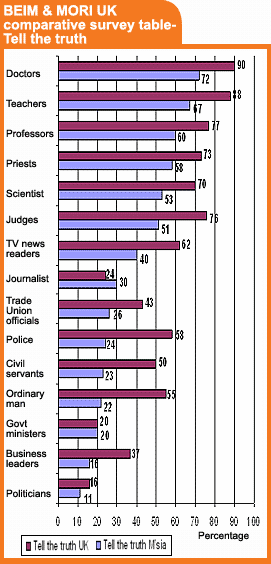 Clergymen in multi-religious Malaysia scored a surprise by ranking fourth after professors while journalists turned out to be the only occupational group to score higher than the UK survey out of 15 polled.
About 30 percent of the 2,000-odd Malaysian respondents trusted to tell the truth compared with 24 percent for their UK counterparts.
The local survey was done by the Business Ethics Institute of Malaysia (BEIM) in comparison with the latest of an annual poll by London-based MORI, a market and public opinion research group.
In the BEIM and MORI surveys, doctors scored 72 and 90 percent respectively, teachers 69 and 88 percent, and professors in third position with a score of 60 and 77 percent.
Politicians come last
However, business leaders in the UK secured a higher public trust by scoring 37 percent to rank 12th compared to locals who scored 16 percent at 14th position.
Although politicians were ranked last in both surveys, only 11 percent of Malaysians felt this group told the truth whereas UK politicians scored 16 percent.
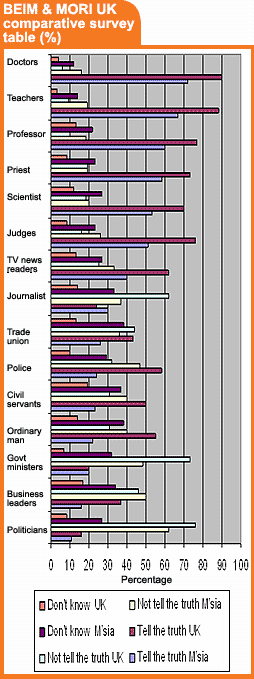
The local survey conducted between April and December last year offered 2,074 respondents within the Klang Valley three answers - "tell the truth", "not tell the truth" and "don't know".
The respondents included professionals, businessmen, civil servants, university students, company employees, pensioners, homemakers, self-employed and the unemployed.
 In releasing the findings yesterday, BEIM chairperson Dr Zainal Abidin Abdul Majid said the overall scores showed that local public perception of integrity was 17.7 percent lower that in the UK.
"The findings on the business leadership poses a concern because it has been rated second lowest. Our main concern is the public' distrust of business leaders and the lack of a code of ethics.
"The integrity of business leaders is obviously at stake which would affect public and investors trust in the way we do business," he told a press conference in Kuala Lumpur.
This, he said, warranted a further investigation into the reasons for the lack of trust in the business leadership.
Zainal said the survey was to create awareness among business leaders in complementing and enhancing the National Integrity Plan (NIP), the anti-corruption master plan Prime Minister Abdullah Ahmad Badawi launched in April 2004.
Ethical code
One way out, he said, was to make it compulsory for all companies to have a code of ethics.
"It must be made operational starting with the Board and the CEO," he said, referring to the ranking of business leaders a notch above politicians who came last on the list.
 "At the moment, there is no uniform policy requiring both government and businesses to adhere to good ethics because most businesses still lacked an internal code.
"We need a panel to monitor and enforce the code of business ethics so that a company's actions or decisions are in compliance with it."
Citing a poll by BEIM in 2004, Zainal said 71 percent of 150 companies then surveyed were found to have a code of ethics but he felt that "it is not a true representation".
"For instance, GLCs (government-linked companies) should seriously adopt a code of ethics to improve their performance. I know that a couple of GLCs do have one.
"Just look at how the MNCs (multi-national corporations) operate. A code of ethic is viewed as an asset for business progress."
He said public-listed companies should be required to submit a statement on the code of ethics to the Securities Commission, in addition to the prevailing requirement for a statement on corporate governance.
"We believe this is the first survey of its kind in the region, and comparable with the MORI survey after having achieved the target of not less than 2,000 respondents.
"This serves as a wake-up call for some of the occupational groups."
The BEIM, he said, held regular talks with state legislators, business bodies and government agencies but "more needs to be done in order for anti-corruption efforts to succeed".
 On locals' perception of journalists, he said: "I'm not sure why this is so. The coverage of the Iraq war in the UK may be one reason why their journalists were ranked lower."
Gifts are bribes
He also related how many in the public and private sectors still saw nothing wrong in offering or accepting gifts for services rendered.
"It is a bribe. The Anti-Corruption Agency is clear on it and the late Justice Tan Sri Harun Hashim had also said that any gift to a civil servant would amount to a bribe."
Zainal was hopeful that the indicators would prompt a more concerted action from all stakeholders including extending the survey nationwide as an annual affair if resources are secured.
Explaining the survey, he said forms in both English and Bahasa Malaysia had been distributed personally by BEIM officials through their contact network and by approaching people directly at shopping malls.
"The respondents comprised 28 organisations including four government departments. We received 15 faxed replies and 113 by post. No token of appreciation in terms of money or gifts was extended to the respondents.
"A total of 2,074 forms out of 2,100 were returned with 12 missing and 14 others rejected due to impropriety."
Foreign nationals were also excluded from the poll conducted between April 16 and Dec 23 last year in collaboration with Binary University College and University of Nottingham Malaysia.
The BEIM will submit the findings for further action to the Malaysian Integrity Institute as the coordinating and implementing body for the NIP.


Are you sure you want to delete this comment?
This action cannot be undone.