




Use economic leverage to persuade Burma
Asean should work with China and India to persuade army-ruled Burma to reform since the regional powerhouses have stronger economic leverage, the bloc's chief Ong Keng Yong said.
Asean should work with China and India to persuade army-ruled Burma to reform since the regional powerhouses have stronger economic leverage, the bloc's chief Ong Keng Yong said.
Ong said there was "certain impatience" among members of the Association of Southeast Asian Nations with Burma's foot-dragging on democracy but the grouping had limited leverage to pressure the junta.
 "Most of Asean believe that Myanmar authorities can only move forward if you have certain leverage applied on them," Ong told reporters as Asean foreign ministers began arriving on Indonesia's Bali island before an informal retreat today.
"The best way is to work with our neighbours who have better leverage with Myanmar. China and India have common borders with Myanmar," he said.
"They are also very involved in cross-border trade, in investment, in tourism and in other things," he added.
Burma is expected to be a key agenda item at the retreat in the cultural hill town of Ubud.
Ong chided the two regional giants late last month, saying Asean should ask them to be more persuasive towards Burma and there was little point in them being Asean's dialogue partners if they were not contributing on the issue.
Singapore's Foreign Minister George Yeo also said last month that China's and India's open policy on Burma diluted the impact of Western sanctions.
China is Burma's staunchest international ally and a major trading partner.
Certain impatience
Ong also said Asean was disappointed that Malaysia's Foreign Minister Syed Hamid Albar was unable to meet detained opposition leader Aung San Suu Kyi and junta leader Than Shwe when he visited Yangon last month.
"There is a certain impatience because the people around the region as well as around the world say, You keep talking, you keep going there - and then what happened?" he said.
"People want to see some concrete steps forward."
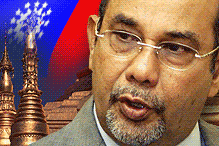 Syed Hamid briefed the ministers about his Burma trip at a working dinner last night. His Burmese counterpart Nyan Win also gave a rundown on the visit.
Speaking to reporters upon his arrival in Ubud, Syed Hamid said he was "not totally happy" with progress in Burma.
"There are still more things to be done," he said. "Our intention was to engage with everybody. So, since we were not able to, in that respect you can see that."
But he said he was given an opportunity by the Burmese junta "to express our views quite openly on behalf of Asean."
Clear timeframe
Thai Foreign Minister Kantathi Suphamongkhon said he was also "disappointed" with the results of Syed Hamid's visit.
"What we would like to do is to see movement in Myanmar toward national reconciliation with a good and clear timeframe," he told reporters.
 "We would like to encourage Myanmar to interact with Asean so that we can together move ahead and we would like Myanmar to be able to participate fully with the work of the international community," he added.
Burma agreed at last year's Asean summit to invite Syed Hamid in the face of growing international pressure for evidence of its democratic progress, as well as embarrassment among some members over its 1997 inclusion in the bloc.
Asean ministers are due to discuss a charter for the bloc which could give it muscle to deal with wayward members like Burma.
Burma's military regime has spelt out a "road map" for democracy, including talks on a new constitution. But Aung San Suu Kyi's party has boycotted the process, which critics have called a sham.


