




EC: Papers are destroyed six months after elections
Electoral rolls are destroyed six months after each election and the Election Commission (EC) is unable to determine whether any impersonator had turned up and voted in the past using the names of other electors, including the deceased.
Electoral rolls are destroyed six months after each election and the Election Commission (EC) is unable to determine whether any impersonator had turned up and voted in the past using the names of other electors, including the deceased.
EC secretary and chief registrar Haji Kamaruzaman Mohd Noor said this today in response to questions at a press conference relating to newspaper reports about a deceased elector whose name still appears on the electoral rolls although she had died three decades ago.
Only election papers like ballot papers would be kept for election petition purposes otherwise they would have been destroyed six months after the conduct of an election.
The election rules have been altered recently to enable the EC to destroy such records one month after an election if they are not required for election petition purposes, Haji Kamaruzaman said.
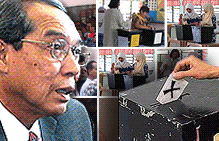 Under amended election rules announced earlier this week by EC chairperson Abdul Rashid Abdul Rahman, the EC clerk will no longer be required to write down the serial number of voters on the counterfoils of the ballots..
He said neither could the EC expunge the name of any deceased elector from the roll if it had been not been notified by the National Registration Department (NRD) of the death.
The EC is linked by an integrated information system called 'Alice' to the NRD.
Story in Borneo Post
In a headline story, the Borneo Post , quoting Mohd Amin Jenal, nephew of the deceased elector in Sibu, said the late Sadiah Taha, who would have been 108 years if she is still alive, passed away in 1975.
Her name as well as those of her three other relatives, all deceased, still appear on the electoral roll.
Mohd Amin's daughter Sapiah Amin, 68, said the decased's name has not been removed from the voters list although the EC had been informed 'numerous times' of her death.
Independent election watchdog Mafrel's Sibu-based monitor Ong Boon Keong, together with several reporters and the late Sadiah's family members visited the graveyard with the tombstone and her name in Jawi inscribed on it.
 The
Borneo Post
also published a photo of the tombstone with Ahmad Shah, one of her grandchildren, standing besides it.
The
Borneo Post
also published a photo of the tombstone with Ahmad Shah, one of her grandchildren, standing besides it.
Asked what steps would the EC take to ensure that no one else would be allowed to vote in the name of the deceased voter, Haji Kamaruzan said candidates' agents could lodge a complaint on the spot against anyone impersonating as voter.
He said impersonation is an offence for which anyone found guilty could be jailed and fined.
The question of deceased voters as well as the high percentage of voters on the rolls without addresses have become a contentious issue between the EC and Mafrel which has carried out a verification exercise of the electoral roll covering Kuching, Sibu, Bintulu and Miri.
EC says the electoral roll is clean and Mafrel argues it is not, with examples of deceased voters still on it, the exceptionally large numbers of registered voters at certain addresses in urban centres and large number of voters without addresses.
Haji Kamaruzaman, in a response to a question, also said he is not aware that certain political parties have been using suraus for campaigning in violation of the Code of Ethics 6.1G which disallows such activities.


Are you sure you want to delete this comment?
This action cannot be undone.