




Auto sector can't survive alone, says Najib
Malaysia's auto industry cannot survive on its own and manufacturers must join forces with strong foreign partners able to open up export markets, Deputy Premier Najib Razak said today.
Malaysia's auto industry cannot survive on its own and manufacturers must join forces with strong foreign partners able to open up export markets, Deputy Premier Najib Razak said today.
Najib said that despite the government's efforts to promote change, it would continue to support the industry which is struggling to adapt to a new era of deregulation and competition from foreign imports.
"We shall not simply tear down the protective barriers and immediately throw our national automotive industry to the wolves of unbridled competition. We have developed this industry at great cost and great effort," he said.
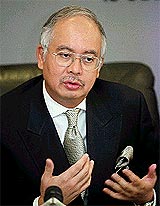 "What is clear, however, is that to continue indefinitely with a policy of shielding our domestic market ... is not a viable long-term strategy," he said in a speech to an automotive conference.
"The solution is to have a powerful foreign partner (who) will open the door for Malaysian-made vehicles to its own larger markets."
His comments apparently referred to struggling national automaker Proton which has had difficulties striking a deal with a foreign partner. Negotiations with Germany's Volkswagen have collapsed and Peugeot Citroen denied rumours of an alliance.
Meanwhile, its Malaysian competitor Perodua is 51 percent owned by Japanese small-car maker Daihatsu Motor and up-and-coming rival Naza is working with Peugeot and South Korea's Kia to bring out new models.
Need to go abroad
In a new blow for Proton, industry figures showed that Perodua has established a convincing lead over its "big brother" Proton, with a 44 percent market share in April against 30 percent for Proton.
Najib said this development should encourage Proton to lift its performance and showed that Malaysian manufacturers should redouble their efforts to crack the export market which they have so far failed to penetrate.
"It is obvious that they need to go abroad. The local market is the biggest passenger (car) market in Asean but it is not enough (to sustain us)," he said.
The influential deputy premier said Malaysia wanted to transform itself from a national car producer into a regional automotive manufacturing hub but foreign expertise was needed to do that.
"In return for this ... the foreign partner will ... have access to the large and fast-growing Asean market, which is expected to reach 2.0 million new cars and light commercial vehicles (annually) by 2010."
Proton's market share has fallen steadily in recent years due to the whittling away of import duties and a persistent reputation for poor quality and unimaginative models.


Are you sure you want to delete this comment?
This action cannot be undone.