




Q&A: My criticisms are constructive
exclusive In this second part of the interview, 82-year-old Dr Mahathir Mohamad talks about PM's sons getting into business and politics, and press freedom.
Malaysiakini: Let's talk about famous sons. At the end of your premiership, you advised your sons to divest their business interests. Why did you do that?
Mahathir: I did not ask them to divest. It's just that I have always stopped them from doing any business with the government. They can do business. I've never stopped them from doing business. But no business with the government, no candidature. People came to ask me to nominate my son as a candidate for parliamentary seat. I said, "No. Not while I'm prime minister." I didn't want to give the impression that I'm creating a dynasty.
exclusive In this second part of the interview, 82-year-old Dr Mahathir Mohamad talks about PM's sons getting into business and politics, and press freedom.
Malaysiakini: Let's talk about famous sons. At the end of your premiership, you advised your sons to divest their business interests. Why did you do that?
Mahathir: I did not ask them to divest. It's just that I have always stopped them from doing any business with the government. They can do business. I've never stopped them from doing business. But no business with the government, no candidature. People came to ask me to nominate my son as a candidate for parliamentary seat. I said, "No. Not while I'm prime minister." I didn't want to give the impression that I'm creating a dynasty.
But as far as business is concerned, they can do business, (but) not with the government. Because of certain things, they actually go abroad to do business. They do business in India, they do business in other countries because Malaysia is a very 'hostile' environment for them. I made it 'hostile', but I didn't stop them from doing business.
What about the situation regarding the son of Abdullah Ahmad Badawi and his son-in-law, Khairy (Jamaluddin)?
 As a matter of principle, when I was prime minister, I did not allow my children, or my wife, to be involved in business with the government. My wife, certainly not - no business at all. This is a matter of principle for me. The children can do business, but not with the government. This is a general principle. This is not only here. I mean, every country does this. If you allow your children to get business from the government, then people will not take kindly to that.
Would you advise the present prime minister to follow suit?
That is up entirely to him. I don't advise (him), but this is a general principle I'm talking about. So, I follow the general principle.
During your time as prime minister, looking back over 22 years, do you regret any of your economic decisions? In hindsight, what would be different? How would you do it differently?
The only problem I got was in getting Malay participation, bumiputera participation. They abused everything that we gave them, except for a few. A few have done well. But those that have done well immediately become labelled as my cronies. If they fail, nobody notices them. They may be my brother or my father, or whatever, if they fail, they are not cronies. But if they succeed, they are cronies. In fact, I have relatives of mine who until now are not on talking terms with me because I refused to help them in any way. But that is my problem.
As to the so-called mega projects, they are not mega at all. Is the Penang Bridge a mega-project? It's not even enough.
You build Subang Airport for 400,000 passengers way back in 1964 - I remember attending the opening ceremony. For 400,000 passengers. By the time we moved to KLIA (Kuala Lumpur International Airport), Subang was handling 14 million passengers, 30 times more. Now you want to build a new airport for, what, 20 million people? Already, now we are handling 21 million. In three years time, we are going to handle 25 million people.
So, when you want to build something, don't build for the present. Build for the future. So KLIA has the capacity to handle 125 million passengers with five runways. It may happen in the year 2100. But if you do a small project, you know how difficult it is to find land for an airport anywhere in the world? Heathrow (Airport in London) spent 15 years trying to decide on the fifth terminal. But planes are coming in, so you have to design for the future.
I made Putrajaya, yes? It's not for me. It's for the future. In fact, I had planned to resign in 1998. Had I resigned in 1998, I wouldn't (have gone) to Putrajaya at all. But it doesn't matter to me. And the house for the prime minister, because the incoming prime minister, I thought, was going to have six children, so I built six rooms, not for me. This is for the future. We would like to have, for the residents there, like a White House, (or) a No 10 Downing Street, or whatever. Not, whenever you change prime minister, you change residence because it's not big enough.
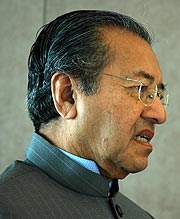 So build everything for the future. They are big. So what? We can pay for it. The government is not bankrupt because of what I spent. When you build something, it generates wealth. When you keep money under your pillow, it's not going to grow. It's going to shrink because cost of living goes up, purchasing power goes down. But if you spend money, every dollar that changes hand, somebody makes money. That's the whole idea about stimulating the economy. Whenever the economy is down, I purposely give money away, give bonus to the government servants, but not too much so that he can go to Haadyai (in Thailand). Give him half the bonus so that he can spend it here, to stimulate retail trade.
You stimulate retail trade, you stimulate also wholesale trade, transportation, everything, somebody gets money all the way. People don't seem to understand that when somebody spends money, somebody else makes money, and when the government spends money, lots of people, contractors, suppliers, workers, even the nasi lemak people make money. If you keep your money, what happens to these people?
Do you think that cronyism has stopped with the new administration?
Well, you can make your own judgement.
You mentioned that some people abused the privileges for bumiputeras. Do you think that this abuse was because there was lack of measures to hold them accountable so that they don't abuse these privileges, including press freedom and other things, to make sure that whatever benefits there are actually go to the majority?
We try as much as possible but we cannot be looking over everyone's shoulder. When we wanted to have these Class F (contractors) people and we said, "OK, you build computer labs." And you know what happened. They abused it. There are hundreds of them. You know how many Class F people there are? There are 40,000 of them. How can you look over their shoulder all the time? The people who look over the shoulders also need somebody to look over their shoulder. So, it's a very difficult proposition.
We try, but I'm quite sure we cannot succeed 100 percent. I believe that if you do something and you achieve even only 10 percent success, in the case of the bumiputera, I think it is good enough. I wish we could achieve 90 percent success, but these are a people with a culture that, somehow or other, does not fit in with the free-market system. They use money as a convenience. You don't have to carry a bag of rice to go to the shop to change. You put money into your pocket and you go and change it into goods. To them, money is not capital. Money is a convenience. So, we have a problem.
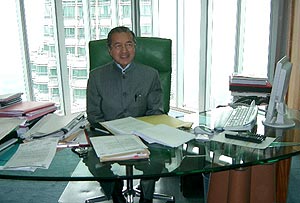 About press freedom. There is press freedom. I don't know what you mean by 'press freedom'. Is it the freedom to say things, to agitate people, to get people to demonstrate, to get people to fight each other, then, sorry - you do that, we take action. But we have very few occasions where we have to take action, (where) we have to warn you.
But when you say, 'I'm doing this, no criticism is allowed,' that is taking away press freedom. I have been reading (on) my first few years as prime minister, and the number of criticisms against me and the number of times I've had to answer these criticisms because of my Look East policy, my Islamisation (policy), my (DRB-)Hicom (policy), all these things were subject to press criticism. A lot of people criticised me, and I spent a lot of time explaining why I'm doing these (things). So you suggest that I don't allow for criticism?
Yes, you criticise me, so you must give me the freedom to criticise you. At the same time, of course, if you want to criticise, be constructive. Give the alternative. What is it that we can do? If you say, 'No, this cannot be done, that cannot be done, this and that cannot be done,' but what can be done? You see? It's not something that can contribute to growth, towards development, if you just say no to everything. This mega-project, don't have it, that mega-project, don't have that. Did you know these mega-projects saved us during the financial crisis?
What about the situation now, you've been complaining that you haven't been getting enough press, that you've been blacked out, that things are not being reported.
I consider my comments as being constructive. That's number one.
Number two, I'm not stirring up racial hatred. I'm not trying to cause any violence in this country. Those (stirring up racial hatred), during my time, you do that, sorry, we'll take action against you. But if you make criticisms against me, I was prepared to accept.
There was an article - I was reading just now, because I was looking at some of the old papers - it said, 'You want to criticise, but be constructive. You criticise something, it's fine, but (when) you start saying 'Well, look at the Chinese, they have no rights in this country, the Malays are given...' That kind of thing is likely to stir up the Malays against the Chinese. You do that, I'll have to come down hard on you.
But a lot of the criticisms are quite constructive...
In your view. Not in my view. You think it is quite constructive, but I don't think so.
Then again, the present government may think that your views are not constructive...
That's OK. When you do something that is so obviously wrong, like surrendering your sovereign right to another nation, I merely comment on that - that cannot be published? I'm not stirring up hatred against anybody. I'm not even stirring up hatred against Singapore (and saying) we should go to war with Singapore, or something like that.
You've always challenged the US on its hegemony. It goes back to the question of a level-playing field. The US decides on what is a 'level-playing field'. In Malaysia we have so many laws, such as the Printing Presses and Publications Act, the OSA (Official Secrets Act) and the ISA (Internal Security Act) which the opposition says create an unbalanced playing field. How do you feel about this? Is it fair?
Well, at least we have laws. The US have no laws. They detain people without any laws. They detain people for any length of time. They don't give any information on the people they detain. When they are not in our situation, it's fine to talk about freedom of this - no (to) detention without trial - and all that. When they are assailed by the same problem, less than us, just a minor problem to them because they are such a huge, powerful country with all the guns and nuclear weapons and all that, they take action without even any regard for the law. So I have a right to criticise.
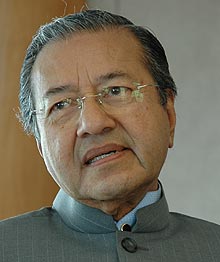 In this country, there is the ISA. It's there. We have gone through many parliaments, we have gone through many elections. Nobody has rejected us because of the ISA. Even Anwar (Ibrahim) did not object when he was in the government. Of course, now he objects-lah. But when he was in the government, he was quite happy about it. Why not [...] detained some people who were against him. So when we are going to do something, OSA, ISA, PPPA, whatever - these are laws that were there before my time.
The OSA, maybe, during my time, but that was because people were actually stealing papers from the government to give to some people. For example, if somebody makes a proposal to do something, they duplicate that thing, and suddenly, you have five to 10 different proposals coming from different people because somebody has sold the application. We had to stop that.
So the OSA was never meant to allow for corruption or to hide government secrets?
Not (to) hide government corruption, because government corruption, if you have the proof we cannot run away from it. But you make just casual accusations against people based on hearsay, we cannot act. You must be fair to people.
I am accused of corruption, all the time. Look at me, I am very rich, I have thousands of houses all over the place, I'm a millionaire. That's how you made me out when I was prime minister, this corrupt prime minister. I have to put up with that.
Tomorrow - Part 3: Mahathir on Umno and Anwar
Part 1


Are you sure you want to delete this comment?
This action cannot be undone.