




Public perceptions of press freedom
Dr Mohd Ramzan, 43, has something in common with Simon Wong, a 54-year old clerk.
They do not know one another but share strong views on the state of press freedom and are against unreasonable controls over the media in Malaysia.
Dr Mohd Ramzan, 43, has something in common with Simon Wong, a 54-year old clerk.
They do not know one another but share strong views on the state of press freedom and are against unreasonable controls over the media in Malaysia.
Their meeting of minds came about during interviews done in conjunction with a street poll on press freedom perceptions among the public, conducted by a team of malaysiakini trainees from May 22-25 in Kuala Lumpur and Petaling Jaya.
The 120 respondents varied in their responses as to whether press freedom is important to them; if they are influenced by the media; if they are aware of recent government actions against the media; and if they agree with those actions.
Mohd Ramzan of Kuala Lumpur was all for press freedom but pointed out that the media should report with a sense of responsibility and sensitivity to "cultural and religious feelings".
 "I am hardly (influenced by news) from the mainstream media, on certain issues. But alternative media reports are usually not convincing enough in providing concrete evidence," he said in response to the second question.
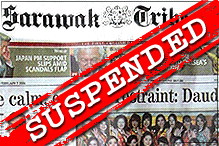
He was aware of action against the Sarawak Tribune for publishing Danish-originated caricatures of the Prophet Mohammad, but was of the opinion that the newspaper got off with a "light reprimand".
"The paper insulted (Islam)... (press) freedom must be in accordance with guidelines," he added.
Wong said press freedom is important for the truth to be revealed and that the press should be free to "correctly present the true facts to the public".
"The reporting of events, opinions expressed by columnists and photos published can all influence the readers," he said.
He too was aware of the reasons for the revocation of the Sarawak Tribune's publishing permit, but disagreed with the action against it.
"The excuse that negative reporting could jeopardise social peace and harmony can't be applied as readers are mature enough to judge what is right or what is wrong," he said.
The majority of those interviewed felt they have the right to know the truth. Since they rely on the media for information, they were against censorship of news and controls by the government. A minority said the media has little influence over them.
These are selected responses by the 55 percent of 120 respondents who said they are aware of press freedom issues.
What is press freedom?
Editor Ashok Kumar, 62: The public should get used to the freedom they have and not abuse (it).
Homemaker Jameelah Koya, 42: The press should be given the freedom to tell the truth without fear or favour, but there is no absolute (freedom).
Director Julian, 44: (Press freedom is) the ability of reporters to question public servants without risk to themselves. And to report news without being influenced by the government.
How does the media influence you?
Bank officer Zulkifli, 29: I'm not really influenced, it depends on the issue published. If consumer-related type of information, it would influence me.
Educator Sunita Selvaraj, 33: When it 's provocative or new, I find myself being more influenced.
 Can you remember any recent actions against the media? Do you agree with the actions?
Student Ong Mei Kying, 27: I agree with the government's action over Sarawak Tribune , because it will prevent any violence on discomfort to any party, especially on religious issues.
Factory engineer Azmi Bindin, 33: I agree with the government closing down Sarawak Tribune - the media must be aware of the sensitivity of Malaysians of different races.
Housewife Pritam, 57: No, I don't agree (because I felt that) Sarawak Tribune was doing a good thing to let the public know (the reason for the controversy the cartoon caused in several countries).


Are you sure you want to delete this comment?
This action cannot be undone.