




Pre-empting Mahathirs next move
After maintaining his 'elegant silence' for a few days, Prime Minister Abdullah Ahmad Badawi has announced that the "relevant ministries and agencies" would reply to the questions raised by former premier Dr Mahathir Mohamad in the latter's public criticisms against him. This could be interpreted as another round of success for Mahathir.
Given his previous predicament of being blacked out or obscured by the mainstream media, Mahathir had succeeded last week in breaking out on the media front.
After maintaining his 'elegant silence' for a few days, Prime Minister Abdullah Ahmad Badawi has announced that the "relevant ministries and agencies" would reply to the questions raised by former premier Dr Mahathir Mohamad in the latter's public criticisms against him. This could be interpreted as another round of success for Mahathir.
Given his previous predicament of being blacked out or obscured by the mainstream media, Mahathir had succeeded last week in breaking out on the media front.
True, there was a seemingly 'outpouring' of criticisms and condemnations of him in the mainstream media, notably the New Straits Times , for "interfering" into the Abdullah administration and also "destabilising" his own party Umno.
However, for the veteran and self-made politician who had also witnessed - and probably engineered - many such 'outpours' of criticisms and condemnations against his opponents and critics while he was in power, the intended psychological effect on him seems to be practically nil.
In real-life politics, the worse a politician could suffer is actually not 'bad' publicity but a media 'blackout'.
After all, a media blackout means that sooner or later, the people will forget about the person. Bad publicity at least acknowledges one's existence and value as a worthy opponent to someone or something.
Turn 'bad' into 'good'
And when one's existence and value is acknowledged, the 'bad' could be turned into 'good' if one is smart enough to negatively exploit the inefficiency and credibility problems and over-zealousness of one's opponents, their strategists and propagandists, and also to positively argue to promote one's virtues.
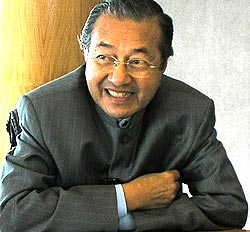 Seen in this light, Mahathir first round of success contains three dimensions:
- His existence and value as a politician is now widely acknowledged in the media, both domestic and international;
It is true that, initially, there were many hostile reactions to Mahathir and his public criticisms against Abdullah as people compare the two personalities and their characters.
It is also undeniable that Abdullah has a more amicable and likable image than his predecessor and this is what the former's media operatives and spin doctors had been attempting to project or exploit by portraying a picture of a 'good' man being 'bullied' by a 'bad' guy.
'Badly-performing' PM
However, that strategy of painting a picture of 'good' Pak Lah being 'bullied' by 'bad' Mahathir seems to have reached its limits when the prime minister's over-zealous media operatives and spin doctors overdid it and ignoring one new reality.
That is, although Abdullah is still likable as a person, his track record as the premier on many vital current issues such as police indiscipline and brutalities, insensitive neo-liberal economic measures such as the drastic increase of petrol and electricity prices as well as corruption, nepotism and cronyism in politics and the economy have caused his popularity to plunge considerably in the eyes of the people since the 2004 general election.
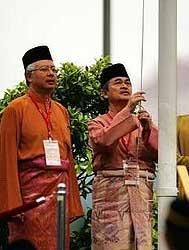 Meanwhile, while Mahathir's past errors and mistakes are still widely acknowledged, a body of public opinion has grown suggesting that the current issues of public interest he has raised such as the government decision to scrap the "crooked" or "scenic" bridge, the sale of Agusta, the issuance of Approved Permits (APs), and the termination of Proton Holding Bhd chief executive officer Tengku Mahaleel Tengku Ariff's service contract, etc, deserve answers from Abdullah.
At this stage, the over-simplistic propaganda of 'good' Abdullah being 'bullied' by 'bad' Mahathir has ceased to win the hearts and minds of the people for they now see a more complicated picture of a 'good' man who is also a 'badly performing' prime minister.
Although some members of the ruling elite have been circulating the term "elegant silence" to shield Abdullah from the pressure of being held answerable or accountable to the points raised by Mahathir, other less glorious interpretations of Abdullah's silence have also developed and been circulating in the civil society, such as:
Why the 'elegant silence'?
- Mahathir is vocal for berani kerana benar , and Abdullah has to maintain silent for takut kerana salah ;
Abdullah has actually communicated with Mahathir privately without the knowledge of most of his advisers, strategists and propagandists (some of them are alleged to be lobbyists for foreign capital and other foreign interests) who try to isolate him (Abdullah) from more disinterested advisers and critics for their own exploitation and manipulation.
Given those conflicting views on the situation, it is not wise or prudent politically for Abdullah to maintain his silence on the points of current and public interest raised by his predecessor.
Now that Abdullah's posturing of "elegant silence" has been abandoned, the next question is whether the new strategy would or not further embolden or encourage Mahathir and his supporters to further pose more and tougher questions or supplementary questions publicly, in the name of public accountability, that strike at the core of Abdullah's fragile and not very coherent power base?


Report this comment
Are you sure you want to delete this comment?
This action cannot be undone.