


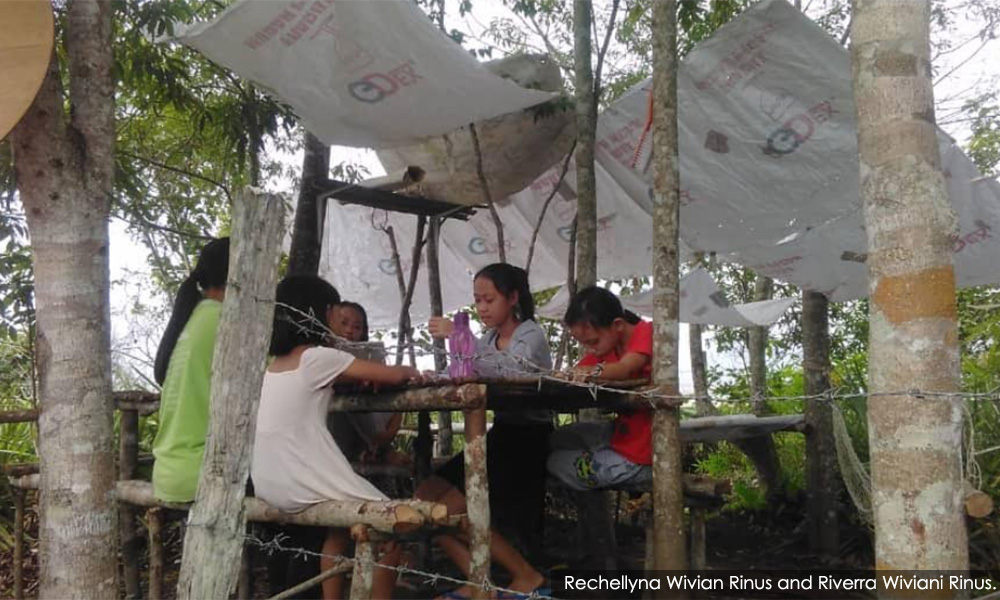

Sabah teens build hut in clearing to keep up with online learning
Having online classes from the comfort of their bedroom during the movement control order (MCO) is a dream come true for many students. But for those in Kampung Bomboi, Sabah, the digital divide means this dream is far from reach.
SMK Keningau students Rechellyna Wivian Rinus, 17, and her sister Riverra Wiviani Rinus, 15, are among the many children who are not able to access the Internet from their homes.
To continue with their studies, they walk 600 metres daily to a clearing at a farm near the edge of their village regardless of the weather, as the area is the only part of the village with strong enough 4G connectivity for online classes.
"Even if it rains or if it is hot, we have to put up with it. All this, so that we have full attendance," said Riverra.
When they first started doing so, the sisters said they had their classes standing up with their single shared laptop placed on a piece of wood. The unconducive environment prompted them to find ways to make the area more comfortable.
With their uncle’s help, they took three days during the beginning of the MCO to build a makeshift hut at the clearing using pieces of wood and plastic sacks.

Today, the hut they call "Puru Online" is used by Riverra (photo, right), her five other younger siblings and a few other children in the village for their studies. Those who do not have electronic gadgets can also come to the hut to share the resources with those who do.
"Puru means jungle (in Kadazandusun language). So Puru Online means 'welcome to the jungle online'," Riverra said.
A video the sisters produced showing how they built Puru Online was uploaded on YouTube and now has more than 12,000 views.
Puru Online is one of several examples of students in rural areas struggling to keep up with online learning during MCO.
These stories began to surface after University Malaysia Sabah student Veveonah Mosibin caught the public's attention when she recorded how she had to spend 24 hours on a tree to access the Internet to sit for an online examination.
Veveonah has since been awarded a scholarship while the Malaysian Communications and Multimedia Commission (MCMC) announced plans to install a telecommunications tower near her village to ensure 4G connectivity.
Malaysiakini also reported how students in Pakan, Sarawak camping in plantations or even jungle clearings to attend online classes.
Not a long-term solution
Even though Puru Online is an improvement from their previous predicament, the children who use the hut still struggle for a conducive study environment, said social activist Angie Chin-Tan, who is assisting the Rinus girls.
The hut does not have walls to keep the rain out while the children have to continue burning egg cartons to keep mosquitoes at bay. They also have to bring their pet dogs along to protect them from dangerous wild animals.

Puru Online’s founders said although they are adapting to the difficult situation, they know it is not a long-term solution.
“We make do where needed, but this is not a long term solution. We wish for better infrastructure and accessibility to be put in place as we too will want access to education just like kids in city areas,” Riverra said.
The children’s plight has also caught the attention of Beyond Pitas, a non-governmental organisation group working to address needs of rural communities in Sabah, and Chin-Tan who are working with the sisters to raise funds to improve the study conditions at Puru Online.
They aim to raise RM25,000, which will also be used to help other rural students in the same predicament, in villages in Sabah, including Membakut, Kudat, Pitas, Kota Marudu and Semporna.
A Sabah native, Chin-Tan said she started the fundraising campaign because she understood the challenges imposed due to the digital divide.
“Not being able to have quality education just because of a student’s geography is a serious issue and has to be addressed immediately by the relevant authorities,” she said.






Report this comment
Are you sure you want to delete this comment?
This action cannot be undone.