




Bridge saga: Point-by-point rebuttal
Former premier Dr Mahathir Mohamad's ex-aide Matthias Chang has issued a point-by-point rebuttal to the documents declassified by the government over the crooked bridge issue.
In a lengthy email communique today, the lawyer argues his case.
Former premier Dr Mahathir Mohamad's ex-aide Matthias Chang has issued a point-by-point rebuttal to the documents declassified by the government over the crooked bridge issue.
In a lengthy email communique today, the lawyer argues his case.
Agreement to build the bridge
Fact
Goh Chok Tong wrote on April 11, 2002:
 "Between a new bridge to replace the entire causeway, and one to replace just the Malaysian side of the Causeway, I like the former better. Once the new bridge is completed, the Causeway can be knocked down, which I prefer to be done after 2007. But if you wish to proceed immediately to replace just your side of the Causeway with a bridge, I shall accept it, though I think this is not ideal."
Conclusion
This is an express agreement and recognition by Singapore of Malaysia's right to build a bridge "just your side of the Causeway," that is to say the right to build a "half bridge" within Malaysian territorial waters.
This is an agreement in writing signed by the then prime minister of Singapore and accepted by the then prime minister of Malaysia via an exchange of letters. Exactly, as Lee Kuan Yew wanted in his letter of Aug 24, 2004.
In law and in fact, agreements can be oral, and or part oral and part in writing. In this case, it was in writing. I am sure well-informed personalities like ( New Straits Times group editor) Brendan Pereira would not dare venture the argument that an agreement cannot be concluded by way of exchange of letters.
Fact
Singapore by way of a diplomatic note purported to "revoke" the said agreement in 2004. Fuzi Abdul Razak, the former secretary-general of the Foreign Ministry, said in his press statement:
"Singapore later further explained in a diplomatic note dated Nov 29, 2004 that the agreement by the then Singapore prime minister was made in the context of the then ongoing negotiations between the two governments as an overall package of bilateral issues."
Conclusion
Singapore has admitted that there was an agreement on the building of the half-bridge.
Fact
Singapore aborted the said agreement on the grounds stated above.
Conclusion
Malaysia need not accept Singapore's grounds for repudiating the said agreement for the half-bridge. Whether Singapore can repudiate the agreement is a legal issue which can only be resolved through international arbitration.
That is why Mahathir said that if Singapore remains intransigent, Malaysia should refer the matter to international arbitration.
This dispute does not in any way affect the sovereign right of Malaysia to build a half-bridge within the territory waters of Malaysia and which has been expressly recognised by Singapore in the letter written by Goh Chok Tong (April 11, 2002).
The Malaysian government is more concerned in accommodating Singapore's reasons for repudiating the agreement than asserting its rights to build the half-bridge.
The stand taken by the government is simply - Singapore's views are always right and proper. Malaysia cannot and should not challenge Singapore's views.
This was the stand taken by the government after the expos that Malaysia had agreed to sell sand to Singapore. This is still the stand of the government as disclosed in the press statement issued on July 15.
Package approach rejected
 Fact
Fact
Mahathir by a letter dated Oct 7, 2002 gave notice that he will discontinue the package approach. He wrote:
"I think we have now come to a point where it would be important for us to prioritise our discussions. The approach that both sides had adopted so far in dealing with outstanding issues in a package has not yielded any meaningful results. In view of this, Malaysia has now decided to discontinue the package approach and to give the highest priority to first resolving the long-delayed water issue, particularly the price review of raw water."
Goh Chok Tong in his letter Oct 14, 2002 replied:
"Since you now want to deal with the water issue separately and discontinue the package approach, these trade offs are no longer possible. And as the package deal is off, I have instructed my officials to deal with water and other issues individually and separately, on their stand-alone merits, and no longer as a package."
Conclusion
All issues are now to be treated on their "stand-alone merits." This does not distract from the fact Malaysia has a sovereign right to build a half-bridge within her territorial waters and that Singapore has previously acknowledged that right.
Therefore, in any future negotiations for the building of a full bridge or a half-bridge, the parties have agreed not to link other issues as have been done in the past. Pak Lah after taking over as prime minister continued with this single issue approach when he explained his diplomatic approach as "plucking the ripe fruit first".
Fuzi in his press statement dated April 25, 2006 explained further Pak Lah's approach as "pluck the low hanging fruit first, and then move on to the higher ones on the trees."
In the latest round of negotiations, Singapore had been very cunning, and did a back-door mini-package approach for which the Malaysian team was so stupid to accept.
Fact
As a result of our incompetence, Malaysians cannot even pluck low-hanging fruits from the trees within the territory of Malaysia. We need to get permission from Singapore, notwithstanding Singapore's acknowledgment of our sovereign right to pluck our fruits in our orchard.
Conclusion
It is pathetic that our government is willing to kow-tow to Singapore.
 Fact
Fact
If as alleged, the attorney-general's (AG) legal opinion was that "Malaysia was required to obtain prior approval of Singapore's Public Utilities Board (PUB) in relation to the alteration of the water pipelines necessitated by the construction of a bridge, whether it is a full straight bridge or a scenic bridge (half-bridge)," then we the Malaysian public demand to know why the government informed Malaysians the following, namely:
( NST , Feb 3, 2006) - Foreign Minister Syed Hamid Albar said: "Malaysia's position all along was that it had every right to do anything within its territory. As such, the proposed scenic bridge was never part of negotiations between the countries. The one that is under negotiation is the full bridge. If we need to do the other one (scenic bridge) we do not need to talk to Singapore."
Conclusion
It is nice to know that as at Feb 3, the foreign minister who is a lawyer by training shares my view as stated in the preceding paragraphs:
Fact
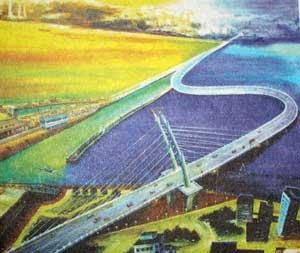
( NST , Feb 7, 2006) - Syed Hamid Albar: "We will continue with whatever work needs to be done on our side. It is Malaysia's right and sovereignty, and Singapore has recognised that. Why should we involve other people in works that are done in our territorial waters and on our own land? Construction on the scenic bridge is within our jurisdiction. It is not part of our discussions with Singapore. We have made ample preparations and held discussions with all parties including project contractor, GPSB (Gerbang Perdana) on the design of the bridge."
 NST
also reported that the contractor, GPSB had been directed by the Public Works Department (PWD) to resume work on seabed studies in the Johor Straits, which have been shelved since 2004.
NST
also reported that the contractor, GPSB had been directed by the Public Works Department (PWD) to resume work on seabed studies in the Johor Straits, which have been shelved since 2004.
Conclusion
Once again the foreign minister shares my view that Singapore has indeed recognised Malaysia's sovereign right to do whatever work within her territory waters.
Fact
( NST , Feb 25, 2006) - Workers have begun soil test at the Johor Straits where the scenic bridge is to be built. Technicians were today seen driving piles into the seabed from a barge anchored near the causeway'.
( NST, March 3 , 2006) - Foreign Minister George Yeo said the republic had explained the matter through a third party note. "We have explained to Malaysia the serious implications of a unilateral move to demolish its side of the causeway and replace it with a crooked bridge, however scenic."
(NST, March 4, 2006 - Syed Hamid Albar is perplexed as to why Singapore is harping on "implications" if Malaysia went ahead and built the scenic bridge to replace the causeway. The foreign minister insists that the construction of the scenic bridge was never a negotiating factor with Singapore as it was within Malaysia's territory and rights.
"That is why the talks only centred on a full bridge. The scenic bridge is for us to decide, not anyone else. I was of the idea that negotiations were going well. Now I want to know if Singapore is even serious or sincere about negotiating with us. We made a pact to conduct negotiations away from the glare of the media, so when Singapore sounded like it was threatening Malaysia with an ultimatum on the scenic bridge, I'm curious to know what is actually going on."
( NST , March 10, 2006) - The scenic bridge on the Malaysian side of the Tebrau Straits is expected to be operational from April 1, 2009. Deputy Works Minister Mohd Zin Mohamad said five percent of the preliminary work has been completed so far.
"We have set aside a buffer zone which will be two meters before the international boundary. This means the bridge will join the Malaysian side of the causeway just before the boundary."
Conclusion
This rebuts the spin that if Malaysia builds the half-bridge, it will be "hanging" in mid-air if Singapore refuses to allow the bridge to be "connected" to the Singapore side of the causeway.
Fact
( NST , March 13, 2006) - Malaysia had agreed in principle to build a bridge to replace the causeway. The agreement was reached at the conclusion of the fifth round of negotiations between senior officials from two countries in Putrajaya.
Foreign Minister Syed Hamid Albar who confirmed this, said an official announcement on the accord could be expected soon. "We have agreed on the main points of agreement for the building of a full bridge."
The negotiations had all along been based on the principle of quid pro quo with Singapore wanting the right to use Johor airspace for training flights by its armed forces jets. The republic in addition, had sought a long-term concession for the supply of sand from Johor for its massive on-going coastal land reclamation work. Malaysia apparently acceded to both these requests.
Conclusion
Malaysia, instead of negotiating on "stand-alone" basis agreed to a mini-package deal, abrogating all previous agreements on rejecting the "package approach" and selling sand to Singapore. Therefore the factor that clinched the deal was Malaysia's sell out to Singapore on the issues of sand and airspace.
'This is our right'
 Fact
Fact
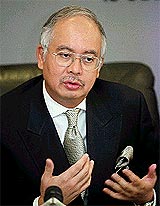
( NST , March 18, 2006) - Deputy Prime Minister Najib Abdul Razak said as Malaysia was committed to building the bridge on its side of the border in the Tebrau Straits, Singapore should join hands to make a full crossing. Referring to Singapore's threat to take Malaysia to the international tribunal for the Law of the Sea should it unilaterally break the causeway, Najib said it was Malaysia's right to build the bridge in its waters.
"This is our right. Nobody can question or deny us this right as a sovereign nation. The government is committed to building the bridge."
Conclusion
This statement is most peculiar especially after the statement of Syed Hamid on April 13. It implies that even Najib was not in the loop and was not briefed properly on the developments. Why this reaction? The right hand does not know what the left hand and or any other "hands" are doing.
Fact
( NST , March 22, 2006) - Syed Hamid said negotiations were done on the mandate given by Prime Minister Abdulah Ahmad Badawi and the cabinet. The minister revealed that three options were on the table for the replacement bridge - a full straight bridge, a full scenic bridge and a scenic bridge - the last one in the event that Malaysia did not get Singapore's cooperation. Pending the approval for a full bridge, Malaysia has started work on the scenic bridge, which was expected to be operational in 2009.
 Conclusion
Bearing in mind the alleged legal opinion from the AG referred to at the beginning of this discussion, was there a different legal stance now. When did the AG give his alleged opinion? If it was way back, why did the government ignore his legal advice? Why did the PWD give a work order to the contractor to recommence work? If the legal opinion was given after the government encountered problems with Singapore, why didn't the government come out immediately and say so? Why the cover-up?
Something is not right and until today, the government and Pak Lah have refused to explain to the public. Instead they indulge in spin and propaganda, demonising Mahathir for asking the right questions for and on behalf of the rakyat.
Fact
( NST , March 22, 2006) - Construction of the bridge to replace the Johor causeway is proceeding on schedule although talks between Malaysia and Singapore are continuing, Deputy Prime Minister Najib Abdul Razak said yesterday.
"There is no postponement. Construction of the bridge is proceeding," the deputy prime minister said.
Work on the scenic bridge on the Malaysian side, costing RM620 million is expected to be completed in 36 months.
Conclusion
The government is telling the rakyat that we are holding fast to our rights to build the scenic bridge (half-bridge). Who is telling the truth? Pak Lah, Syed Hamid or Najib? Whose version is correct? What game plan is this?
Fact
( NST , April 13, 2006) - The contractor GPSB has been asked to construct a permanent road from the new customs, Immigration and Quarantine Complex to the Johor causeway. GPSB which is the contractor for the scenic bridge, has also been instructed to immediately stop all work on the bridge.
Conclusion
The wayang kulit (charade) has finally come to an end at a huge cost to the taxpayers. The foregoing analysis shows all too clearly that someone or a group of people have messed up the scenic bridge project.
 Fact
Fact
( NST , April 13, 2006) - Prime Minister Abdullah Ahmad Badawi, in a statement said: "The government decision was made after taking into account the voices and statements of the Malaysian people, especially on the supply of sand and airspace."
"Problem will arise when we have to cut the Causeway, the water pipes and railway track and connect them to the new bridge. The problems will continue."
Another view as reported was: "Even if we were to build the crooked bridge on our side, we would have to get Singapore's consent before we even touch one brick of the Causeway to link it to the bridge," one source said.
Conclusion
What happened to our determination to complete the bridge, that there will be no postponement, that it will be operational by 2009? How very strange that all of a sudden, legal issues are being used to cover-up the mistakes made. But who made these mistakes? Pak Lah, please explain to the rakyat all the previous press statements made by your ministers.


