




More than 100,000 pupils can't read, write or count
More than 100,000 of the five million primary school pupils in the country cannot read, write and count, the Dewan Negara was told today.
More than 100,000 of the five million primary school pupils in the country cannot read, write and count, the Dewan Negara was told today.
However, Deputy Education Minister Hon Choon Kim said they did not represent the number of pupils who could not read, write and count at all.
"Going by the statistics we received, there are over 100,000 pupils, but not all of them cannot read, write and count.
 "Probably, the students cannot count but we still classify them as unable to master the 3Ms (reading, writing and arithmetic)," he was quoted as saying by
Bernama
.
"Probably, the students cannot count but we still classify them as unable to master the 3Ms (reading, writing and arithmetic)," he was quoted as saying by
Bernama
.
Hon was responding to Senator Sharifah Azizah Syed Zain during question time.
He said the ministry had introduced a new method - early intervention in reading and writing for standard one pupils to identify their need for assistance to read and write.
"This initiative will be continued to improve children's academic performance from standard one," he added.
Earlier, replying to Senator Armani Mahiruddin on pupils not getting enough attention from their class teachers, rendering more pupils unable to read, write and count, Hon said the ministry had created the post of rehabilitation teachers to focus on the teaching of and learning of weak pupils.
He said there were many factors that contributed to pupils not being able to read, write and count, including the lack of teaching aids, inaccurate and ineffective diagnoses of tests on pupils' abilities, lack of motivation from family members, unfavourable living environment, family's socio-economic status and inconducive school atmosphere.
"To overcome this problem, the ministry is working to create the norm suitable for rehabilitation teachers besides creating new ones for normal teachers," he added.
Merit for National Service
In another development, the Upper House was told that students who participate in the National Service training programme stand a better chance of being chosen for study in public universities compared to others.
This is because the merit for the programme is the highest in the co-curriculum percentage for admittance into a public university.
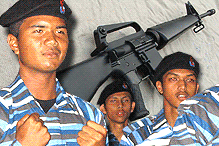 Higher Education Ministry parliamentary secretary Dr Adham Baba said there were four components of the 10 percent co-curriculum prerequisite with participation in the National Service carrying six marks.
"The 10 per cent for co-curriculum was introduced from the 2006/2007 session and students should grasp this chance to qualify for a place in university," he said.
He said, three more elements in the 10 percent were student participation in sports and games, clubs and associations and uniformed unit.
Adham was replying to Senator Yaakob Mohammad who wanted to know what the ministry's actions were in view of the larger number of eligible students compared to the number of availabe places in the universities.
"To date, 720 courses have been offered at public universities and students should know the courses they wish to take," he said.
He added that the ministry was going all out to explain to students the basis and process of accepting them into public universities, especially the new system whereby 90 percent went to academic performance and 10 percent to co-curricular activities.


