




'Excise duty on e-cigarettes won't work if unlicensed sellers continue to thrive'
Putrajaya's plan to generate revenue through the imposition of excise duty on electronic cigarettes and their liquid won't work if unlicensed sellers are allowed to continue thriving, said the Malaysian Council for Tobacco Control (MCTC).
The MCTC said while the effort appears laudable with known strategies to tax 'sin' products to reduce their usage, the Finance Ministry may have overlooked some facts...
Putrajaya's plan to generate revenue through the imposition of excise duty on electronic cigarettes and their liquid won't work if unlicensed sellers are allowed to continue thriving, said the Malaysian Council for Tobacco Control (MCTC).
The MCTC said while the effort appears laudable with known strategies to tax 'sin' products to reduce their usage, the Finance Ministry may have overlooked some facts.
It noted that the previous government had in 2016 put three ministries in charge of regulating the e-cigarette industry and progress were made on the development of standards but the number of unlicensed sellers remains "innumerable".
"This is because there has been no direction to do this.
"Without a registry of licensed sellers, there will be no viable collection mechanism in place to actually collect this revenue in a significant manner, ever.
"Thus, a lot of work has to be first put into addressing a larger framework to support such a revenue-generation strategy; of which little is in place," the MCTC said in a statement.
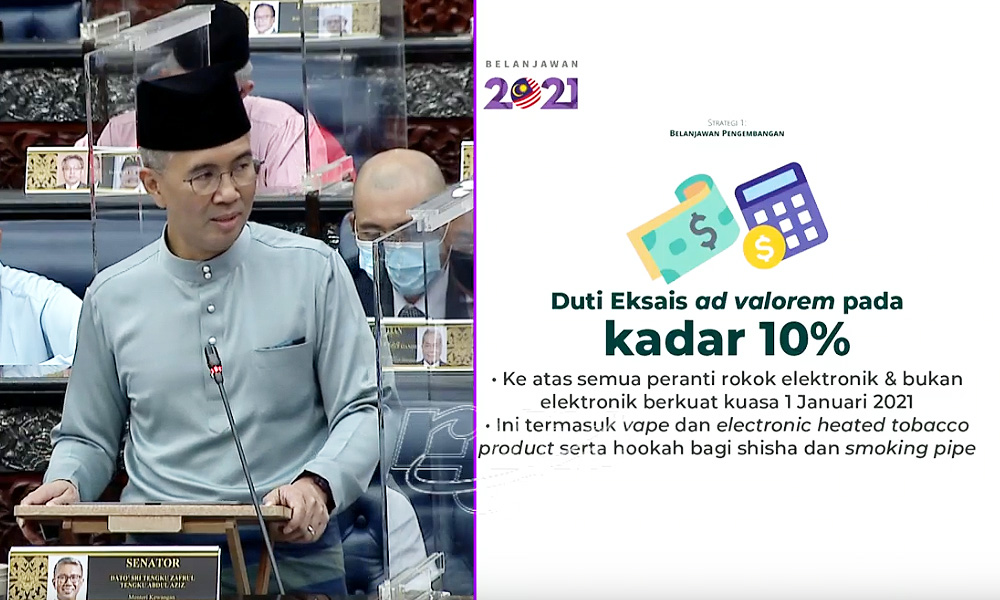
The Finance Ministry announced under Budget 2021 that it planned to impose a 10 percent excise duty on all types of electronic and non-electronic cigarette devices, including vape, as well as an excise duty of 40sen/ml for all liquids in electronic cigarettes.
The MCTC said on top of the festering issue of unlicensed electronic cigarette sellers, the proposed excise duty had not made a distinction between nicotine and non-nicotine liquid for electronic cigarettes.
It noted that Health Minister Dr Adham Baba had on Sept 23 reaffirmed that all devices containing nicotine remain under the Poisons Act 1952 and the Sale of Drugs Act 1952.
This means that the sale of any nicotine-containing preparations is only allowed by licensed pharmacists and registered medical practitioners for the purpose of medical treatment.
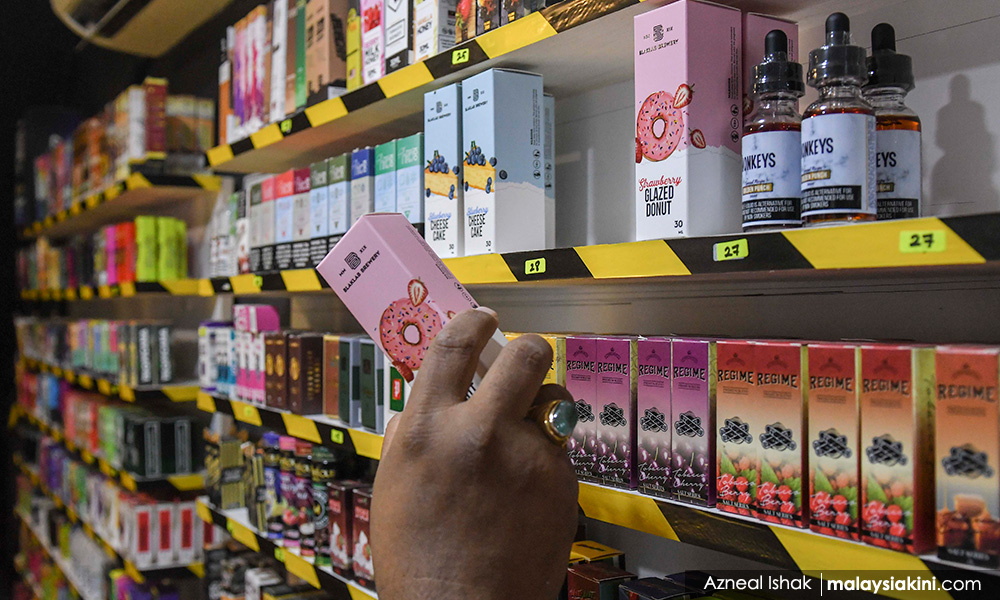
However, it said the government not distinguishing between electronic cigarette liquids with nicotine and without nicotine raises the question if a plan was afoot to turn a blind eye to the ongoing violations of the Poison Act 1952 and Sale and Drug Act 1952 as long as excise duty is paid.
"Through this excise tax, is Finance Ministry offering them a mechanism to ‘pay their way out of trouble’ in terms of selling this illegal device?
"Through this Budget 2021, the strategy of an excise tax on electronic/non-electronic cigarettes also, unfortunately, provides a ‘mantle of legitimacy’ on the industry," it said.
MCTC also raised the question of whether there is a large enough pool of legal users to justify the revenue that will be raised from taxing the liquids.
MCTC said despite electronic cigarettes being touted as an alternative to conventional smoking and can be an aid to quit regular cigarettes, the trend is being taken up by younger people who previously had not smoked any cigarettes.
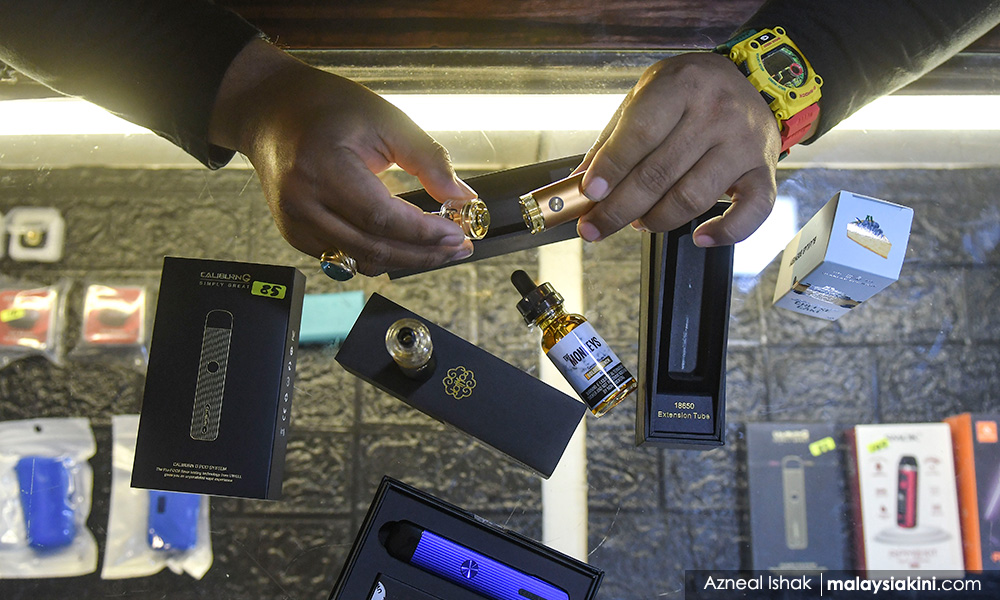
The economic incentive for sellers to continue selling any form of these products to whoever they can is far too lucrative, and they have cashed in on this, especially since there have not been clear regulations on this.
"With this ‘stamp’ of legitimacy being conferred, one can fully expect more sellers to mushroom; along with the sales of different sorts of illegal contents including nicotine.
"We also strongly doubt the net gain of the costs of increased enforcement including the lab costs for analysing illegal liquids being sold has been considered by the MOF in rationalising this excise tax.
"The final net result may result in losses to the government, rather than any financial gain," it said.
As such, the MCTC urged the Finance Ministry to revisit the plan and instead opt to ban electronic cigarettes as some neighbouring countries have done.




Are you sure you want to delete this comment?
This action cannot be undone.