




US to examine refugee woes in Malaysia
The US official in charge of refugee affairs will travel to Malaysia as part of a three-country tour next week to examine refugee issues, the State Department said today.
The US official in charge of refugee affairs will travel to Malaysia as part of a three-country tour next week to examine refugee issues, the State Department said today.
 Ellen Sauerbrey, assistant secretary of state for population, refugees and migration affairs, will also be visiting Thailand and Bangladesh.
She will be accompanied by the United Nations High Commissioner for Refugees (UNHCR), Antonio Guterres, on the Thai portion of the trip.
The objective of the trip to the three Asian nations, from Aug 21 to Sept 2, was to "examine refugee programmes and policy, including a number of high-profile refugee issues," a State Department statement said, without giving details.
It will be Sauerbrey's first trip to the region since her appointment in January, US officials said.
She will meet officials and review US-funded refugee programmes in the three countries, they said.
Malaysia is home to some 50,000 refugees, most of whom are from military-ruled Burma and Indonesia's Aceh.
The country has not ratified the 1951 Convention Relating to the Status of Refugees and labels all undocumented persons as illegal immigrants making them subject to harsh immigration laws.
There are about 12,000 Burmese Chin living, for the most part, in jungle settlements, where they are often at risk of arrest and deportation.
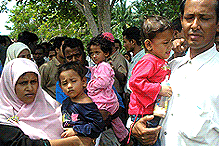 The Muslim Rohingya, however, fare slightly better. In November 2004, Malaysia granted legal migrant status to the Rohingya community, which numbers about 10,000.
But the registration process was suspended yesterday by the authorities in the wake of allegations of corruption, fraud and bribery.
CIA-backed secret army
Meanwhile, Thailand is saddled with 140,000 refugees from Burma as well as several thousand ethnic Hmong believed from neighbouring Laos.
The refugees from Burma are living in nine border camps in Thailand, many of whom have been there for up to 20 years. Some of them fled fighting between the Karen National Union, the oldest and largest rebel force, against Burma's military regime.
Thailand had also been running refugee camps for several thousand ethnic Hmong.
Some Hmong were allied with the United States during the Vietnam War and formed a Central Intelligence Agency-backed secret army when the war spilled into Laos.
When the United States withdrew in 1975, many Hmong feared persecution by the communist government of Laos and fled to Thailand, where they lived in refugee camps.
Last year, the United States initiated a large-scale programme to resettle Burmese refugees living in Malaysia and Thailand.
But Washington-based rights group Refugee International said that the resettlement programme virtually ground to a halt due to strict interpretation of the government prohibitions on the entry into the United States of individuals who have provided "material support" to armed groups.
"The fact that this assistance may have been provided under duress, was usually given in token amounts, and was provided to groups contesting a government that the US deplores was all deemed immaterial in the name of homeland security," it said.
Bangladesh, which like Thailand shares a common border with Burma, also has a high number of ethnic Rohinya refugees.


