




Angry docs warn of hike in medical cost
General practitioners (GP) are crying foul as they bear the brunt of the strict regulations imposed by the controversial Private Healthcare Facilities and Services Act 1998 and Regulations 2006.
General practitioners (GP) are crying foul as they bear the brunt of the strict regulations imposed by the controversial Private Healthcare Facilities and Services Act 1998 and Regulations 2006.
Under the Act, it will be compulsory for private medical practitioners to upgrade their clinics, have equipment for emergencies, pay a RM1,500 registration fee besides providing details on their clinic layout, staff, billing procedures and infection and vector control.
 Most of the doctors contacted by
malaysiakini
expressed disappointment but refused to provide their names for fear of backlash from the Health Ministry.
Most of the doctors contacted by
malaysiakini
expressed disappointment but refused to provide their names for fear of backlash from the Health Ministry.
A 35-year-old GP based in Kuala Lumpur asked why the Act singled out private clinics.
"Have they forgotten the bigger medical centres? What about government clinics and hospitals? I don't think they provide adequate facilities either.
"They must set up the government sector properly first before demanding the private sector to follow," he said.
He also expressed disappointment that the Health Ministry is absolving liability by blaming the previous administration for the draconian legislation being passed in the first place.
He was referring to Health Minister Dr Chua Soi Lek's response to allegations that doctors were not consulted before the Act was passed.
Chua said the first meeting with representatives from associations of private medical practitioners and private hospitals was held on Sept 8, 1993 and was chaired by the then health director-general. Forty-six meetings were held in all.
"Some of the office bearers now were not the presidents then. I was also not consulted because in 1998, I was not the health minister," he was reported as saying in The Star last week.
Healthcare cost to rise
A GP from Penang, Dr BS Khoo, 55 said the cost of healthcare will rise because new renovations and emergency equipments are required.
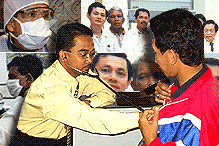 "We now have to renovate the place and buy emergency equipment and that is going to cost money. So do we pass the costs back to the patients?" he asked when contacted.
"Some of the doctors are not even in touch with these equipment," he said.
Similarly, a 57-year-old GP from Puchong said a complete set of emergency equipment stipulated in the Act could come up to RM10,000.
He explained that this is not a one-off expenditure because the range of equipment stated in the Act requires future maintenance and renewal.
"Things like oxygen tanks and drips have life span and need to be renewed after a period of time. The machines might also break down if you don't use it," he said.
There has been fervent discussion on this Act in the past weeks and one news report said doctors planned to boycott the Act and stage a protest in Putrajaya.
No proper briefing
A physician who operates a clinic along Jalan Ipoh asserted that he would join a demonstration should there be one.
"I will definitely protest. It is quite unheard of to see doctors picketing but this legislation is not fair for us," he said.
Another GP who works in Kuala Lumpur told malaysiakini he knew little of the Act despite attending a meeting organised by the Health Ministry in May this year.
"They merely explained the registration clauses and handed me this thick book," said the 55-year-old doctor.
He then said the Act was difficult to read and it wasn't fair that there was no briefing on the provisions at the meeting.


Are you sure you want to delete this comment?
This action cannot be undone.