




Unity hinges on mother-tongue education
Fostering national unity in Malaysia requires the preservation of mother-tongue education among ethnic groups, said two prominent vernacular educationists.
Fostering national unity in Malaysia requires the preservation of mother-tongue education among ethnic groups, said two prominent vernacular educationists.
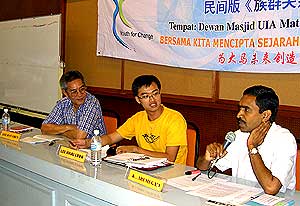
 Long-time Chinese educationist Lee Ban Chen (
right
) said language serves more than just a tool of communication as values also transcend through language.
Long-time Chinese educationist Lee Ban Chen (
right
) said language serves more than just a tool of communication as values also transcend through language.
"It is impossible to use only one language to represent all kinds of culture and heritage because every ethnic group have their own language where it derived their cultures, beliefs and moral values," he said.
Lee said this during a lecture titled Ethnic Relations and Language as part of a Alternative Ethnic Relations Course at the Selangor Chinese Assembly Hall yesterday, organised by youth group Youth Four Change.
Representing Malaysia Tamil Education Research and Development Foundation, K Arumugam elaborated at the same lecture that there cannot be a separation of culture and language.
"If the language of an ethnic group is taken away, hence it will result in the extinction of a culture," he added.
Integration or assimilation?
Lee asserted that while the government attempts to promote Bahasa Melayu as the national language on the pretext of forging national unity, its policies discourage the use of mother tongue of minority groups.
 He later cited how the Chinese studies course in Universiti Malaya compels students to write their thesis in Bahasa Melayu and how the Chinese community-initiated Merdeka University failed to take off in the 70s because of the government's refusal to let the institution conduct its operations without using the national language.
This, argued Lee, are examples of the government's bid to assimilate minority groups into society.
"Assimilation is to force the minority (ethnic groups) to accept that their language and culture is (a form of) hegemony and hence shouldn't be accepted by the community because it will deter the process of achieving national unity," opined Lee.


